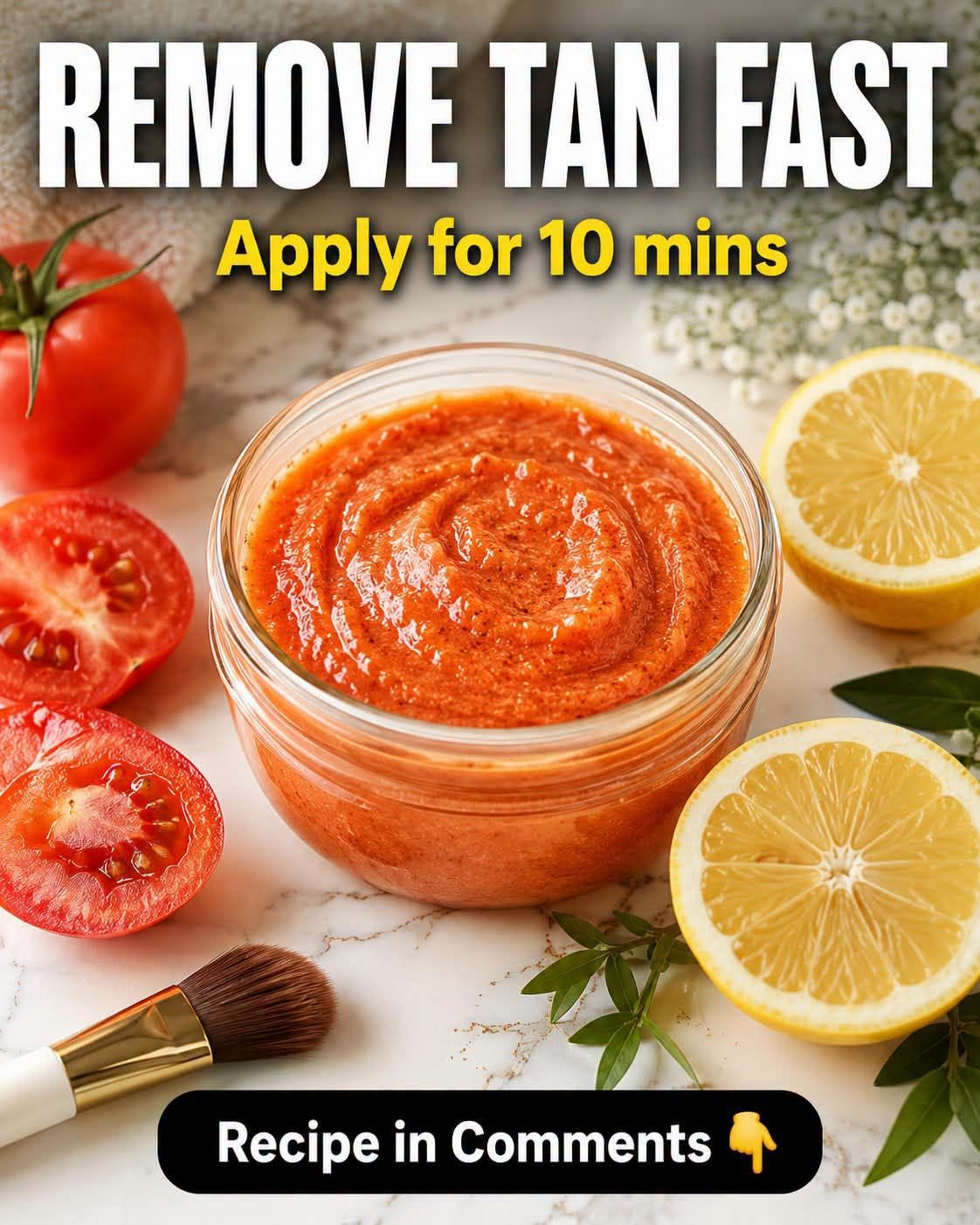
Sun tanning occurs when ultraviolet radiation stimulates the skin to produce more melanin. Although a freshly prepared face pack may make the skin look smoother and brighter after ten minutes, no kitchen remedy can safely erase melanin or reverse a tan instantly. A tan is evidence of ultraviolet injury, so the most effective strategy is to prevent further exposure while supporting the skin barrier as the excess pigmentation gradually fades. Daily broad-spectrum SPF 30 or higher, protective clothing and shade are therefore more important than any face mask. (American Academy of Dermatology)
The tomato-and-lemon remedy shown in the image should be approached cautiously. Dietary tomato and lycopene may support the skin’s natural antioxidant defences, but research does not prove that raw tomato paste removes a tan in ten minutes. Lemon juice is more concerning because citrus compounds followed by sunlight may cause phytophotodermatitis, burning, blistering and long-lasting dark pigmentation. For that reason, the following remedies do not contain lemon. (PubMed)
These skin-type-specific remedies are designed mainly to reduce dryness, roughness, irritation and temporary dullness. The evidence behind botanical extracts or professionally formulated ingredients is generally stronger than evidence for homemade mixtures, so expectations should remain realistic.
Remedy 1: Green Tea and Yogurt De-Tan Pack for Normal Skin
Ingredients and Their Scientific Working
- Plain unsweetened yogurt – 1 tablespoon: Yogurt naturally contains lactic acid, an alpha-hydroxy acid that loosens dull surface cells. Clinical research on properly formulated lactic acid has shown gradual improvement in roughness and mottled pigmentation, although homemade yogurt is much milder and less predictable. (PubMed)
- Colloidal oatmeal – 1 teaspoon: Oat beta-glucan helps retain moisture, while avenanthramides provide soothing and anti-inflammatory activity. (PubMed)
- Pure aloe vera gel – 1 teaspoon: Aloe hydrates and soothes heat-exposed skin. Aloesin, a compound isolated from aloe, has demonstrated tyrosinase-inhibiting activity in laboratory research, but ordinary aloe gel should not be treated as an instant bleaching agent. (PubMed)
- Strong cooled green tea – 1 teaspoon: Green tea polyphenols have antioxidant and anti-inflammatory properties that may help reduce ultraviolet-induced oxidative stress. It does not replace sunscreen. (PubMed)
- Honey – ½ teaspoon: Honey acts as a humectant and gives the mixture a softer, less drying texture. Evidence is stronger for wound care than for pigmentation removal. (PubMed)
Procedure
Mix the ingredients into a smooth paste. Apply a thin layer to cleansed skin without scrubbing. Leave it on for eight to ten minutes, rinse with cool or lukewarm water and gently pat the skin dry. Apply a plain moisturizer, followed by sunscreen during the day.
How Often to Apply
Apply once daily for three days, then reduce to three times weekly if the skin remains comfortable.
Initial Results
Within one to three days, the skin may feel softer, calmer and better hydrated. A visible tan generally requires several weeks to fade rather than a few applications.
Remedy 2: Soy and Licorice Balancing Pack for Combination Skin
Ingredients and Their Scientific Working
- Plain unsweetened soy milk – 1 tablespoon: Clinical research on stabilized soy-containing moisturizers found gradual improvement in blotchiness, texture and uneven pigmentation, with measurable changes beginning after approximately two weeks. Kitchen soy milk is less concentrated, so its effect will be gentler. (PubMed)
- Colloidal oatmeal – 1 teaspoon: Oatmeal absorbs some excess surface oil without aggressively stripping dry areas.
- Aloe vera gel – 1 teaspoon: Aloe provides lightweight hydration for both oily and dry facial zones.
- Cooled green tea – 1 teaspoon: Tea polyphenols help calm the appearance of redness and environmental stress.
- Weak licorice-root infusion – ½ teaspoon: Glabridin and other licorice compounds can inhibit enzymes involved in melanin production in experimental studies. Evidence is strongest for controlled extracts rather than homemade licorice tea. (PubMed)
Procedure
Prepare a weak licorice infusion, allow it to cool completely and mix it with the other ingredients. Apply a slightly thicker layer over dry cheek areas and a thinner layer over the forehead, nose and chin. Rinse after ten minutes without rubbing.
How Often to Apply
Use on alternate days for five days. Stop immediately if itching, swelling or persistent redness develops.
Initial Results
Dry areas may feel less tight while the T-zone may look temporarily less greasy. Pigment changes should not be expected in the first three days.
Remedy 3: Oat and Green Tea Tan-Care Pack for Oily Skin
Ingredients and Their Scientific Working
- Strong cooled green tea – 1 tablespoon: Provides polyphenols that may help reduce oxidative stress caused by ultraviolet exposure.
- Plain yogurt – 2 teaspoons: Supplies mild lactic acid for gentle surface exfoliation.
- Colloidal oatmeal – 2 teaspoons: Creates a non-abrasive paste and helps soothe irritation.
- Aloe vera gel – 1 teaspoon: Adds water-based hydration without requiring a heavy oil.
- Vegetable glycerin – 2 drops: Glycerin attracts water into the outer layer of the skin. Controlled studies have found that glycerin-containing preparations can improve hydration, although too much may feel sticky. (PubMed)
Procedure
Combine the ingredients and apply to clean skin. Do not massage the oatmeal into active pimples. Leave the pack on for seven to eight minutes rather than waiting for it to dry completely. Rinse thoroughly and use a non-comedogenic moisturizer.
How Often to Apply
Apply once daily for three days and then twice weekly. Avoid using it on the same night as strong exfoliants, retinoids or acne peels.
Initial Results
The face may appear fresher and less dull after the first application because dead surface cells and excess oil have been removed. The underlying melanin will remain and must fade naturally.
Remedy 4: Aloe, Oat and Sunflower Comfort Pack for Dry Skin
Ingredients and Their Scientific Working
- Aloe vera gel – 1 tablespoon: Supplies lightweight hydration and helps soothe skin that feels warm or uncomfortable.
- Colloidal oatmeal – 1 tablespoon: Supports moisture retention and helps reduce dry, rough texture.
- Plain soy milk – 1 tablespoon: Gives the mask a creamy consistency and supplies soy-derived proteins and isoflavones.
- Honey – 1 teaspoon: Helps reduce the tight feeling that can follow cleansing or sun exposure.
- Cold-pressed sunflower seed oil – 3 drops: Sunflower seed oil is rich in linoleic acid. Research suggests it can preserve skin-barrier integrity and improve hydration, whereas olive oil may impair the barrier in some people. (PubMed)
Procedure
Mix all ingredients until creamy. Apply a thin, even coating and leave it for ten minutes. Rinse gently, leaving no sticky residue. Apply moisturizer while the skin is slightly damp.
How Often to Apply
Use daily for three to five days, followed by two or three applications weekly.
Initial Results
Dryness and roughness may improve within one to three days. This can make the complexion look more luminous, but it does not mean the tan has been completely removed.
Remedy 5: Minimal Oat and Aloe Pack for Sensitive Skin
Ingredients and Their Scientific Working
- Colloidal oatmeal – 1 tablespoon: Oatmeal has one of the stronger evidence bases among natural soothing ingredients and supports barrier repair. (PubMed)
- Pure aloe vera gel – 1 tablespoon: Helps cool and hydrate, provided the user is not allergic to aloe.
- Cooled boiled water – 1 teaspoon: Thins the mixture without adding fragrance or acids.
- Vegetable glycerin – 2 drops: Improves water retention in very small quantities.
- Sunflower seed oil – 1 drop: Adds a small amount of barrier-supporting lipid without making the pack excessively greasy.
Procedure
Mix thoroughly and patch-test behind the ear or on the inner arm before applying it to the face. Spread a thin layer without rubbing. Leave it for only five minutes during the first use. If no irritation occurs, later applications may be left on for up to eight minutes.
How Often to Apply
Apply every other day for three to five days. Do not use it during an active eczema flare, on blistered sunburn or on broken skin without medical advice.
Initial Results
Sensitive skin may feel less tight and appear calmer within two or three days. Stop using the remedy if it produces burning rather than mild temporary cooling.
Final Tips for Safe and Lasting Tan Reduction
Apply a broad-spectrum, water-resistant SPF 30 or higher every morning. Use enough sunscreen and reapply approximately every two hours when outdoors, particularly after sweating or swimming. A tinted sunscreen containing iron oxide can provide additional protection against visible light, which may worsen pigmentation in darker skin tones. (American Academy of Dermatology)
Keep bowls, brushes and applicators clean, prepare a fresh batch each time and never store a yogurt-based mask for later use. Avoid lemon, undiluted vinegar, baking soda, toothpaste, harsh scrubs and aggressive daily exfoliation. Irritation can trigger post-inflammatory hyperpigmentation and make the treated area look darker. (PubMed)
Hydration, softness and a temporary glow may begin within two to three days. Meaningful improvement in pigmentation generally takes several weeks. These masks do not clinically reverse established wrinkles, but consistent sun protection can help prevent additional photoaging, dark spots and premature lines. (American Academy of Dermatology)
Diet Plan to Support Sun-Exposed Skin
Diet cannot bleach a tan, but balanced nutrition supplies antioxidants, protein and micronutrients needed for normal skin repair.
Breakfast: Eat plain yogurt or eggs with oats and one vitamin-C-rich fruit such as guava, orange, strawberries or kiwi.
Mid-morning: Drink water and eat a small portion of almonds, walnuts or pumpkin seeds.
Lunch: Choose lentils, beans, chicken or fish with leafy vegetables, carrots and a small serving of cooked tomato. Tomato and lycopene intake has been associated with modest photoprotective effects in intervention research, but it is not a substitute for sunscreen. (PubMed)
Evening: Have unsweetened green tea or another caffeine-appropriate drink with fruit rather than a high-sugar snack.
Dinner: Include protein, whole grains and mixed vegetables. Vitamin C supports collagen formation and antioxidant protection, while a varied diet is preferable to unnecessary high-dose supplements. (PubMed)
Continue the home-care routine and balanced diet for four to six weeks while practising strict sun protection. Consult a dermatologist if pigmentation remains unchanged after six to eight weeks, becomes patchy, itchy or painful, or is accompanied by blistering, scaling, bleeding or a changing skin lesion.
References for the above remedy
- American Academy of Dermatology. How to apply sunscreen.
https://www.aad.org/public/everyday-care/sun-protection/shade-clothing-sunscreen/how-to-apply-sunscreen - American Academy of Dermatology. How dermatologists treat sun-damaged skin.
https://www.aad.org/public/everyday-care/sun-protection/sun-damage-skin/wrinkles-sun-damage-can-be-treated - Cerio R, et al. Mechanism of action and clinical benefits of colloidal oatmeal for dermatologic practice.
https://pubmed.ncbi.nlm.nih.gov/20865844/ - Camouse MM, et al. Topical application of green and white tea extracts provides protection from solar-simulated ultraviolet light in human skin.
https://pubmed.ncbi.nlm.nih.gov/19492999/ - Jones K, et al. Modulation of melanogenesis by aloesin: a competitive inhibitor of tyrosinase.
https://pubmed.ncbi.nlm.nih.gov/12213089/ - Yokota T, et al. The inhibitory effect of glabridin from licorice extracts on melanogenesis and inflammation.
https://pubmed.ncbi.nlm.nih.gov/9870547/ - Wallo W, et al. Efficacy of a soy moisturizer in photoaging: a double-blind, vehicle-controlled, 12-week study.
https://pubmed.ncbi.nlm.nih.gov/17941363/ - Smith WP. Topical 8% glycolic acid and 8% L-lactic acid creams for the treatment of photodamaged skin.
https://pubmed.ncbi.nlm.nih.gov/8651713/ - Danby SG, et al. Effect of olive and sunflower seed oil on the adult skin barrier.
https://pubmed.ncbi.nlm.nih.gov/22995032/ - Zhang X, et al. The effect of tomato and lycopene on UV-induced skin deterioration: systematic review and meta-analysis.
https://pubmed.ncbi.nlm.nih.gov/36606553/