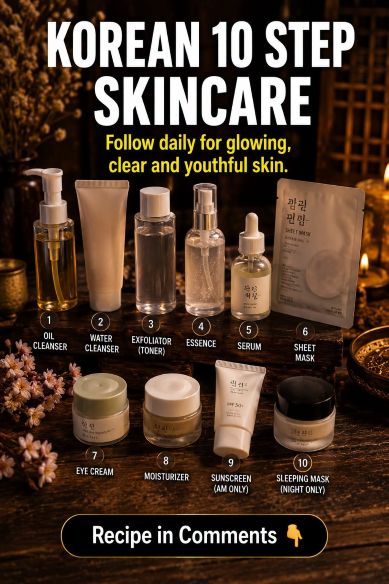
The Korean 10-step skincare routine is popular because it focuses on gentle cleansing, hydration, skin-barrier support and daily sun protection rather than depending on one harsh treatment. However, using ten separate products every morning and night is neither essential nor suitable for everyone. Dermatologists emphasize that a consistent routine built around gentle cleansing, moisturizing and broad-spectrum sunscreen is usually more valuable than applying too many layers, which can irritate the skin. (American Academy of Dermatology)
The routines below combine the sensible principles of Korean skincare with simple natural ingredients. The individual ingredients have scientific support for hydration, soothing or barrier protection, but the exact homemade combinations have not been tested as complete clinical treatments. Expect early improvements mainly in softness, comfort and temporary radiance—not permanent whitening, instant acne removal or deep-wrinkle reversal.

The Correct Korean 10-Step Skincare Order
A safe Korean-inspired routine can be arranged in the following order:
- Oil cleanser: Use at night only when removing makeup or water-resistant sunscreen. A few drops of jojoba oil may help loosen oily residue, but acne-prone skin should stop if congestion develops.
- Water-based cleanser: Wash with a gentle, fragrance-free cleanser. Avoid washing more than twice daily unless you have been sweating.
- Exfoliation: Exfoliate only once or twice weekly. Toner is not automatically an exfoliator, and rough scrubs can damage the skin barrier.
- Hydrating toner: Apply a simple, alcohol-free hydrating liquid or cooled green tea.
- Essence: Use a light layer of aloe-based or oat-based hydration.
- Serum or treatment: Select only one treatment based on your main concern rather than layering several strong ingredients.
- Sheet mask: Use once or twice weekly instead of daily. A freshly prepared oat mask can provide a similar short-contact hydration step.
- Eye-area moisture: A small amount of your regular gentle moisturizer is usually sufficient. Avoid rubbing or stretching the eye area.
- Moisturizer: Apply while the skin is slightly damp to help retain water.
- Sunscreen or sleeping layer: Use broad-spectrum SPF 30 or higher every morning. At night, dry skin may use a thin moisturizing sleeping layer. Sunscreen helps prevent premature wrinkles, uneven pigmentation and sun damage. (American Academy of Dermatology)
Remedy 1: Green Tea and Rice Glow Mask for Normal Skin
Ingredients and Their Scientific Working
- One tablespoon colloidal oatmeal: Oatmeal supports hydration and can help calm mild irritation while improving barrier function.
- One teaspoon rice starch: Rice starch has shown barrier-supporting effects on irritated skin, although most research involved bath preparations rather than homemade facial masks.
- Two tablespoons cooled green tea: Green tea contains antioxidant polyphenols and has demonstrated anti-inflammatory benefits in topical skin research.
- One teaspoon pure aloe vera gel: Aloe provides a cooling, water-rich layer and may help soothe minor inflammation.
- Half a teaspoon honey: Honey acts as a humectant and possesses antimicrobial activity, although evidence for treating facial acne with ordinary kitchen honey remains limited.
Colloidal oatmeal has improved hydration and barrier measurements in controlled studies, while topical green tea has reduced inflammatory acne lesions in clinical research. (PubMed)
Procedure
Mix the ingredients in a clean bowl until a soft, spreadable paste forms. Apply a thin layer after cleansing, avoiding the eyelids and lips. Leave it on for eight to ten minutes without allowing it to become completely dry. Rinse with cool or lukewarm water and apply moisturizer.
How Often to Apply
Use three times over five days, preferably in the evening.
Initial Results
Within one to three days, the skin may feel softer, calmer and temporarily more radiant. Pigmentation and wrinkles will not disappear in this period.
Remedy 2: Dual-Zone Oat and Jojoba Treatment for Combination Skin
Ingredients and Their Scientific Working
- One tablespoon colloidal oatmeal: Helps soothe both oily and dry areas without abrasive scrubbing.
- Two tablespoons cooled green tea: May reduce the appearance of inflammation and excess oiliness.
- One teaspoon aloe vera gel: Adds lightweight hydration without a heavy greasy layer.
- Half a teaspoon rice starch: Helps create a smooth, oil-absorbing texture for the T-zone.
- One-quarter teaspoon jojoba oil: Its wax esters provide emollient support for dry cheeks.
- One-quarter teaspoon sunflower seed oil: A linoleic-acid-rich oil that can help reduce moisture loss when used sparingly.
Research suggests that plant oils differ considerably. Sunflower seed oil has preserved barrier integrity better than olive oil in an adult skin study, while jojoba is commonly used as an emollient in dermatological formulations. (PubMed)
Procedure
Mix oatmeal, green tea and rice starch in one bowl for the forehead, nose and chin. Mix aloe, jojoba oil and sunflower oil separately for the cheeks. Apply the green-tea mixture to oily areas and the oil-containing mixture to dry areas. Leave for seven minutes, rinse and moisturize.
How Often to Apply
Apply on alternate evenings for three to five days.
Initial Results
The cheeks may feel less tight, while the T-zone may appear temporarily less shiny. Persistent blackheads require appropriate acne treatment rather than repeated scrubbing.
Remedy 3: Green Tea Clarifying Gel for Oily Skin
Ingredients and Their Scientific Working
- Three tablespoons strongly brewed, cooled green tea: Topical green tea has the strongest acne-related evidence among the ingredients in this remedy.
- One tablespoon pure aloe gel: Supplies lightweight moisture and may reduce a feeling of irritation.
- One tablespoon finely ground colloidal oatmeal: Helps calm the skin barrier, especially if acne treatments have caused dryness.
- One teaspoon rice starch: Gives the mixture a light, non-greasy consistency.
- Half a teaspoon honey: Provides humectant and antimicrobial properties but should not be considered an acne medicine.
A systematic review of randomized trials found that topical green-tea preparations reduced inflammatory acne lesions, although the researchers stated that further high-quality studies were needed. (PubMed)
Procedure
Blend the ingredients into a thin gel. Apply to clean skin for five to seven minutes. Do not massage it like a scrub. Rinse thoroughly and follow with a lightweight, non-comedogenic moisturizer.
How Often to Apply
Use once daily for three days, then reduce to two or three times weekly.
Initial Results
Redness and surface oil may look slightly reduced within one to three days. Cystic, painful or scarring acne will not be cured by this mask and should be examined by a dermatologist.
Remedy 4: Oat, Aloe and Sunflower Recovery Mask for Dry Skin
Ingredients and Their Scientific Working
- One and a half tablespoons colloidal oatmeal: Helps improve hydration and reduces the rough feeling associated with a damaged barrier.
- One tablespoon aloe vera gel: Adds water and creates a soothing base.
- One teaspoon honey: Helps attract and retain moisture at the skin surface.
- Half a teaspoon sunflower seed oil: Forms an emollient layer and supplies linoleic-acid-rich lipids.
- One-quarter teaspoon jojoba oil: Reduces roughness by softening the outer skin layer.
- One tablespoon cooled boiled water: Adjusts the consistency and supplies water that the oils help retain.
Controlled research supports colloidal oatmeal for hydration and barrier repair. Evidence for aloe is more varied, but reviews suggest possible benefits for inflammation, xerosis and wound healing in certain preparations. (PubMed)
Procedure
Stir until creamy. Apply to damp skin for ten minutes. Rinse gently, pat the face until slightly damp and immediately apply moisturizer to trap water in the skin.
How Often to Apply
Apply once daily for three days, then two or three times weekly.
Initial Results
Dryness, flaking and tightness may begin to improve within one to three days. Fine dehydration lines can appear softer, but structural wrinkles require long-term sun protection and proven dermatological care.
Remedy 5: Minimal Oat Barrier Soak for Sensitive Skin
Ingredients and Their Scientific Working
- One tablespoon colloidal oatmeal: Provides the most established soothing and barrier-supporting ingredient in this mixture.
- One teaspoon rice starch: May support recovery of irritated barrier-damaged skin.
- One teaspoon pure, fragrance-free aloe gel: Provides cooling hydration but must be patch-tested.
- One-quarter teaspoon sunflower seed oil: Helps reduce dryness when tolerated.
- One-quarter teaspoon jojoba oil: Acts as a mild emollient.
- Two tablespoons cool boiled water: Dilutes the mixture and prevents excessive rubbing.
Natural does not mean allergy-free. Sensitive skin may react to aloe, oats, honey, botanical extracts or oils. Test each ingredient separately before combining them.
Procedure
Mix into a very thin paste. Apply without rubbing and leave for only five minutes. Rinse carefully and apply a fragrance-free moisturizer. If the skin stings, burns or becomes redder, wash it off immediately.
How Often to Apply
Use once every other day for three to five days. Very reactive skin should begin with only colloidal oatmeal and water.
Initial Results
The skin may feel less tight and more comfortable after one or two applications. Stop immediately if itching, swelling, burning or a rash develops.
Final Tips for Clear and Glowing Skin
Keep the routine simple and introduce only one new remedy at a time. Clean bowls, towels and applicators after every use, and never store wet homemade masks because they lack preservatives. Avoid lemon juice, baking soda, toothpaste, undiluted essential oils and rough sugar scrubs on the face.
Sleep regularly, avoid picking pimples and wear sunscreen every day. Hydration and surface softness may improve in two to three days, but meaningful improvement in acne, pigmentation, texture or fine lines generally requires several weeks. Deep wrinkles cannot be removed through kitchen remedies.
Diet Plan to Support Healthy-Looking Skin
For breakfast, choose oats or whole-grain bread with eggs, unsweetened yogurt, nuts or fruit. At lunch, include vegetables, lentils, beans, chicken or fish with brown rice or whole-grain roti. A suitable snack may include fruit, cucumber, carrots or a small portion of unsalted nuts. Dinner can consist of vegetables with lentils, fish, chicken or another lean protein source.
Drink water regularly according to thirst and weather conditions. Limit sugary drinks, frequent sweets, highly refined bread, fried snacks and excessive fast food. A low-glycemic eating pattern may help some people with acne, but diet alone is not a replacement for medical treatment. Research on dairy and acne is mixed, so observe personal triggers instead of unnecessarily removing major food groups. (American Academy of Dermatology)
Continue the home routine for two to four weeks if it remains comfortable. See a dermatologist if acne is painful or scarring, pigmentation is spreading, the skin remains inflamed, or there is no meaningful improvement after four to six weeks.
References for the above remedy
- American Academy of Dermatology. “A Dermatologist’s Guide to Skincare from Growing Up to Glowing Up.”
https://www.aad.org/news/dermatologist-guide-skincare - American Academy of Dermatology. “Should I Apply My Skin Care Products in a Certain Order?”
https://www.aad.org/public/everyday-care/skin-care-basics/care/apply-skin-care-certain-order - American Academy of Dermatology. “Skin Care on a Budget.”
https://www.aad.org/public/everyday-care/skin-care-basics/care/skin-care-budget - Kim S, et al. “The Effects of Green Tea on Acne Vulgaris: A Systematic Review and Meta-analysis of Randomized Clinical Trials.”
https://pubmed.ncbi.nlm.nih.gov/32812270/ - Capone K, et al. “Effects of Colloidal Oatmeal Topical Atopic Dermatitis Cream on Skin Microbiome and Skin Barrier Properties.”
https://pubmed.ncbi.nlm.nih.gov/32484623/ - De Paepe K, et al. “Effect of Rice Starch as a Bath Additive on the Barrier Function of Healthy but SLS-Damaged Skin and Skin of Atopic Patients.”
https://pubmed.ncbi.nlm.nih.gov/12353708/ - Hekmatpou D, et al. “The Effect of Aloe Vera Clinical Trials on Prevention and Healing of Skin Wound: A Systematic Review.”
https://pubmed.ncbi.nlm.nih.gov/30666070/ - Lin TK, et al. “Anti-Inflammatory and Skin Barrier Repair Effects of Topical Application of Some Plant Oils.”
https://pubmed.ncbi.nlm.nih.gov/29280987/ - Pazyar N, et al. “Jojoba in Dermatology: A Succinct Review.”
https://pubmed.ncbi.nlm.nih.gov/24442052/ - American Academy of Dermatology. “Can the Right Diet Get Rid of Acne?”
https://www.aad.org/public/diseases/acne/causes/diet