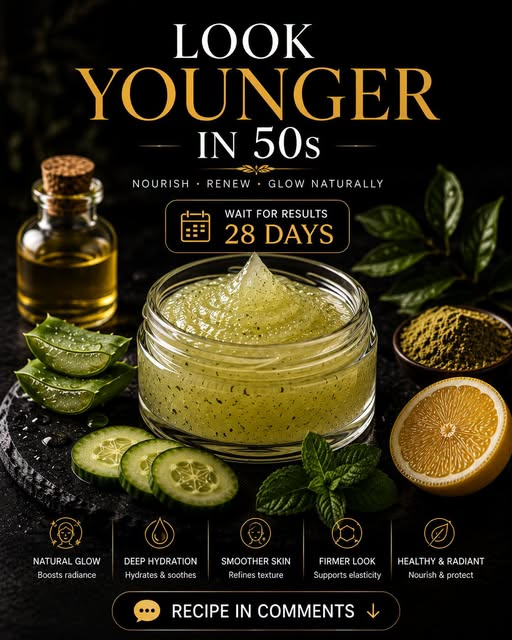
Looking younger in your 50s is less about changing your age and more about helping the skin appear hydrated, smooth, even-toned and well protected. During this stage of life, the skin commonly becomes drier and thinner, while collagen loss, hormonal changes and accumulated sun exposure can make wrinkles, sagging and pigmentation more visible. A homemade mask cannot rebuild deep facial support or erase wrinkles in 28 days, but consistent moisturization may soften dehydration lines and create a healthier, plumper appearance. Dermatologists consider daily moisturizer and sun protection the most important foundations of an effective age-supportive skincare routine. (American Academy of Dermatology)
The lemon displayed in the image has deliberately been excluded. Lemon and other citrus juices can irritate facial skin, and exposure to sunlight afterward may trigger phytophotodermatitis, which can cause redness, blistering and persistent dark marks. The exact homemade mixtures below have not been clinically tested as complete formulas; their individual ingredients were selected because research supports their roles in hydration, barrier care, oil control or protection against photoaging. (DermNet®)
Remedy 1: For Normal Skin
Soy, Green Tea and Yogurt Renewal Mask
Ingredients
- 1 teaspoon unsweetened soy milk: Contains soy proteins and naturally occurring isoflavones.
- 1 teaspoon plain unsweetened yogurt: Provides milk proteins and a mild amount of naturally occurring lactic acid.
- 1 teaspoon cooled green tea: Supplies antioxidant polyphenols, including catechins.
- 1 teaspoon colloidal oatmeal: Helps reduce dryness and supports the protective barrier.
- ½ teaspoon pure honey: Forms a moisture-retaining layer on intact skin.
- 3 drops sunflower seed oil: Helps reduce water loss and soften the skin.
How the Ingredients Work Scientifically
Clinical research involving professionally formulated soy moisturizers found improvements in dullness, uneven pigmentation, fine lines, texture and overall appearance after continued use. Green-tea preparations have also been studied for their antioxidant and photoaging-related effects. Yogurt is considerably weaker and less predictable than a formulated lactic-acid product, so it should be regarded as a gentle conditioning ingredient rather than a professional peel. Oatmeal, honey and sunflower oil mainly support hydration, allowing light to reflect more evenly from the skin. (PubMed)
Procedure
- Brew plain green tea and allow it to cool.
- Combine the soy milk, yogurt and honey.
- Mix in the colloidal oatmeal.
- Add the green tea gradually, followed by the sunflower oil.
- Apply a thin layer to clean skin, avoiding the eyes and lips.
- Leave it on for eight minutes.
- Rinse gently with lukewarm water and pat dry.
How Often to Apply
Use on days one, three and five. Continue twice weekly for the remainder of the 28-day routine.
Initial Results
The skin may feel softer after one application. Within one to three days, improved hydration may make the complexion appear smoother and more refreshed. Fine lines caused by dryness may look softer, but deeper wrinkles will remain.
Remedy 2: For Combination Skin
Rice Bran and Kaolin Balancing Mask
Ingredients
- 1 teaspoon finely ground rice bran: Contains natural lipids and antioxidant compounds.
- ½ teaspoon cosmetic-grade kaolin clay: Absorbs excess surface oil from the T-zone.
- 1 teaspoon clear aloe vera gel: Provides lightweight hydration.
- 1 tablespoon cooled green tea: Creates an antioxidant-rich liquid base.
- ⅛ teaspoon vegetable glycerin: Helps retain water in the outer skin layer.
- 3 drops sunflower seed oil: Protects dry areas from excessive moisture loss.
How the Ingredients Work Scientifically
Rice-bran compounds, including ferulic acid and gamma-oryzanol, have demonstrated antioxidant and antiaging potential in tested formulations. However, ground rice bran does not deliver these compounds as efficiently as a laboratory-produced formulation. Kaolin removes some surface oil, while aloe and glycerin help prevent the mask from becoming excessively drying. Sunflower oil is useful on dry cheeks because research indicates that it can support skin-barrier integrity. (PubMed)
Procedure
- Combine the rice bran and kaolin clay.
- Add aloe gel and enough green tea to create a soft paste.
- Stir in the glycerin and sunflower oil.
- Apply a slightly thicker layer to the forehead, nose and chin.
- Apply only a light coating to the cheeks.
- Leave it on for five to seven minutes.
- Rinse before the clay becomes completely dry or cracked.
How Often to Apply
Use every other evening for the first five days. Continue twice weekly until day 28.
Initial Results
The T-zone may appear less shiny after the first treatment. Within two or three days, dry areas may feel smoother and the face may look more balanced.
Remedy 3: For Oily Skin
Green Tea, Aloe and Rice-Water Refining Gel
Ingredients
- 1 tablespoon cooled green tea: Provides catechins with antioxidant activity.
- 1 tablespoon aloe vera gel: Hydrates without a heavy oily finish.
- ½ teaspoon cosmetic-grade kaolin clay: Temporarily absorbs surface sebum.
- 1 teaspoon freshly prepared rice water: Adds lightweight conditioning starches.
- ½ teaspoon colloidal oatmeal: Helps calm irritation and protect the barrier.
- ⅛ teaspoon vegetable glycerin: Reduces the risk of dehydration from clay.
How the Ingredients Work Scientifically
Oily skin can still become dehydrated, particularly when washed aggressively. Green-tea preparations have shown antioxidant, anti-inflammatory and sebum-related benefits, while aloe, oatmeal and glycerin maintain surface hydration. Kaolin may create an immediate matte appearance, but it cannot permanently reduce oil-gland activity or tighten loose skin. Rice-derived ingredients have shown moisturizing and photoprotective potential, although fresh rice water is much less standardized than extracts used in research. (PubMed)
Procedure
- Mix the kaolin and colloidal oatmeal.
- Add aloe gel and rice water.
- Stir in the glycerin.
- Add cooled green tea until a thin gel-like texture forms.
- Apply to oily areas without scrubbing.
- Leave it on for five minutes.
- Rinse while the mask is still slightly damp.
How Often to Apply
Apply on alternate nights during the first five days. Continue two or three times weekly for the rest of the month.
Initial Results
Excess shine may decrease after one use. Within three days, the skin may appear fresher and smoother, although wrinkles and sagging will not noticeably change.
Remedy 4: For Dry Skin
Coconut, Honey and Oat Plumping Mask
Ingredients
- 1 teaspoon virgin coconut oil: Works as a rich emollient for dry skin.
- 1 teaspoon pure honey: Helps maintain a moist surface.
- 1 teaspoon aloe vera gel: Supplies water-based hydration.
- 1 teaspoon colloidal oatmeal: Improves roughness, dryness and barrier comfort.
- ¼ teaspoon vegetable glycerin: Attracts moisture into the outer layer.
- 1 teaspoon plain unsweetened yogurt: Provides mild conditioning and milk proteins.
How the Ingredients Work Scientifically
Dry skin can make the face look older because dehydration deepens the appearance of fine lines and reduces surface smoothness. A randomized trial found virgin coconut oil comparable with mineral oil for improving mild to moderate dryness. Colloidal oatmeal and glycerin improve hydration, while honey and aloe help create a softer surface. These effects may produce temporary plumping, but they cannot lift structurally sagging skin. (PubMed)
Procedure
- Mix the aloe, honey, yogurt and glycerin.
- Stir in the colloidal oatmeal.
- Warm the coconut oil between clean fingertips and add it to the mixture.
- Apply a thin layer to slightly damp skin.
- Leave it on for eight to ten minutes.
- Rinse gently without scrubbing.
- Press one drop of coconut oil onto exceptionally dry areas if needed.
How Often to Apply
Apply nightly for the first three days and once more on day five. Continue three times weekly through day 28.
Initial Results
Tightness may improve after the first application. Within one to three days, flaky areas and dehydration lines may look softer, creating a temporarily fuller appearance.
Remedy 5: For Sensitive Skin
Fragrance-Free Oat and Sunflower Compress
Ingredients
- 1 tablespoon boiled and cooled water: Creates a simple fragrance-free base.
- 1 teaspoon colloidal oatmeal: Helps calm dryness, itching and irritation.
- 1 teaspoon pure aloe vera gel: Provides gentle hydration.
- 1 teaspoon freshly prepared rice water: Adds lightweight surface conditioning.
- ⅛ teaspoon vegetable glycerin: Supports moisture retention when diluted.
- 3 drops sunflower seed oil: Helps reduce water loss without essential oils.
How the Ingredients Work Scientifically
Sensitive mature skin often looks rough or prematurely lined when inflammation disrupts its moisture barrier. Colloidal oatmeal has shown anti-inflammatory activity and measurable improvements in dryness, hydration and barrier function. Glycerin acts as a humectant, while sunflower oil supplies barrier-supporting lipids. Aloe is generally well tolerated but may occasionally cause burning, itching or a rash, making patch-testing essential. (PubMed)
Procedure
- Combine the oatmeal with boiled and cooled water.
- Add the aloe gel, rice water and glycerin.
- Stir in the sunflower oil.
- Soak a clean, soft cotton cloth in the mixture.
- Press it gently over the face for five minutes.
- Do not massage or rub.
- Rinse lightly and pat dry.
How Often to Apply
Use once daily for three days. Continue twice weekly for 28 days only when no burning, swelling, rash or increased redness occurs.
Initial Results
Sensitive skin may feel calmer and less tight within one to three days. Reduced irritation can make the complexion appear smoother and more radiant.
Final Tips for Looking Younger in Your 50s
Apply broad-spectrum, water-resistant SPF 30 or higher every morning. UV exposure contributes to wrinkles, pigmentation, sagging and loss of firmness, while sunscreen helps prevent further premature aging. A homemade antioxidant mask cannot replace tested sun protection. (American Academy of Dermatology)
Moisturize immediately after cleansing, use lukewarm instead of hot water and avoid rough scrubs, facial brushes, lemon, baking soda and undiluted essential oils. Keep towels and applicators clean, patch-test each recipe and prepare water-based mixtures fresh.
A softer glow may appear within two or three days as hydration improves. More meaningful changes in texture or fine lines generally require at least eight to twelve weeks, while creams and home remedies produce only subtle effects on true sagging. (American Academy of Dermatology)
Diet Plan for Healthy-Looking Skin After 50
For breakfast, choose eggs, plain yogurt, oats or unsweetened soy foods with guava, kiwi, berries, papaya or another vitamin-C-rich fruit. At lunch, eat fish, chicken, lentils, beans or chickpeas with whole grains and colourful vegetables. Select walnuts, almonds, pumpkin seeds or fruit as an afternoon snack. Dinner should include vegetables with fish, tofu, beans, chicken or another protein source.
Vitamin C is required for normal collagen formation, while adequate dietary protein supplies amino acids needed for tissue maintenance. A randomized trial involving postmenopausal women found improvements in hydration and some signs of photoaging after consuming soy protein with isoflavones for several months—not after only a few days. (Office of Dietary Supplements)
Follow the diet and daily sun-protection routine for at least eight to twelve weeks. Use the selected mask for 28 days, provided it remains comfortable. Consult a dermatologist if dryness, itching, pigmentation or facial redness persists, or if you notice a rapidly changing, bleeding, crusted or non-healing skin spot.
References for the above remedy
- American Academy of Dermatology Association. “Skin Care in Your 40s and 50s.”
https://www.aad.org/public/everyday-care/skin-care-basics/care/skin-care-in-your-40s-and-50s - American Academy of Dermatology Association. “Caring for Your Skin in Menopause.”
https://www.aad.org/public/everyday-care/skin-care-secrets/anti-aging/skin-care-during-menopause - American Academy of Dermatology Association. “Many Ways to Firm Sagging Skin.”
https://www.aad.org/public/cosmetic/younger-looking/firm-sagging-skin - Wallo W, et al. “Efficacy of a Soy Moisturizer in Photoaging: A Double-Blind, Vehicle-Controlled Study.”
https://pubmed.ncbi.nlm.nih.gov/17941363/ - Chiu AE, et al. “Double-Blinded, Placebo-Controlled Trial of Green Tea Extracts in Photoaging Skin.”
https://pubmed.ncbi.nlm.nih.gov/16029678/ - Ilnytska O, et al. “Colloidal Oatmeal Improves Skin Barrier Through Multi-Therapy Activity.”
https://pubmed.ncbi.nlm.nih.gov/27272074/ - Danby SG, et al. “Effect of Olive and Sunflower Seed Oil on the Adult Skin Barrier.”
https://pubmed.ncbi.nlm.nih.gov/22995032/ - Agero ALC, Verallo-Rowell VM. “Virgin Coconut Oil Compared with Mineral Oil as a Moisturizer for Xerosis.”
https://pubmed.ncbi.nlm.nih.gov/15724344/ - Rizzo J, et al. “Soy Protein Containing Isoflavones Improves Facial Signs of Photoaging and Skin Hydration.”
https://pubmed.ncbi.nlm.nih.gov/37836398/ - National Institutes of Health, Office of Dietary Supplements. “Vitamin C: Fact Sheet for Health Professionals.”
https://ods.od.nih.gov/factsheets/VitaminC-HealthProfessional/