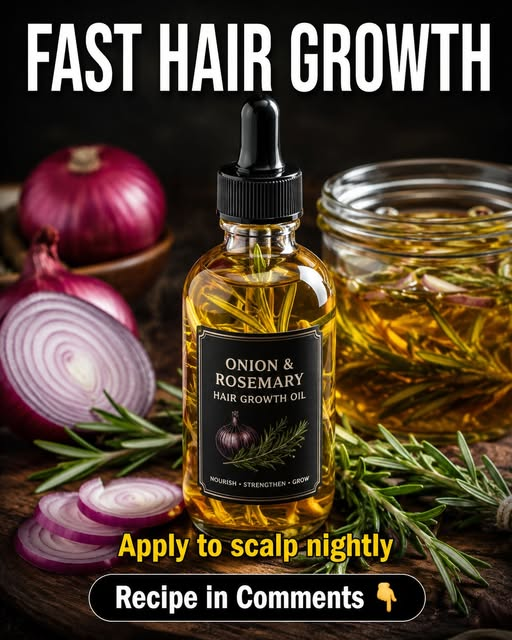
Hair thinning, excess shedding and slow-looking growth can affect appearance and confidence, particularly when the scalp becomes oily, dry, irritated or flaky. Onion and rosemary are widely promoted as quick hair-growth ingredients, but realistic results require patience. A small clinical study found that crude onion juice encouraged regrowth in people with patchy alopecia areata, while a separate randomized trial found that rosemary oil improved hair count after six months in people with androgenetic hair loss. Neither ingredient can create visible new hair within a few nights, and the evidence does not prove that a homemade onion-and-rosemary mixture will work for every cause of hair loss. (PubMed)
The following remedies are designed according to scalp type. They combine evidence-supported ingredients with natural carriers that may protect the hair shaft, reduce breakage and improve scalp comfort. Onion juice and essential oils can cause irritation, so they should not automatically be applied nightly. Always dilute essential oils, prepare water-based mixtures fresh and complete a patch test first.
What Science Says About Onion and Rosemary for Hair Growth
The onion study involved people with patchy alopecia areata, an autoimmune form of hair loss. Participants applied crude onion juice, and regrowth was reported in 73.9 percent of the treated group after four weeks and 86.9 percent after six weeks. These findings are promising but come from a small study and should not be generalized to hereditary thinning, postpartum shedding or nutritional hair loss. (Wiley Online Library)
In the rosemary study, 100 people with androgenetic alopecia used either rosemary oil or 2 percent minoxidil for six months. Hair counts did not improve significantly after three months, but both groups showed improvement after six months. Therefore, claims such as “fast growth in three days” are unrealistic; early changes are more likely to involve softness, reduced dryness and less breakage. (PubMed)

Remedy 1: Rosemary and Pumpkin Seed Oil for a Normal Scalp
Ingredients and Scientific Working
- Pumpkin seed oil: 1 tablespoon. A randomized comparative study investigated topical pumpkin seed oil for female-pattern hair loss over three months.
- Jojoba oil: 1 tablespoon. This wax-like oil spreads easily across the scalp and acts as a light carrier for essential oils.
- Grapeseed oil: 1 tablespoon. It dilutes concentrated essential oils without creating an excessively heavy treatment.
- Coconut oil: 1 teaspoon. Coconut oil can enter the hair shaft and has been shown to reduce protein loss from damaged and undamaged hair.
- Rosemary essential oil: 5 drops. Human research suggests consistent use may improve hair count over several months.
- Lavender essential oil: 2 drops. Lavender was included with rosemary, thyme and cedarwood in a randomized aromatherapy study of alopecia areata.
Clinical evidence exists for topical pumpkin seed oil and diluted essential-oil blends, although the exact home recipe below has not itself been clinically tested. (PubMed)
Procedure
Combine all ingredients in a clean, dark glass bottle. Apply approximately one teaspoon to the scalp and massage gently for three to five minutes. Leave it on for one to two hours, then wash with a gentle shampoo. Avoid aggressive rubbing, which can pull fragile hair.
How Often to Apply
Use three times during the first five days. Continue two or three times weekly for at least three months. Evaluate genuine regrowth after three to six months rather than after a few days.
Initial Results
Within one to three days, hair may feel smoother and less brittle. New hair growth should not be expected during this period.
Remedy 2: Fresh Onion and Rosemary Treatment for a Combination Scalp
Ingredients and Scientific Working
- Fresh red-onion juice: 1 tablespoon. Onion juice has limited clinical evidence for patchy alopecia areata.
- Pure aloe-vera gel: 1 tablespoon. Aloe creates a cooling, water-based base and may help reduce dryness caused by onion.
- Pumpkin seed oil: 1 teaspoon. It provides fatty acids while adding an ingredient studied for pattern hair loss.
- Jojoba oil: 1 teaspoon. It distributes the oil phase without making dry areas excessively greasy.
- Rosemary essential oil: 2 drops. Diluted rosemary provides the principal plant-based active for long-term use.
- Cooled green-tea infusion: 1 teaspoon. Green-tea compounds have demonstrated effects on human follicle cells in laboratory research, although homemade tea has not been proven to regrow hair clinically. (PubMed)
Procedure
Grate a small onion and strain it through clean muslin. Mix one tablespoon of juice with the remaining ingredients immediately before application. Shake or whisk thoroughly because the oils and water will separate. Apply mainly to thinning areas, leave for 20 minutes and shampoo well. Discard any leftover mixture.
How Often to Apply
Use every other day for the first five days if no irritation occurs. Afterwards, apply twice weekly for six to eight weeks.
Initial Results
The scalp may feel cleaner and less coated within one to three days. Visible regrowth, when it occurs, generally requires several weeks or months.
Remedy 3: Lightweight Onion Scalp Mask for an Oily Scalp
Ingredients and Scientific Working
- Fresh onion juice: 2 teaspoons. It is the main evidence-informed ingredient for patchy alopecia areata.
- Aloe-vera gel: 1 tablespoon. It provides slip and hydration without requiring a large amount of oil.
- Strong cooled green tea: 1 tablespoon. It supplies plant polyphenols and creates a lightweight base.
- Pumpkin seed oil: ½ teaspoon. A small quantity prevents the treatment from becoming too greasy.
- Jojoba oil: ½ teaspoon. It helps dilute rosemary and spread the formula.
- Rosemary essential oil: 2 drops. It should always be diluted rather than applied directly.
Procedure
Whisk the ingredients in a small bowl. Part the hair and apply a thin layer directly to the scalp rather than saturating the hair lengths. Leave it for 15 to 20 minutes, then rinse and shampoo. Never store this preservative-free mixture.
How Often to Apply
Apply three times across five days. Continue twice weekly if the scalp remains comfortable. Do not apply nightly, because frequent onion juice and essential-oil exposure can increase irritation.
Initial Results
Excess surface oil may feel reduced after washing, while hair can appear lighter at the roots. These cosmetic changes do not represent new follicle growth.
Remedy 4: Coconut, Honey and Rosemary Mask for a Dry Scalp
Ingredients and Scientific Working
- Virgin coconut oil: 1 tablespoon. Research shows it can reduce hair-fibre protein loss and grooming damage.
- Jojoba oil: 1 tablespoon. It creates a lighter consistency and supports even scalp coverage.
- Pumpkin seed oil: 2 teaspoons. It adds an evidence-informed hair-loss ingredient.
- Raw honey: 1 teaspoon. A small clinical study reported improvement in seborrheic dermatitis and associated hair loss with diluted crude honey.
- Aloe-vera gel: 1 teaspoon. It adds water-based hydration and reduces the heaviness of the oils.
- Rosemary essential oil: 4 drops. It provides a diluted rosemary concentration suitable for a wash-off mask. (PubMed)
Procedure
Warm the coconut oil only until it becomes liquid; do not overheat it. Mix in the other ingredients and apply to the scalp and dry hair ends. Massage gently and leave for 30 to 45 minutes. Shampoo thoroughly with lukewarm water.
How Often to Apply
Apply on alternate days during the first five days if severe dryness is present, then reduce to twice weekly. Continue for eight to twelve weeks for reduced breakage.
Initial Results
Dryness, roughness and tangling may improve within one to three applications. Hair can look fuller because fewer fibres are breaking, but this is different from growing new follicles.
Remedy 5: Barrier-First Rosemary Treatment for a Sensitive Scalp
Ingredients and Scientific Working
- Pure aloe-vera gel: 1 tablespoon. It provides a cooling base, although aloe itself can occasionally cause a reaction.
- Jojoba oil: 1 tablespoon. It dilutes the active ingredient and limits direct essential-oil exposure.
- Sunflower seed oil: 1 teaspoon. It supplies linoleic-acid-rich emollients for dry, sensitive skin.
- Coconut oil: 1 teaspoon. It reduces protein loss from the hair shaft.
- Diluted raw honey: ½ teaspoon. It acts as a humectant and has limited clinical evidence for flaky scalp conditions.
- Distilled water: 1 teaspoon. It reduces stickiness and makes the treatment easier to wash out.
- Rosemary essential oil: 1 drop only. This very low amount should be omitted completely if the patch test produces itching or redness.
Natural oils can support the skin barrier, but “natural” does not mean allergy-free. Evidence for sensitive-scalp regrowth is limited, so maintaining scalp comfort is more important than using a strong formula. (PubMed)
Procedure
Mix a single-use portion and patch-test it behind the ear or on the inner arm for 24 hours. Apply a thin layer for only 10 to 15 minutes during the first use. Rinse immediately if burning, swelling or intense itching develops.
How Often to Apply
Use twice during the first five days. If completely comfortable, continue once or twice weekly. Do not add onion juice to this sensitive-scalp formula.
Initial Results
The scalp may feel less tight and the hair may become easier to comb. Stop treatment if sensitivity increases.
Final Tips for Healthier Hair Growth
Use only one remedy at a time so that any reaction can be traced to a specific ingredient. Keep bowls, strainers, applicators and bottles clean. Fresh onion mixtures should be discarded after use because they contain water and have no preservative. Avoid undiluted rosemary oil, harsh lemon juice, baking soda, tight hairstyles, excessive straightening and vigorous scalp scratching.
Surface improvements such as softness and reduced dryness may begin within two or three days. Reduced breakage may become noticeable over several weeks, while measurable regrowth usually requires at least three to six months. The rosemary clinical trial did not show a significant hair-count change at three months, demonstrating why consistency and realistic expectations matter. (PubMed)
Diet Plan to Support Hair Growth
A topical remedy cannot correct iron deficiency, thyroid disease, severe calorie restriction or inadequate protein intake. Hair is primarily made from keratin, so include a reliable protein source at every main meal.
Breakfast: Eggs or plain yoghurt with oats, pumpkin seeds and one vitamin-C-rich fruit.
Lunch: Lentils, beans, chicken or fish with whole-grain roti or brown rice, leafy vegetables and salad.
Evening snack: A small handful of almonds, walnuts or roasted chickpeas.
Dinner: Fish, chicken, beans or tofu with cooked vegetables and a moderate portion of whole grains.
Hydration: Drink water regularly according to thirst, climate and activity level.
Foods containing iron, zinc, vitamin D, biotin and protein help prevent deficiency, but supplements should not be taken in large doses without medical assessment. Biotin deficiency can cause thinning hair, yet deficiency is uncommon, and extra biotin has not been proven to improve hair in people who already receive enough. Iron or zinc supplements can also cause harm when taken unnecessarily. (PubMed)
Continue a tolerated home remedy for approximately three months before judging reduced shedding and up to six months before judging regrowth. See a dermatologist sooner if hair loss is sudden, patchy, painful, accompanied by scaling or pus, affects the eyebrows, follows major weight loss, or continues despite eight to twelve weeks of gentle care. A dermatologist may need to investigate nutritional deficiency, hormonal imbalance, infection, autoimmune disease or hereditary hair loss. (American Academy of Dermatology)
References for the above remedy
- Panahi Y, et al. Rosemary oil vs minoxidil 2% for the treatment of androgenetic alopecia: a randomized comparative trial.
https://pubmed.ncbi.nlm.nih.gov/25842469/ - Sharquie KE, Al-Obaidi HK. Onion juice, a new topical treatment for alopecia areata.
https://pubmed.ncbi.nlm.nih.gov/12126069/ - Ibrahim IM, et al. Pumpkin seed oil vs. minoxidil 5% topical foam for the treatment of female pattern hair loss.
https://pubmed.ncbi.nlm.nih.gov/33544448/ - Hay IC, Jamieson M, Ormerod AD. Randomized trial of aromatherapy: successful treatment for alopecia areata.
https://pubmed.ncbi.nlm.nih.gov/9828867/ - Rele AS, Mohile RB. Effect of mineral oil, sunflower oil, and coconut oil on prevention of hair damage.
https://pubmed.ncbi.nlm.nih.gov/12715094/ - Al-Waili NS. Therapeutic and prophylactic effects of crude honey on chronic seborrheic dermatitis and dandruff.
https://pubmed.ncbi.nlm.nih.gov/11485891/ - Kwon OS, et al. Human hair growth enhancement in vitro by green tea epigallocatechin-3-gallate.
https://pubmed.ncbi.nlm.nih.gov/17092697/ - American Academy of Dermatology. Hair loss: Diagnosis and treatment.
https://www.aad.org/public/diseases/hair-loss/treatment/diagnosis-treat - Wang R, et al. Micronutrients and androgenetic alopecia: a systematic review.
https://pubmed.ncbi.nlm.nih.gov/39440586/ - National Institutes of Health Office of Dietary Supplements. Biotin: Health Professional Fact Sheet.
https://ods.od.nih.gov/factsheets/Biotin-HealthProfessional/