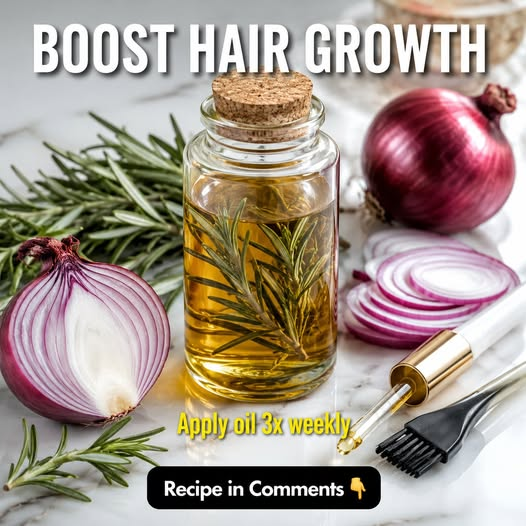
Slow hair growth, widening parts and excessive shedding can affect confidence, but the cause is not always poor hair care. Genetics, hormonal changes, nutritional deficiencies, scalp inflammation, illness, stress and tight hairstyles can all contribute. Onion juice and rosemary oil are among the better-studied natural options, although neither produces overnight regrowth. Rosemary oil increased hair count after six months in a clinical trial involving androgenetic hair loss, while onion juice showed encouraging results in a small study involving patchy alopecia areata. These findings do not prove that every homemade mixture will work, but they provide a scientific basis for cautious, consistent use. (PubMed)
How Onion and Rosemary May Support Hair Growth
Rosemary oil appears to influence the scalp environment and microcirculation, which may support active follicles. In one randomized study, participants using rosemary oil did not show a significant hair-count improvement at three months, but they did after six months. This means that the phrase “fast hair growth” should refer to supporting healthier growth over time rather than creating long hair within a few days.
Onion juice contains sulfur-containing compounds and plant antioxidants. The available clinical study tested crude onion juice specifically for alopecia areata, an autoimmune condition that produces smooth patches of hair loss. It should not be assumed to treat hereditary baldness, thyroid-related shedding or iron deficiency. (PubMed)
The exact home recipes below have not been clinically tested as complete formulas. Their ingredients are selected according to available evidence for hair growth, dandruff control, reduced breakage or scalp-barrier support.
Remedy 1: Rosemary and Pumpkin Seed Growth Oil for a Normal Scalp
Ingredients and Their Scientific Working
- Pumpkin seed oil: 1 tablespoon. A randomized comparative trial found encouraging improvements in women with female-pattern hair loss after topical use.
- Jojoba oil: 1 tablespoon. Its wax-like texture spreads concentrated essential oils evenly and reduces direct exposure.
- Virgin coconut oil: 1 tablespoon. Coconut oil penetrates the hair fibre and can reduce protein loss, helping hair retain length by breaking less.
- Rosemary essential oil: 4 drops. It is the main growth-focused ingredient and has human clinical evidence for androgenetic hair loss.
- Lavender essential oil: 2 drops. Lavender was one component of an essential-oil blend that produced better results than carrier oils alone in an alopecia-areata trial.
- Cedarwood essential oil: 1 drop. Cedarwood was also included in the clinically studied aromatherapy combination.
The evidence for lavender and cedarwood applies to a particular multi-oil clinical blend rather than to either oil alone. Pumpkin seed and rosemary oils have separate human studies, while coconut oil primarily protects the hair shaft rather than stimulating new follicles. (PubMed)
Procedure
Pour the carrier oils into a clean dark-glass bottle. Add the essential oils and shake well. Part the hair into sections and apply approximately one teaspoon across the scalp. Massage gently with the fingertips for three minutes without scratching.
Leave the oil on for 60 to 90 minutes and wash with a mild shampoo. Do not leave it overnight during the first week.
How Often to Apply
Use three times during the first five days, leaving at least one rest day between applications. Continue two or three times weekly for three to six months if the scalp remains comfortable.
Initial Results
Within one to three days, the hair may feel softer and less rough. Reduced breakage may appear after several weeks, while genuine growth requires months.
Remedy 2: Onion, Aloe and Honey Scalp Pack for Combination Scalp
Ingredients and Their Scientific Working
- Fresh red-onion juice: 1 tablespoon. It has limited clinical support for patchy alopecia areata.
- Pure aloe-vera gel: 1½ tablespoons. Aloe provides a cooling base and has been studied for inflammatory seborrheic dermatitis.
- Pumpkin seed oil: 1 teaspoon. It adds a plant oil with clinical evidence for female-pattern thinning.
- Sunflower seed oil: 1 teaspoon. Sunflower oil supplies linoleic acid and has shown skin-barrier-supporting effects.
- Raw honey: ½ teaspoon. Diluted honey has been studied for dandruff and seborrheic dermatitis.
- Rosemary essential oil: 2 drops. Rosemary provides the longer-term growth-supporting component.
The formula balances oily roots with drier areas, but it is unsuitable for anyone who reacts to onion, fragrance or essential oils. Honey and aloe may improve scalp comfort, while onion and rosemary provide the main hair-loss-related evidence. (PubMed)
Procedure
Grate a small onion and strain it through clean cotton or muslin. Measure one tablespoon of fresh juice and combine it with the other ingredients.
Apply the mixture directly to the scalp, concentrating on thinning areas rather than coating the hair. Leave it for 15 to 20 minutes, then wash thoroughly. Prepare a fresh portion every time and discard leftovers.
How Often to Apply
Apply twice during the first five days. When no burning, swelling or rash occurs, continue twice weekly for six to eight weeks.
Initial Results
The scalp may feel fresher after one or two washes. New hair should not be expected in three days; the onion study observed the beginning of regrowth after approximately two weeks in some participants with alopecia areata.
Remedy 3: Lightweight Rosemary and Tea Tree Gel for an Oily, Flaky Scalp
Ingredients and Their Scientific Working
- Aloe-vera gel: 2 tablespoons. It creates a lightweight base without saturating oily roots.
- Jojoba oil: 1 teaspoon. It dilutes essential oils while keeping the mixture less greasy than heavy carrier oils.
- Pumpkin seed oil: 1 teaspoon. It provides a clinically studied botanical oil for pattern thinning.
- Raw honey: ½ teaspoon. Honey may help loosen flakes and support a healthier scalp environment.
- Rosemary essential oil: 2 drops. It supports long-term hair-growth efforts.
- Tea tree essential oil: 1 drop. Tea tree oil has clinical evidence for dandruff when used in a properly formulated 5 percent shampoo.
This low-strength home mixture is not equivalent to the standardized tea-tree shampoo used in the clinical trial. Tea tree oil helps address dandruff rather than directly growing new hair, and it may irritate sensitive skin. (PubMed)
Procedure
Whisk the aloe and honey until smooth. Mix the carrier oils with the essential oils separately, then blend both phases together.
Apply a thin coating to the scalp with clean fingertips or a soft applicator brush. Leave for 15 minutes and shampoo thoroughly. Do not apply to scratched, infected or bleeding skin.
How Often to Apply
Use twice within the first five days. If tolerated, apply twice weekly rather than every night.
Initial Results
Flaking, greasiness and scalp odour may improve after one to three applications. Hair may appear cleaner and fuller at the roots, but this is not new follicle growth.
Remedy 4: Coconut, Pumpkin and Honey Repair Mask for a Dry Scalp
Ingredients and Their Scientific Working
- Virgin coconut oil: 1 tablespoon. It penetrates the hair shaft and reduces protein loss, which may limit breakage.
- Pumpkin seed oil: 1 tablespoon. It is included for its promising clinical evidence in female-pattern hair loss.
- Sunflower seed oil: 1 tablespoon. It acts as a linoleic-acid-rich emollient and supports the scalp barrier.
- Aloe-vera gel: 1 tablespoon. Aloe adds water-based hydration to the oil-rich mixture.
- Raw honey: 1 teaspoon. Honey attracts moisture and has limited clinical evidence for flaky scalp conditions.
- Rosemary essential oil: 3 drops. It provides a low-strength botanical active for longer-term use.
The oils can make dry hair look thicker by reducing roughness and breakage. This cosmetic fullness should not be confused with an increase in follicle number. (PMC)
Procedure
Liquefy the coconut oil between warm hands; do not heat it until hot. Mix all ingredients and apply first to the scalp, then lightly coat the dry ends.
Leave the treatment on for 30 to 45 minutes. Rinse with lukewarm water and shampoo once or twice as needed.
How Often to Apply
Apply twice during the first five days and then twice weekly for eight to twelve weeks.
Initial Results
Dryness and tangling may begin to improve within one to three days. Less breakage and better length retention usually require several weeks of gentle care.
Remedy 5: Oat, Aloe and Sunflower Mask for a Sensitive Scalp
Ingredients and Their Scientific Working
- Finely ground colloidal oatmeal: 1 teaspoon. Colloidal oatmeal has clinical evidence for improving hydration and barrier function in irritated skin.
- Pure aloe-vera gel: 1 tablespoon. It provides cooling moisture and has limited evidence in seborrheic dermatitis.
- Sunflower seed oil: 1 teaspoon. It helps preserve barrier integrity and is generally lighter than many heavier oils.
- Virgin coconut oil: ½ teaspoon. A small amount can reduce hair-shaft protein loss.
- Raw honey: ½ teaspoon. It provides moisture and may support flaky scalp care.
- Distilled or previously boiled water: 2 tablespoons. It creates a washable, low-irritant consistency.
Onion juice, tea tree oil and rosemary oil are intentionally excluded from this remedy. A calm scalp is more important than forcing a strong ingredient onto reactive skin. This mask is designed to reduce dryness and breakage, not to treat genetic or autoimmune hair loss. (PubMed)
Procedure
Combine the oatmeal with water and let it soften for five minutes. Stir in the aloe, honey and oils.
Apply a thin layer to the scalp for ten minutes, then rinse carefully. Avoid rubbing the oatmeal particles into the skin.
How Often to Apply
Use once during the first three days. If no reaction develops, repeat once more by day five and continue once or twice weekly.
Initial Results
Tightness and dryness may improve after one or two applications. Stop immediately if itching, redness or swelling becomes worse.
Final Tips for Better Hair Growth
Patch-test every remedy before applying it across the scalp. Dermatologists recommend testing new topical products on a small area because botanical ingredients and essential oils can still trigger allergic contact dermatitis. Never apply undiluted rosemary, lavender, cedarwood or tea tree oil directly to the scalp. (American Academy of Dermatology)
Keep applicators, bowls and bottles clean. Avoid storing mixtures containing onion juice, aloe, honey or water because homemade preparations lack preservatives. Do not combine all five remedies or use them daily. Excessive treatment can create irritation, inflammation and additional shedding.
Sleep adequately, manage stress, avoid tight ponytails and reduce excessive heat styling. Initial softness or reduced flaking may appear within two to three days, but reduced shedding generally requires weeks. Evidence-based assessment of rosemary oil should take approximately six months.
Diet Plan to Support Hair Growth
A balanced diet supports follicle activity, but it cannot reverse every form of hair loss.
Breakfast: Two eggs or plain yoghurt, oats, pumpkin seeds and an orange, guava or another vitamin-C-rich fruit.
Lunch: Lentils, beans, chicken or fish with whole-grain roti or brown rice, leafy vegetables and salad.
Evening snack: A small handful of almonds, walnuts, roasted chickpeas or pumpkin seeds.
Dinner: Fish, chicken, tofu or beans with cooked vegetables and a moderate serving of whole grains.
Hydration: Drink water regularly according to climate, thirst and physical activity.
Protein provides amino acids needed to form keratin. Iron-rich foods include meat, lentils, beans and leafy vegetables, while eggs, fish, dairy, seeds and nuts provide other nutrients associated with healthy hair. Deficiencies in iron, vitamin D or zinc may contribute to certain forms of hair loss, but supplements should not be started in high doses without testing or medical advice. Excessive supplementation can also be harmful. (PubMed)
Continue a well-tolerated remedy for at least eight to twelve weeks before judging reduced breakage and for three to six months before judging regrowth. Consult a dermatologist if hair loss persists, rapidly worsens, forms smooth patches, causes scalp pain or burning, affects the eyebrows, or occurs with pus, thick scaling, fatigue, irregular periods or unexplained weight changes. Medical evaluation may include tests for nutritional deficiency, thyroid disease, hormonal imbalance, infection or autoimmune hair loss. (American Academy of Dermatology)
References for the above remedy
- Panahi Y, et al. Rosemary oil vs minoxidil 2% for the treatment of androgenetic alopecia: a randomized comparative trial.
https://pubmed.ncbi.nlm.nih.gov/25842469/ - Sharquie KE, Al-Obaidi HK. Onion juice, a new topical treatment for alopecia areata.
https://pubmed.ncbi.nlm.nih.gov/12126069/ - Ibrahim IM, et al. Pumpkin seed oil versus minoxidil for female-pattern hair loss: a randomized comparative trial.
https://pubmed.ncbi.nlm.nih.gov/33544448/ - Hay IC, Jamieson M, Ormerod AD. Randomized trial of aromatherapy for alopecia areata.
https://pubmed.ncbi.nlm.nih.gov/9828867/ - Rele AS, Mohile RB. Effect of mineral oil, sunflower oil and coconut oil on prevention of hair damage.
https://pubmed.ncbi.nlm.nih.gov/12715094/ - Satchell AC, et al. Treatment of dandruff with 5% tea tree oil shampoo.
https://pubmed.ncbi.nlm.nih.gov/12451368/ - Al-Waili NS. Therapeutic and prophylactic effects of crude honey on seborrheic dermatitis and dandruff.
https://pubmed.ncbi.nlm.nih.gov/11485891/ - Vardy DA, et al. Double-blind, placebo-controlled trial of an Aloe vera emulsion in seborrheic dermatitis.
https://www.tandfonline.com/doi/abs/10.3109/09546639909055904 - Capone K, et al. Effects of colloidal oatmeal cream on the skin microbiome and skin-barrier properties.
https://pubmed.ncbi.nlm.nih.gov/32484623/ - American Academy of Dermatology. Hair loss: Diagnosis and treatment.
https://www.aad.org/public/diseases/hair-loss/treatment/diagnosis-treat