Naturally healthy lips can be pale pink, deep pink, brown, mauve, or darker depending on genetics, skin tone, and normal melanin levels. Dark lips are not automatically unhealthy. However, new or increasing discoloration may be related to sun exposure, repeated lip licking, dryness, smoking, irritation from toothpaste or cosmetics, allergic contact cheilitis, certain medicines, or an underlying medical condition. A homemade remedy cannot permanently make naturally pigmented lips pink in five days. What may improve quickly is dryness, roughness, dullness, and temporary surface color. True pigment changes usually require several weeks and depend on the cause. (PubMed)
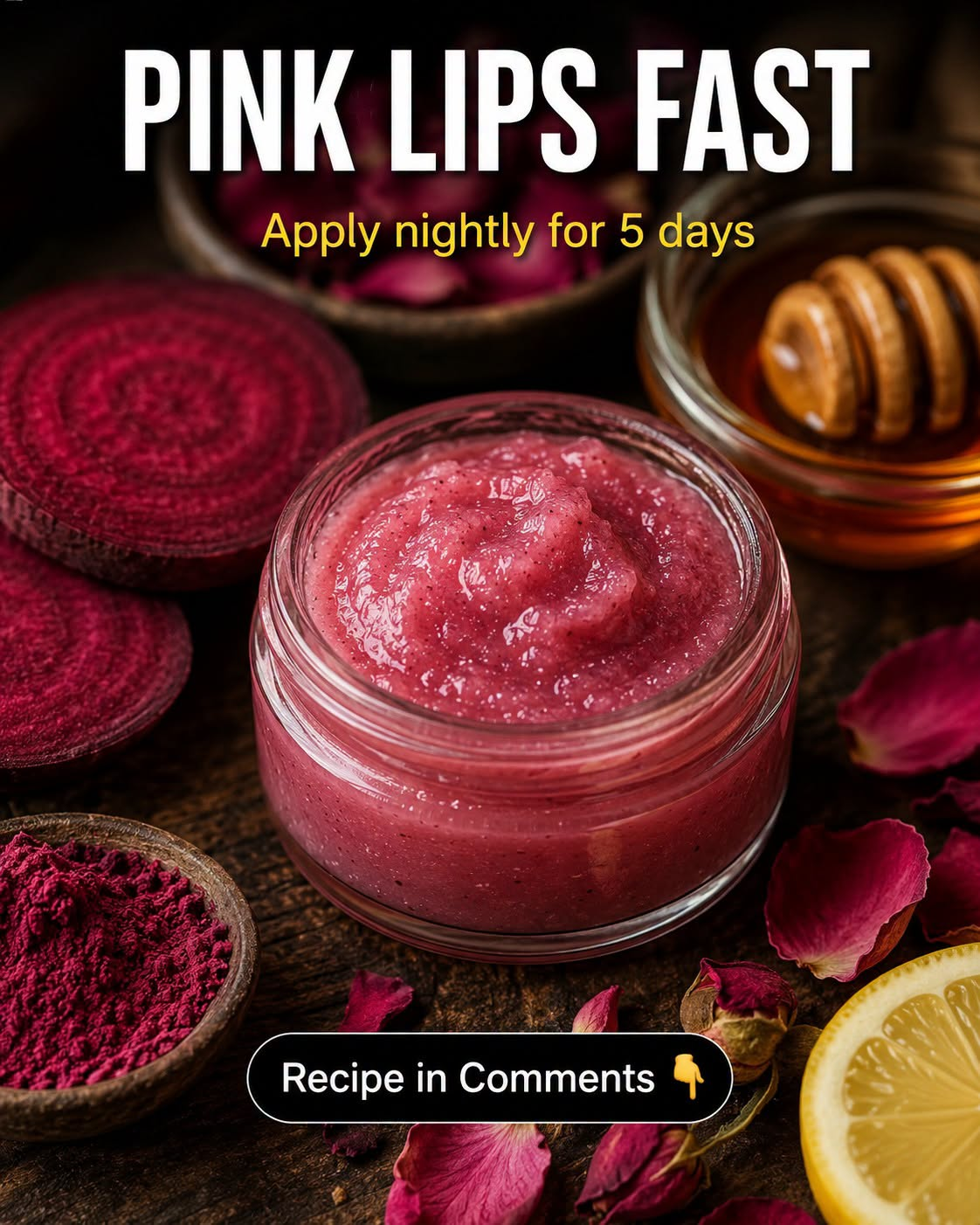
The beetroot mixture shown in the image can provide a temporary rosy stain, while moisturizing ingredients may make lips appear smoother and brighter. Beetroot should not be described as a clinically proven depigmenting treatment. The remedies below are designed to support hydration, reduce irritation, and gradually improve uneven-looking lip color. Because lips do not produce oil in the same way as facial skin, the skin-type categories refer mainly to the condition of the lips and surrounding mouth area.
Apply mixtures only to the visible outer lip surface. Avoid the wet inner mouth, open cracks, cold sores, bleeding areas, and infected skin. Prepare every remedy fresh and perform a patch test before regular use.
Remedy 1: Beetroot, Honey, and Aloe Lip Veil for Normal Skin
This remedy is suitable for lips that are generally soft but occasionally look dull or mildly dry. Beetroot provides temporary color, while the remaining ingredients support moisture and surface smoothness.
Ingredients and Scientific Working
Fresh beetroot juice — 2 drops: Beetroot contains strong red-purple plant pigments that can temporarily stain the outer lip surface. This creates a short-lived rosy appearance but does not remove melanin or permanently lighten dark lips.
Pure clear aloe vera gel — 1 teaspoon: Aloe supplies water-rich polysaccharides that may improve surface hydration. Aloe-derived aloesin has shown effects on melanin-related pathways in human skin research, although ordinary aloe gel contains an unknown and much lower concentration. (PubMed)
Pure honey — 1/2 teaspoon: Honey has moisture-retaining, soothing, and wound-supporting properties. Its established dermatological evidence relates mainly to skin repair rather than permanent lip lightening. (PubMed)
Vegetable glycerin — 1/8 teaspoon: Glycerin is a humectant that attracts water into the outer skin layer and helps reduce roughness. (PubMed)
Cold-pressed sunflower seed oil — 2 drops: Sunflower oil contains linoleic-acid-rich lipids that may support barrier integrity and reduce moisture loss. (PubMed)
Boiled and cooled water — 1/2 teaspoon: Water dilutes the mixture so it spreads without becoming excessively sticky.
Procedure
Mix the aloe gel, honey, glycerin, and cooled water. Add two drops of beetroot juice and stir until evenly colored. Add sunflower oil last.
Apply a very thin layer to clean lips. Leave it on for five minutes, then rinse gently. Do not scrub. The beetroot may leave a temporary stain.
How Often to Apply
Apply once nightly for five days. Afterward, use two or three evenings weekly.
Initial Results
Within one to three days, lips may feel softer and look temporarily rosier. The color effect may disappear after eating, drinking, or washing. Permanent pigmentation changes should not be expected.
Remedy 2: Soy, Rice, and Oat Smoothing Mask for Combination Skin
This remedy is designed for lips with dry corners but a relatively normal center. It provides lightweight hydration while giving extra barrier support to rough areas.
Ingredients and Scientific Working
Plain unsweetened soy milk — 1 teaspoon: Standardized topical soy ingredients have demonstrated gradual benefits for uneven skin pigmentation by influencing the transfer of melanin-containing structures to surface cells. Kitchen soy milk is much weaker and has not been clinically tested for lip pigmentation. (PubMed)
Rice starch water — 1 teaspoon: Rice starch supports a smoother surface and has been studied for its ability to assist damaged skin-barrier recovery. (PubMed)
Finely powdered colloidal oatmeal — 1/2 teaspoon: Colloidal oatmeal supports hydration, reduces roughness, and helps strengthen the protective barrier. (PubMed)
Pure aloe vera gel — 1/2 teaspoon: Aloe adds lightweight moisture and creates a smooth, non-scrubbing texture.
Vegetable glycerin — 3 drops: Diluted glycerin helps retain water and reduces tightness.
Sunflower seed oil — 1 drop: Apply this mainly to dry corners to reduce friction and moisture loss.
Procedure
Combine the soy milk, rice starch water, aloe gel, oatmeal, and glycerin. Let the mixture rest for two minutes. Add one drop of sunflower oil only to the portion intended for the dry corners.
Apply gently to the lips without rubbing. Leave on for six to eight minutes and rinse with cool-to-lukewarm water.
How Often to Apply
Use on alternate nights for five days. Continue twice weekly if the lips remain comfortable.
Initial Results
Dry corners may feel smoother after one or two applications. Better hydration can make lip color appear more even, but existing pigmentation will usually need longer-term care.
Remedy 3: Licorice and Aloe Lightweight Gel for Oily Facial Skin
Lips themselves are not oily, but people with oily or acne-prone skin around the mouth may prefer a light, oil-free remedy. This gel avoids heavy plant butters that may spread onto the surrounding skin.
Ingredients and Scientific Working
Weak cooled licorice-root infusion — 1 teaspoon: Licorice contains glabridin, which has demonstrated effects on tyrosinase activity and inflammation in laboratory and animal studies. A homemade infusion is not equivalent to a concentrated, standardized extract. (PubMed)
Pure aloe vera gel — 1 teaspoon: Aloe provides water-based hydration without a greasy coating.
Vegetable glycerin — 1/8 teaspoon: Glycerin supports moisture retention and helps prevent the lips from becoming tight.
Finely powdered colloidal oatmeal — 1/4 teaspoon: Oatmeal creates a soft texture and supports the barrier without physical exfoliation.
Boiled and cooled water — 1 teaspoon: Water produces a light gel that rinses easily.
Procedure
Prepare a very weak licorice infusion and allow it to cool completely. Mix one teaspoon with aloe, glycerin, oatmeal, and cooled water.
Apply only to the outer lip surface. Leave it on for five minutes during the first application. Rinse gently and stop using it if burning, swelling, or itching occurs.
How Often to Apply
Apply once nightly for three days. If there is no irritation, continue on alternate evenings for two weeks.
Initial Results
Lips may feel less dry within one to three days. Any improvement in uneven pigment is expected to be gradual because homemade licorice tea is not a standardized lightening treatment.
Remedy 4: Oat, Honey, and Sunflower Recovery Balm for Dry Lips
Dry, peeling lips often appear darker or duller because cracks and rough surface cells reflect light unevenly. Restoring moisture can improve appearance without trying to bleach the lips.
Ingredients and Scientific Working
Colloidal oatmeal — 1 teaspoon: Oat compounds have moisturizing, barrier-supporting, and anti-inflammatory properties. Clinical studies have found improvements in dryness and skin-barrier function with colloidal-oat formulas. (PubMed)
Pure honey — 1/2 teaspoon: Honey provides a moisture-rich coating and has evidence for supporting wound healing. It should be avoided by anyone with a known honey or bee-product allergy. (PubMed)
Pure aloe vera gel — 1/2 teaspoon: Aloe adds water and helps create a soft, spreadable mixture.
Vegetable glycerin — 1/8 teaspoon: Glycerin increases water retention and helps reduce the appearance of surface flaking.
Cold-pressed sunflower seed oil — 3 drops: Sunflower oil provides lipids that support the barrier and improve flexibility of dry skin. (PubMed)
Procedure
Mix the oatmeal with aloe gel and leave it for two minutes so the particles soften. Add honey, glycerin, and sunflower oil.
Apply without massaging. Leave the mixture on for eight to ten minutes. Remove gently with a soft, damp cotton cloth. Do not peel or scrub loose skin.
How Often to Apply
Use nightly for five days. Continue three times weekly until dryness improves.
Initial Results
Tightness may improve after the first use. Within two or three days, lips may look smoother, healthier, and slightly brighter because rough flakes are reduced.
Remedy 5: Minimal Rice and Oat Compress for Sensitive Lips
Sensitive lips may react to fragrance, flavors, rosewater, essential oils, honey, aloe, or strongly colored plant ingredients. This simplified remedy limits unnecessary exposure.
Ingredients and Scientific Working
Colloidal oatmeal — 1 teaspoon: Oatmeal supports the barrier and may reduce dryness and irritation. (PubMed)
Rice starch water — 2 teaspoons: Rice starch creates a soft, non-abrasive liquid base and may support barrier recovery.
Boiled and cooled water — 2 teaspoons: Additional water dilutes the mixture and allows it to be used as a gentle compress.
Vegetable glycerin — 2 drops: A very small quantity supports hydration without producing a heavy coating.
Cold-pressed sunflower seed oil — 1 drop: One drop provides light barrier support. Omit it if plant oils have caused previous reactions.
Procedure
Combine all ingredients and allow the oatmeal to soften for five minutes. Dip a small piece of clean, soft cotton cloth into the liquid.
Place it over closed lips for three minutes. Do not rub. Rinse gently and pat dry.
How Often to Apply
Use once daily for three days. Continue every other day only when there is no burning, itching, swelling, or increased peeling.
Initial Results
Sensitive lips may feel calmer and less tight within one to three days. This remedy is intended for comfort and barrier support rather than rapid pigment removal.
Why Lemon Should Not Be Used to Make Lips Pink
The image includes lemon, but fresh lemon juice should not be applied to dry or pigmented lips. Its acidity may sting, increase irritation, damage an already weak barrier, and encourage further discoloration after inflammation. Repeated irritation can contribute to cheilitis and post-inflammatory pigment changes. Lip products, foods, toothpaste ingredients, fragrances, and other natural substances can also trigger allergic or irritant reactions. (DermNet®)
Avoid lemon, baking soda, toothpaste, undiluted apple-cider vinegar, cinnamon, peppermint oil, menthol, strong essential oils, and rough sugar or salt scrubs. A burning or tingling sensation is not proof that a remedy is working.
Final Tips for Naturally Healthy-Looking Lips
Apply broad-spectrum SPF 30 or higher lip protection before going outdoors. Zinc oxide or titanium dioxide are useful mineral sun-protective ingredients. Reapply approximately every two hours while outdoors and after eating, swimming, or heavy sweating. Consistent sun protection helps prevent further UV-related darkening and dryness. (American Academy of Dermatology)
Stop licking, biting, peeling, or rubbing the lips. Repeated wetting and drying from saliva disrupts the protective barrier and may lead to ongoing inflammation and discoloration. (DermNet®)
Keep lip containers, spoons, cloths, and applicators clean. Prepare homemade remedies fresh and discard unused portions. Do not store mixtures containing water, aloe, soy milk, honey, or fresh juice because homemade preparations do not contain reliable preservation systems.
Review products that touch the lips, including toothpaste, mouthwash, lipstick, lip color, fragrance, and flavored lip care. Persistent burning, scaling, itching, or darkening may indicate contact cheilitis rather than simple dryness. (DermNet®)
Visible improvement in softness and smoothness may begin within two to three days. A temporary beetroot tint can appear immediately. Natural pigmentation, sun-related color, and post-inflammatory darkening generally require longer care and may not completely change with home remedies.
Diet Plan for Healthy Lips
Diet cannot turn naturally brown or dark lips pink, but adequate nutrition supports normal skin renewal and oral health. Nutritional deficiencies can contribute to inflammation, cracking, and recurrent problems around the mouth. Iron, riboflavin, folate, vitamin B12, vitamin B6, zinc, and other nutrient deficiencies may be associated with some forms of cheilitis. Supplements should be used only when a deficiency has been diagnosed. (NCBI)
Breakfast: Eat eggs with whole-grain bread, unsweetened oatmeal with milk or yogurt, or lentils with whole-wheat roti.
Mid-morning: Choose guava, orange, papaya, berries, kiwi, or another vitamin-C-rich fruit. Vitamin C supports normal collagen production and helps the body absorb plant-based iron.
Lunch: Include lentils, chickpeas, beans, fish, chicken, eggs, or lean meat. Add leafy vegetables and whole-wheat roti or a moderate serving of rice.
Evening snack: Choose fruit with a small handful of almonds, walnuts, pumpkin seeds, or sunflower seeds.
Dinner: Eat vegetables with lentils, beans, eggs, fish, or chicken. Include iron-rich and protein-rich foods regularly.
Hydration: Drink water according to thirst, activity level, and climate. Water can support general hydration but does not directly remove lip pigment.
Continue the balanced diet for at least eight to twelve weeks. Use the selected lip remedy for three to five days initially. When well tolerated, continue two or three times weekly for three to four weeks.
See a dermatologist, dentist, or doctor if darkening appears suddenly, affects only one area, continues to spread, or persists despite avoiding possible irritants. Medical assessment is also important for a dark patch with bleeding, pain, crusting, a persistent ulcer, significant swelling, recurrent cracking at the corners, or a rough scaly area on the lower lip. Lip pigmentation has many possible causes, and correct treatment depends on identifying the cause. (PubMed)
References for the above remedy
- Ho KK, et al. Approaches to the Evaluation of Lip Hyperpigmentation.
https://pubmed.ncbi.nlm.nih.gov/22715817/ - American Academy of Dermatology. 7 Dermatologists’ Tips for Healing Dry, Chapped Lips.
https://www.aad.org/public/everyday-care/skin-care-basics/dry/heal-dry-chapped-lips - DermNet. Pigmented Contact Cheilitis.
https://dermnetnz.org/topics/pigmented-contact-cheilitis - Choi S, et al. Aloesin Inhibits Hyperpigmentation Induced by UV Radiation.
https://pubmed.ncbi.nlm.nih.gov/12372097/ - Leyden J, et al. The Mechanism of Action and Clinical Benefits of Soy for the Treatment of Hyperpigmentation.
https://pubmed.ncbi.nlm.nih.gov/21332714/ - Yokota T, et al. The Inhibitory Effect of Glabridin From Licorice Extracts on Melanogenesis and Inflammation.
https://pubmed.ncbi.nlm.nih.gov/9870547/ - Burlando B, Cornara L. Honey in Dermatology and Skin Care: A Review.
https://pubmed.ncbi.nlm.nih.gov/24305429/ - Ilnytska O, et al. Colloidal Oatmeal Improves Skin Barrier Through Multitherapy Activity.
https://pubmed.ncbi.nlm.nih.gov/27272074/ - Breternitz M, et al. Placebo-Controlled, Double-Blind Study of Glycerol-Based Emollients and Skin Hydration.
https://pubmed.ncbi.nlm.nih.gov/18025807/ - Danby SG, et al. Effect of Olive and Sunflower Seed Oil on the Adult Skin Barrier.
https://pubmed.ncbi.nlm.nih.gov/22995032/