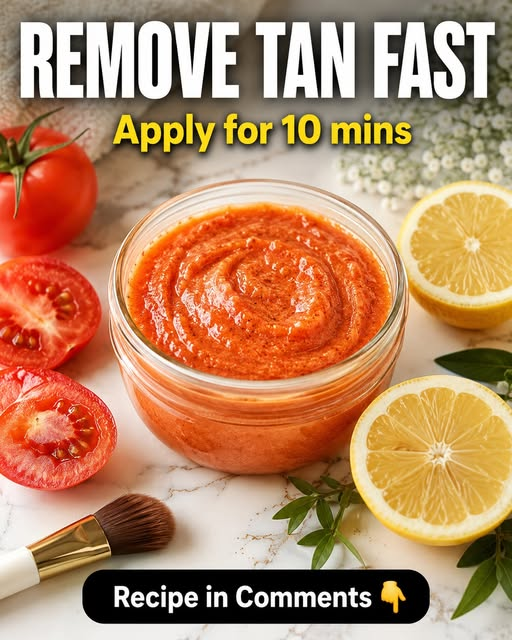
A sun tan develops when ultraviolet exposure stimulates the skin to produce more melanin as a protective response. Although a fresh tan may gradually become lighter as surface skin cells naturally renew, no homemade mask can safely erase established pigmentation in ten minutes. The most effective first step is preventing additional tanning with shade, protective clothing, and broad-spectrum sunscreen. Natural ingredients may support hydration, calm sun-stressed skin, reduce dullness, and help the complexion look smoother while normal fading takes place. UV exposure can produce both immediate darkening and delayed tanning, so consistent sun protection is essential throughout the routine. (PubMed)
The tomato-and-lemon mask shown in the image is not recommended. Tomato is more strongly supported as a dietary source of lycopene than as a homemade topical tan remover, while lemon juice can irritate the skin. Citrus juice followed by sunlight may cause phytophotodermatitis, which can leave painful inflammation and darker pigmentation. (PubMed)
The following remedies use gentle, easy-to-find ingredients. Research supports several individual ingredients, but these exact homemade mixtures have not been clinically tested as complete treatments. Patch-test each remedy for 24 hours before applying it widely.

Remedy 1: Soy, Aloe, and Licorice Brightening Mask for Normal Skin
Normal skin usually tolerates a balanced mixture of lightweight hydration and gentle plant ingredients.
Ingredients and Their Scientific Working
Plain unsweetened soy milk — 2 tablespoons: Soy contains natural proteins that may influence the transfer of pigment-containing melanosomes into surface skin cells. Research on stabilized topical soy preparations has shown gradual improvements in uneven tone and hyperpigmentation. Homemade soy milk is milder and less standardized. (PubMed)
Pure aloe vera gel — 1 tablespoon: Aloe provides water-binding compounds that support hydration. Aloesin, a compound obtained from aloe, has demonstrated effects on UV-related pigmentation, although ordinary aloe gel contains an unpredictable amount. (PubMed)
Weak cooled licorice-root infusion — 1 tablespoon: Licorice contains glabridin, which has been studied for effects on tyrosinase, an enzyme involved in melanin production. Home infusions are much weaker than standardized extracts. (PubMed)
Colloidal oatmeal — 1 teaspoon: Oat compounds help support the protective barrier and reduce dryness and irritation. (PubMed)
Vegetable glycerin — 1/4 teaspoon: Glycerin attracts water into the outer skin layer and improves surface hydration. (PubMed)
Cooled boiled water — 1 teaspoon: Water creates a smooth, light consistency.
Procedure
Mix all ingredients until creamy. Apply a thin layer over clean skin without rubbing. Leave it on for eight to ten minutes, rinse with lukewarm water, and pat dry.
How Often to Apply
Use once daily for three to five days. Continue three evenings weekly if the skin remains comfortable.
Initial Results
Within one to three days, the skin may feel softer and appear less dull. Noticeable fading of a true sun tan generally takes longer.
Remedy 2: Dual-Zone Green Tea and Rice Mask for Combination Skin
Combination skin may become oily across the forehead, nose, and chin while the cheeks remain normal or dry. Treating both areas differently helps prevent over-drying.
Ingredients and Their Scientific Working
Cooled green tea — 2 tablespoons: Green-tea polyphenols provide antioxidant activity and have been studied for protection against some UV-related skin effects. (PubMed)
Rice starch water — 2 tablespoons: Rice-derived ingredients may support moisturization and barrier recovery. Research on rice starch found improved healing capacity in damaged skin. (PubMed)
Pure aloe vera gel — 1 tablespoon: Aloe creates a light hydrating base.
Colloidal oatmeal — 1 teaspoon: Oatmeal supports moisture retention on the cheeks.
White kaolin clay — 1/2 teaspoon: Clay absorbs temporary surface oil but does not bleach melanin or permanently lighten a tan.
Vegetable glycerin — 1/4 teaspoon: Glycerin helps prevent tightness in drier areas.
Procedure
Combine green tea, rice starch water, aloe, oatmeal, and glycerin. Divide the mixture into two portions. Add kaolin only to the portion intended for the forehead, nose, and chin. Apply the clay-free portion to the cheeks.
Leave on for five to seven minutes. Rinse before the clay becomes completely dry or begins to crack.
How Often to Apply
Use on alternate evenings for five days. Continue twice weekly afterward.
Initial Results
The oily areas may appear less shiny after the first application. The cheeks may look smoother within two to three days, creating a more even-looking complexion.
Remedy 3: Licorice and Green Tea Cooling Gel for Oily Skin
Oily skin may appear darker or duller when excess sebum, sweat, and surface buildup reflect light unevenly. A lightweight routine is preferable to aggressive scrubbing.
Ingredients and Their Scientific Working
Weak cooled licorice infusion — 2 tablespoons: Licorice compounds have shown pigment-related activity in laboratory and animal research, but homemade tea is not equivalent to a standardized extract. (PubMed)
Strong cooled green tea — 1 tablespoon: Green tea supplies antioxidant polyphenols without adding oil.
Pure aloe vera gel — 1 tablespoon: Aloe supports lightweight hydration.
Rice starch water — 1 tablespoon: Rice starch improves the texture of the gel and supports skin-barrier comfort.
Finely powdered colloidal oatmeal — 1/2 teaspoon: Oatmeal reduces friction and helps prevent excessive dryness.
Vegetable glycerin — 1/8 teaspoon: A small quantity helps maintain hydration without creating a heavy texture.
Procedure
Mix all ingredients and refrigerate for five minutes. Do not freeze. Apply a thin layer to clean skin, especially over uneven-looking areas. Leave it on for six minutes and rinse gently.
Do not scrub with a towel or facial brush.
How Often to Apply
Use once nightly for three days. Continue every other night for two weeks if there is no irritation.
Initial Results
The skin may feel cooler, fresher, and less greasy within one to three uses. Cooling does not remove melanin, so complete tan removal should not be expected.
Remedy 4: Oat, Soy, and Sunflower Recovery Pack for Dry Skin
Dryness can make a tan look patchy because rough surface cells scatter light unevenly. Improving hydration may make the complexion appear softer and more luminous while pigmentation gradually fades.
Ingredients and Their Scientific Working
Colloidal oatmeal — 2 teaspoons: Clinical research has found improvements in dryness, moisturization, and protective barrier function with colloidal-oat preparations. (PubMed)
Plain unsweetened soy milk — 2 tablespoons: Soy-based topical preparations have shown gradual improvements in tone and photoaged skin, although ordinary soy milk is less concentrated. (PubMed)
Pure aloe vera gel — 1 tablespoon: Aloe provides water-rich hydration.
Vegetable glycerin — 1/2 teaspoon: Glycerin improves water retention in the outer skin layer. (PubMed)
Cold-pressed sunflower seed oil — 3 drops: Sunflower oil contains linoleic-acid-rich lipids. A small human study found that it preserved barrier integrity and improved hydration. (PubMed)
Rice starch water — 1 tablespoon: Rice starch provides a soft, non-abrasive base.
Procedure
Soak the oatmeal in soy milk and rice starch water for five minutes. Add aloe, glycerin, and sunflower oil. Apply gently without massaging.
Leave the mixture on for eight to ten minutes, rinse with lukewarm water, and pat dry.
How Often to Apply
Apply nightly for three days. Continue every other night for two weeks.
Initial Results
Tightness may improve after the first application. The skin may look smoother and more radiant within two to three days, but pigment reduction will be slower.
Remedy 5: Minimal Oat and Rice Comfort Compress for Sensitive Skin
Sensitive skin may develop darker marks after irritation. Harsh acids, strong essential oils, lemon juice, and aggressive rubbing can worsen uneven pigmentation.
Ingredients and Their Scientific Working
Colloidal oatmeal — 2 teaspoons: Oatmeal has soothing, barrier-supporting, and anti-inflammatory properties. (PubMed)
Rice starch water — 2 tablespoons: Rice starch creates a gentle, non-exfoliating liquid base.
Pure aloe vera gel — 1 teaspoon: Aloe adds hydration but should be omitted if it has caused itching previously.
Vegetable glycerin — 1/4 teaspoon: Glycerin reduces dryness without exfoliating sensitive skin.
Weak cooled green tea — 1 tablespoon: A weak infusion provides antioxidant plant compounds.
Cooled boiled water — 2 tablespoons: Extra water makes the formula suitable for a compress.
Procedure
Mix all ingredients and allow the oatmeal to soften for ten minutes. Soak a clean, soft cotton cloth in the liquid. Rest it over the tanned area for three to five minutes.
Do not rub or scrub. Rinse with cool-to-lukewarm water.
How Often to Apply
Use once daily for three days. Continue every other day only if no irritation develops.
Initial Results
The skin may feel calmer and less dry within one to three days. Sensitive skin should be brightened gradually because inflammation may create additional discoloration.
Final Tips for Preventing and Fading a Tan
Apply broad-spectrum, water-resistant SPF 30 or higher every morning to exposed skin. Reapply after heavy sweating, swimming, or prolonged outdoor exposure. Sunscreen helps prevent additional pigmentation and gives existing discoloration a better opportunity to fade. (American Academy of Dermatology)
Wear a wide-brimmed hat, sunglasses, and protective clothing, and seek shade during strong sunlight. (American Academy of Dermatology)
Do not scrub the face with sugar, salt, coffee grounds, or rough brushes. Exfoliating aggressively does not remove deep melanin and may cause irritation.
Avoid raw lemon or lime juice, baking soda, toothpaste, bleach, and undiluted essential oils. Citrus exposure followed by sunlight can produce inflammation, blistering, and residual hyperpigmentation. (PubMed)
Keep towels, masks, bowls, and applicators clean. Prepare each homemade remedy fresh and discard leftovers.
Visible softness and improved glow may begin within two to three days. A mild recent tan may gradually become lighter over several weeks, while persistent or deeper pigmentation may take considerably longer.
Diet Plan to Support Healthy, Sun-Resilient Skin
Diet cannot erase a tan, but a balanced eating pattern provides antioxidants, protein, vitamins, and healthy fats needed for normal skin function.
Breakfast: Choose eggs with whole-grain bread or unsweetened oatmeal with fruit, nuts, and seeds.
Mid-morning: Eat guava, orange, papaya, berries, or another vitamin-C-rich fruit.
Lunch: Include vegetables, lentils, beans, fish, eggs, or chicken with whole-wheat roti or a moderate portion of rice.
Evening snack: Choose carrots, cucumber, fruit, walnuts, or almonds instead of sugary drinks and fried snacks.
Dinner: Eat colorful vegetables with lentils, beans, fish, eggs, or lean chicken.
Tomato intake: Include cooked tomato in meals several times weekly. Human research suggests that regular consumption of lycopene-rich tomato paste may provide modest support against UV-related skin damage over time, but it does not replace sunscreen. (PubMed)
Hydration: Drink water according to thirst, physical activity, and weather.
Continue the balanced diet for at least eight to twelve weeks. Use the remedy suitable for your skin for three to five days initially. If it causes no irritation, continue two or three times weekly for three to four weeks.
See a dermatologist if pigmentation is spreading, becoming patchy, appearing without obvious sun exposure, or failing to improve after eight to twelve weeks. Seek medical care for severe sunburn, blistering, significant swelling, fever, or persistent skin pain.
References for the above remedy
- Gilchrest BA, et al. Mechanisms of Ultraviolet Light-Induced Pigmentation.
https://pubmed.ncbi.nlm.nih.gov/8577860/ - Leyden J, et al. The Mechanism of Action and Clinical Benefits of Soy for the Treatment of Hyperpigmentation.
https://pubmed.ncbi.nlm.nih.gov/21332714/ - Choi S, et al. Aloesin Inhibits Hyperpigmentation Induced by UV Radiation.
https://pubmed.ncbi.nlm.nih.gov/12372097/ - Yokota T, et al. The Inhibitory Effect of Glabridin From Licorice Extracts on Melanogenesis and Inflammation.
https://pubmed.ncbi.nlm.nih.gov/9870547/ - Ilnytska O, et al. Colloidal Oatmeal Improves Skin Barrier Through Multitherapy Activity.
https://pubmed.ncbi.nlm.nih.gov/27272074/ - De Paepe K, et al. Effect of Rice Starch as a Bath Additive on the Barrier Function of Damaged Skin.
https://pubmed.ncbi.nlm.nih.gov/12353708/ - Danby SG, et al. Effect of Olive and Sunflower Seed Oil on the Adult Skin Barrier.
https://pubmed.ncbi.nlm.nih.gov/22995032/ - Elmets CA, et al. Cutaneous Photoprotection From Ultraviolet Injury by Green Tea Polyphenols.
https://pubmed.ncbi.nlm.nih.gov/11209110/ - Rizwan M, et al. Tomato Paste Rich in Lycopene Protects Against Cutaneous Photodamage in Humans.
https://pubmed.ncbi.nlm.nih.gov/20854436/ - American Academy of Dermatology. How to Fade Dark Spots in Darker Skin Tones.
https://www.aad.org/public/everyday-care/skin-care-secrets/routine/fade-dark-spots