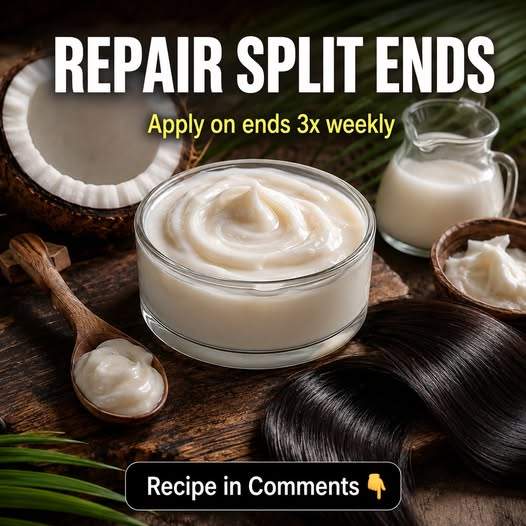
Split ends, medically called trichoptilosis, develop when the protective cuticle at the end of a hair fibre becomes worn away and the exposed shaft separates into two or more fragments. Frequent heat styling, bleaching, chemical straightening, rough towel drying, excessive brushing and repeated friction can accelerate this weathering process. Because the visible hair shaft is made of dead keratin, a split end cannot biologically heal or permanently fuse itself together. Trimming is the only reliable way to remove an existing split. Natural oils and conditioning masks can, however, coat weakened ends, reduce friction, limit protein loss and make splitting temporarily less noticeable while helping prevent additional breakage. (PubMed)
The remedies below should be applied mainly from the middle of the hair to the ends, not heavily on the scalp. They are designed for different hair types and use natural ingredients with the strongest available hair-shaft evidence. The complete homemade mixtures have not been clinically tested as formulas, so realistic results are smoother ends, easier detangling and reduced future damage rather than permanent repair.
Remedy 1: Coconut and Argan End Mask for Normal Hair
Ingredients
- 1 teaspoon virgin coconut oil — penetrates the hair shaft and helps reduce protein loss.
- ½ teaspoon argan oil — deposits protective lipids and may limit oxidative hair damage.
- 1 tablespoon pure aloe vera gel — creates a lightweight, spreadable conditioning base.
- ½ teaspoon honey — attracts moisture and helps prevent the mixture from drying too quickly.
- 1 teaspoon boiled and cooled water — dilutes the mask for even distribution.
Scientific Working of the Ingredients
Coconut oil contains a high proportion of lauric acid. Its relatively straight molecular structure and affinity for hair proteins allow it to enter the shaft more effectively than many heavier oils. Research found that coconut oil reduced protein loss in both damaged and undamaged hair when used before or after washing. Argan oil has also been tested on human hair fibres; pretreatment reduced protein loss caused by oxidative damage. Aloe, water and honey mainly improve spreadability and provide a temporary hydrated feel, but they should not be considered permanent split-end treatments. (PubMed)
Procedure
Warm the coconut oil between your fingers without heating it excessively. Mix it with the argan oil, aloe gel, honey and water. Apply a thin coating to the final 10–15 centimetres of damp hair. Gently press the product into the ends instead of rubbing them. Leave it on for 20 minutes, then shampoo and condition normally.
How Often to Apply
Apply two or three times during the first five days. Afterward, use once or twice weekly for six to eight weeks.
Initial Results
Within one to three days, the ends may look smoother, feel less rough and separate less during combing. Existing splits will still remain and should eventually be trimmed.
Remedy 2: Flaxseed and Jojoba Smoothing Gel for Wavy or Combination Hair
Ingredients
- 1 tablespoon homemade flaxseed gel — forms a light film that helps waves stay together.
- ½ teaspoon jojoba oil — lubricates weathered ends without the heaviness of thick butter.
- ½ teaspoon coconut oil — helps protect the internal hair structure from protein loss.
- 1 tablespoon aloe vera gel — provides slip and makes the treatment easier to spread.
- 1 teaspoon cooled water — creates a lightweight consistency suitable for mixed hair textures.
Scientific Working of the Ingredients
Flaxseed produces a mucilage-rich gel that can temporarily coat the surface and reduce the dry, expanded appearance of frayed ends. Direct clinical research proving flaxseed gel repairs split ends is lacking, so its role is mainly film formation and styling support. Jojoba oil is technically a liquid wax. In laboratory work involving chemically straightened hair, conditioning formulas containing jojoba improved hair protection, combability and resistance to breakage. Coconut oil provides the stronger protein-loss evidence in this blend. (PubMed)
Procedure
To make flaxseed gel, simmer one tablespoon of whole flaxseeds in half a cup of water for approximately five minutes and strain while warm. Allow it to cool completely. Measure one tablespoon and combine it with the remaining ingredients. Smooth a small amount over damp waves, concentrating on frayed areas. Leave for 15 minutes and rinse, or use a pea-sized quantity as a leave-in treatment if the hair does not become sticky.
How Often to Apply
Use on alternate days for the first five days, then one or two times weekly.
Initial Results
Waves may look more defined and the ends may feel less coarse after the first few applications. This visual sealing will wash away and must not be mistaken for permanent repair.
Remedy 3: Lightweight Aloe and Sunflower Treatment for Fine or Oily Hair
Ingredients
- 2 tablespoons aloe vera gel — provides a lightweight base without heavily coating fine strands.
- ½ teaspoon sunflower seed oil — lubricates the hair surface and reduces dry friction.
- ¼ teaspoon argan oil — supplies protective lipids in a small, non-heavy quantity.
- ¼ teaspoon honey — supports moisture retention.
- 1 tablespoon boiled and cooled water — reduces oil concentration and prevents flatness.
Scientific Working of the Ingredients
Fine hair can quickly become limp when too much oil is applied. Sunflower oil does not penetrate hair or reduce protein loss as effectively as coconut oil, but a thin surface layer may improve lubrication and reduce friction during detangling. Argan oil is included in a small amount because experimental research found that it reduced protein loss after oxidative stress. Aloe and diluted honey help create a washable gel rather than a dense oil mask. (PubMed)
Procedure
Whisk the aloe, water and honey until smooth. Add the two oils and mix again immediately before application. Spread only over the bottom few centimetres of damp hair. Leave it for 10–12 minutes and rinse thoroughly with lukewarm water. Shampoo only the roots if the lengths already feel clean.
How Often to Apply
Apply every other day for three to five days. Continue once weekly if the hair remains light and manageable.
Initial Results
The ends may appear less fluffy and may snag less during combing. Stop or reduce the oil quantity if the hair looks greasy or loses volume.
Remedy 4: Rich Coconut, Olive and Shea Mask for Dry, Curly or Coily Hair
Ingredients
- 1 teaspoon virgin coconut oil — penetrates the shaft and helps limit protein loss.
- 1 teaspoon extra-virgin olive oil — creates surface lubrication and softens rough-feeling ends.
- 1 teaspoon unrefined shea butter — forms a thicker protective coating around highly porous hair.
- ½ teaspoon argan oil — helps protect hair exposed to oxidation or chemical processing.
- 1 teaspoon honey — improves moisture retention within the mask.
- 1 tablespoon aloe vera gel — balances the heavy oils and improves distribution.
Scientific Working of the Ingredients
Curly and coily fibres can experience greater mechanical stress where bends in the strand rub against one another. Oils reduce combing forces by lubricating the surface, while coconut oil can also penetrate the fibre. Research comparing botanical oils and butters found that some oil treatments decreased wet-combing force and reduced split-end formation, although not every oil improved tensile strength. Shea butter is therefore used mainly as a coating emollient, not as a proven structural repair agent. Argan and coconut oils provide the better direct evidence for reducing protein damage. (PubMed)
Procedure
Melt the shea butter by placing its bowl in warm water. Stir in the coconut, olive and argan oils. Add the honey and aloe after the mixture has cooled slightly. Divide damp hair into sections and apply generously to the final third of each section. Cover for 25–30 minutes, rinse and follow with gentle shampoo if necessary.
How Often to Apply
Apply twice within the first five days, then once or twice weekly for eight weeks.
Initial Results
Dry ends may feel softer after one application and curls may separate with less pulling. Noticeable reduction in repeated breakage generally takes several weeks of careful handling.
Remedy 5: Oat, Aloe and Jojoba Mask for Sensitive or Colour-Treated Hair
Ingredients
- 1 tablespoon finely strained oat gel — creates a soft film without coarse particles.
- 1 tablespoon aloe vera gel — provides a fragrance-free, water-based conditioning base.
- ½ teaspoon jojoba oil — improves lubrication and combability.
- ½ teaspoon coconut oil — helps reduce wash-related protein loss.
- ¼ teaspoon honey — prevents the mixture from drying hard on the strands.
- 1 tablespoon boiled and cooled water — dilutes the formula for fragile hair.
Scientific Working of the Ingredients
Colouring and bleaching oxidise hair proteins and disturb the cuticle, increasing porosity, roughness and vulnerability to breakage. Coconut oil can limit water-driven swelling and reduce protein loss, while jojoba has demonstrated protective conditioning effects in chemically treated hair. Oat gel, aloe and honey primarily provide a gentle carrier and temporary surface softness. They have not been proven to rebuild bleached keratin. (PubMed)
Procedure
Simmer one tablespoon of finely ground oats in half a cup of water for three minutes, strain carefully and cool. Measure one tablespoon of the smooth liquid gel. Combine it with the other ingredients and patch-test it on a small section of hair and nearby skin. Apply to the ends for 10–15 minutes and rinse without vigorous rubbing.
How Often to Apply
Use once during the first three days. If no irritation or colour change occurs, repeat on day five and continue once weekly.
Initial Results
The treated ends may feel calmer, softer and less tangled after one or two applications. Discontinue the remedy if itching, redness or unusual colour fading occurs.
Final Tips to Prevent More Split Ends
Trim visibly split sections every six to twelve weeks, depending on the speed of damage and the length you wish to maintain. Cutting slightly above the split prevents it from travelling farther up the shaft. Conditioner should be applied after every shampoo because it coats weathered areas, reduces static and improves wet and dry combing.
Detangle from the ends upward with a wide-tooth comb. Avoid brushing repeatedly, especially when strands are tangled. Wet hair is more vulnerable to stretching and breakage, although tightly curled hair is usually safest to detangle while damp and coated with conditioner. Blot hair with a soft cotton T-shirt or microfibre towel rather than rubbing it.
Limit straighteners, curling irons and very hot blow-drying. Select a low or medium heat setting and avoid repeatedly passing the tool over the same section. Space out bleaching, permanent colouring, relaxing and chemical straightening whenever possible. Dermatologists also recommend avoiding tight hairstyles and rough pulling, both of which can weaken already fragile fibres. (American Academy of Dermatology)
Smoother-looking ends can appear within one to three days, but preventing new splits requires at least six to eight weeks of consistent care. Established splits still need to be cut.
Diet Plan for Stronger, Healthier Hair
Diet cannot glue together an existing split end, but insufficient protein, iron, zinc or overall calories can affect the production and strength of new hair growing from the follicle. Supplements are not automatically beneficial; excessive amounts of certain nutrients can worsen hair loss or cause toxicity. Testing and medical advice are preferable when deficiency is suspected. (American Academy of Dermatology)
Breakfast: Eat eggs, unsweetened yogurt or a lentil-based dish with whole-grain bread or oats. Add guava, berries, citrus fruit or another vitamin-C source.
Lunch: Choose chicken, fish, lean meat, beans, chickpeas or lentils with brown rice or whole-grain bread and green vegetables.
Snack: Have fresh fruit with a small serving of pumpkin seeds, almonds, walnuts or roasted chickpeas.
Dinner: Include fish, eggs, tofu, beans or lean meat with cooked vegetables and a whole-grain carbohydrate.
Weekly plan: Eat legumes regularly and fish once or twice weekly where suitable. Include iron-rich foods such as meat, lentils, beans and dark-green vegetables. Combine plant-based iron with vitamin-C-rich foods to support absorption.
Continue the selected remedy for six to eight weeks and follow the balanced diet consistently. Consult a dermatologist if the hair continues breaking near the roots, develops white nodes, becomes suddenly fragile, falls out in patches or does not improve after changing grooming habits. These signs may indicate a hair-shaft disorder, nutritional deficiency, thyroid condition or another medical problem rather than ordinary split ends.
References for the above remedy
- Rele AS, Mohile RB. Effect of mineral oil, sunflower oil, and coconut oil on prevention of hair damage.
https://pubmed.ncbi.nlm.nih.gov/12715094/ - Sharifi N, et al. Argan oil as a pretreatment of human hair before exposure to oxidative damage.
https://pubmed.ncbi.nlm.nih.gov/35226791/ - Keis K, et al. Investigation of penetration abilities of various oils into human hair fibres.
https://pubmed.ncbi.nlm.nih.gov/16258695/ - Dias TCS, et al. Protective effect of conditioning agents, including jojoba oil, on chemically treated hair.
https://pubmed.ncbi.nlm.nih.gov/18482015/ - Fregonesi A, et al. Brazilian oils and butters: effects on hair properties and split-end formation.
https://pubmed.ncbi.nlm.nih.gov/19450426/ - Gamez-Garcia M. Semi-permanent split-end mending with a polyelectrolyte complex.
https://pubmed.ncbi.nlm.nih.gov/17728946/ - D’Souza P, Rathi SK. Shampoo and Conditioners: What a Dermatologist Should Know?
https://pmc.ncbi.nlm.nih.gov/articles/PMC4458934/ - American Academy of Dermatology. Hair Styling Without Damage.
https://www.aad.org/public/diseases/hair-loss/hair-care/styling - American Academy of Dermatology. How to Stop Damaging Your Hair.
https://www.aad.org/public/diseases/hair-loss/insider/stop-damage - Guo EL, Katta R. Diet and hair loss: Effects of nutrient deficiency and supplement use.
https://pubmed.ncbi.nlm.nih.gov/28243487/