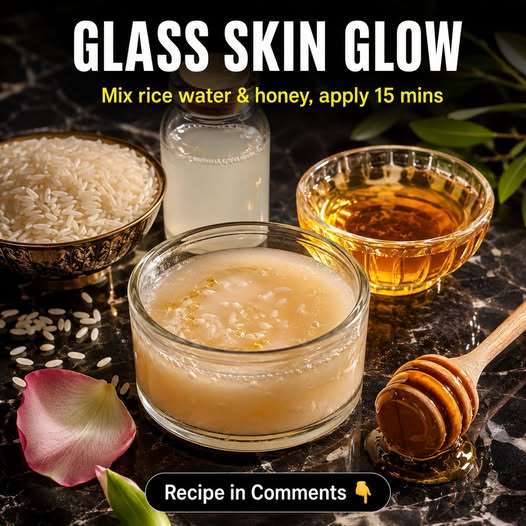
“Glass skin” describes a complexion that looks smooth, evenly hydrated and naturally reflective. Dryness, rough texture, excess oil and irritation can make the face appear dull, but a gentle routine may temporarily improve softness and light reflection. Rice water contains starches and rice-derived compounds that may support hydration, while honey acts as a humectant that attracts moisture. Small studies have reported cosmetic benefits from professionally formulated rice-water gels and honey-containing creams; however, an ordinary homemade mask has not been clinically proven to permanently brighten skin, remove pigmentation or erase wrinkles. These remedies are therefore designed to improve hydration and surface smoothness—not change natural skin colour. (MDPI)
Use freshly prepared, non-fermented rice water. Wash one tablespoon of white rice, soak it in half a cup of boiled and cooled water for 30 minutes, stir, and strain. Prepare only enough for one use because homemade water-based mixtures lack preservatives.

Remedy 1: Rice Water and Honey Hydration Mask for Normal Skin
Ingredients
- 2 tablespoons fresh rice water — provides a lightweight starch-containing base.
- 1 teaspoon honey — attracts water and helps the skin feel softer.
- 1 tablespoon pure aloe vera gel — supports surface hydration.
- 1 teaspoon finely ground oats — helps reduce roughness and water loss.
- 1 tablespoon cooled green tea — supplies antioxidant polyphenols.
Scientific Working of the Ingredients
Rice water: A small human study evaluated a gel containing 96% rice water. It was well tolerated and produced favourable sensory results for hydration and freshness, although the trial included only 12 people and used a professionally formulated gel rather than kitchen rice water. Rice starch has separately been shown to support recovery of a damaged skin barrier. (MDPI)
Honey: Honey contains sugars that function as humectants. A small controlled study of honey-containing creams reported improvements in moisturization and smoothness after regular use, but the complete cream—not raw honey alone—was tested. (PubMed)
Aloe vera: Formulations containing aloe extract increased water content in the outer layer of the skin after a single application and continued use. Fresh household aloe may differ from the standardized extracts used in research. (PubMed)
Oats: Finely ground colloidal oatmeal contains beta-glucans, lipids and soothing compounds. Clinical studies show that oatmeal-containing formulas can improve hydration, skin pH and barrier function. (PubMed)
Green tea: Its catechins provide antioxidant activity. Topical green-tea formulations have also been studied for controlling facial oil, although homemade tea is less concentrated and not standardized. (PubMed)
Procedure
Mix all ingredients into a thin paste. Apply to cleansed, slightly damp skin without rubbing. Avoid the eyelids and lips. Leave for 10 to 12 minutes, rinse with lukewarm water and apply a plain moisturizer.
How Often to Apply
Apply on alternate days during the first five days. If the skin remains comfortable, continue twice weekly for four to six weeks.
Initial Results
Within one to three days, the face may feel softer and look temporarily fresher because hydrated skin reflects light more evenly. Permanent brightening or wrinkle removal should not be expected.
Remedy 2: Zone-Balancing Rice Mask for Combination Skin
Ingredients
- 2 tablespoons rice water — hydrates without creating a heavy oil layer.
- 1 tablespoon aloe vera gel — supplies lightweight moisture.
- ½ teaspoon honey — helps reduce tightness on drier areas.
- 1 tablespoon cooled green tea — suitable for the oilier T-zone.
- 1 teaspoon finely ground oatmeal — improves the mask’s soothing texture.
- 2 drops sunflower seed oil — used only on dry cheeks.
Scientific Working of the Ingredients
Rice water, aloe and honey help increase the water available at the skin surface. Green-tea polyphenols have shown sebum-reducing effects in small facial studies conducted over several weeks. Oatmeal supports barrier repair, while sunflower seed oil is rich in linoleic acid. A controlled adult study found that sunflower oil preserved skin-barrier integrity and improved hydration, whereas olive oil weakened the barrier. (PubMed)
Procedure
Combine the rice water, aloe, honey, green tea and oatmeal. Apply a thin layer over the entire face. Press the two drops of sunflower oil into the remaining mixture and place it only on dry cheeks or around the jaw. Leave for 10 minutes and rinse gently.
How Often to Apply
Use every other day for the first five days, then reduce to twice weekly. Do not apply oil to acne-prone or congested areas.
Initial Results
The cheeks may feel less tight after one or two uses, while the forehead and nose should not feel heavily coated. Oil regulation requires several weeks and cannot be judged after one application.
Remedy 3: Lightweight Rice and Green Tea Compress for Oily Skin
Ingredients
- 2 tablespoons fresh rice water — creates an oil-free base.
- 2 tablespoons cooled green tea — provides topical tea polyphenols.
- 1 tablespoon aloe vera gel — hydrates without adding facial oil.
- 1 teaspoon oatmeal water — supplies soothing oat compounds.
- ¼ teaspoon honey — provides mild humectant activity.
Scientific Working of the Ingredients
Oily skin can still be dehydrated, so harsh drying masks may increase tightness and irritation. Green-tea preparations have produced statistically significant reductions in facial sebum during studies lasting around 60 days, and a separate small trial reported improvement in mild-to-moderate acne with a formulated 2% green-tea lotion. These findings do not prove that brewed tea will treat acne, but they support its use as a gentle, low-oil ingredient. Rice water, aloe and diluted honey primarily support hydration rather than suppressing sebaceous glands. (PubMed)
Procedure
Mix the ingredients thoroughly. Soak clean cotton pads or a soft cotton cloth in the liquid and place them on the cheeks and forehead for five to seven minutes. Remove the compress, rinse, and pat the face dry. Do not scrub with rice grains.
How Often to Apply
Use once daily for three days. If no irritation or clogged pores appear, continue three times weekly.
Initial Results
The skin may feel refreshed and less tight within one to three days. A temporary reduction in surface shine may occur, but meaningful sebum control generally requires longer, consistent care.
Remedy 4: Rice-Oat Barrier Mask for Dry Skin
Ingredients
- 2 tablespoons rice water — supplies starch and water.
- 1 teaspoon honey — attracts moisture to the skin surface.
- 1 tablespoon aloe vera gel — adds water-based hydration.
- 1 tablespoon finely ground colloidal oatmeal — supports the protective barrier.
- ½ teaspoon sunflower seed oil — provides linoleic-acid-rich emollience.
- ¼ teaspoon virgin coconut oil — helps reduce dryness and rough texture.
Scientific Working of the Ingredients
Dry skin benefits from combining humectants with emollient lipids. Honey, aloe and rice water contribute water-binding or hydrating properties, while oats help reinforce barrier function. Sunflower oil has preserved skin integrity in adult research. Virgin coconut oil has also performed similarly to mineral oil as a moisturizer in a randomized trial involving mild-to-moderate xerosis. Facial skin can be more acne-prone than the body areas studied, so coconut oil should be omitted if it causes bumps or congestion. (PubMed)
Procedure
Blend the ingredients until creamy. Apply a thin, even layer to damp skin. Leave it on for 10 minutes; do not wait until it becomes completely dry. Rinse gently and immediately seal in moisture with a fragrance-free moisturizer.
How Often to Apply
Apply on days one, three and five during the first week. Continue twice weekly for at least four weeks if well tolerated.
Initial Results
Flakiness and tightness may look reduced after one to three applications. Fine dehydration lines can temporarily appear softer, but structural wrinkles require prolonged evidence-based treatment and sun protection.
Remedy 5: Minimal Rice-Starch Soothing Mask for Sensitive Skin
Ingredients
- 1 tablespoon diluted rice water — provides a mild, low-concentration base.
- 1 tablespoon soft cooked-rice gel — adds starch without coarse exfoliation.
- 1 tablespoon finely powdered colloidal oatmeal — supports barrier recovery.
- 1 tablespoon pure aloe vera gel — provides cooling hydration.
- 2 drops sunflower seed oil — reduces dryness with minimal heaviness.
Scientific Working of the Ingredients
Sensitive skin needs fewer ingredients and no fragrance, essential oils, citrus juice or physical scrubbing. Rice starch improved barrier recovery in experimentally irritated skin, while colloidal oatmeal formulas have demonstrated significant benefits for hydration and barrier function. Aloe may increase outer-layer water content, and sunflower oil can preserve barrier integrity. Because these studies generally tested controlled formulations, individual tolerance to homemade ingredients remains unpredictable. (PubMed)
Procedure
Mash one teaspoon of freshly cooked plain rice with a little rice water and measure one tablespoon of the smooth gel. Mix in the oatmeal, aloe and sunflower oil. Patch-test behind the ear or along the jaw for 24 hours. If comfortable, apply for only five minutes and rinse without rubbing.
How Often to Apply
Use once during the first three days. If no stinging, redness or itching develops, apply again on day five and then once weekly.
Initial Results
The skin may feel calmer and less rough after one or two applications. Stop immediately if burning, swelling, hives or persistent redness occurs.
Final Tips for Maintaining a Glass-Skin Glow
Cleanse with lukewarm water and avoid abrasive scrubs, undiluted essential oils, lemon juice and baking soda. Apply moisturizer while the face is slightly damp, and use broad-spectrum sunscreen every morning because ultraviolet exposure contributes to uneven pigmentation, dryness and premature skin ageing. Keep bowls, spoons and cloths clean, prepare each mask fresh and never use food-based remedies on broken or infected skin.
Perform a patch test before every new recipe, particularly when using honey, aloe, oats or plant oils. People with eczema, rosacea, severe acne or known food allergies should consult a dermatologist before using homemade masks.
A smoother glow may begin within two to three days as hydration improves. Continued softness can develop over several weeks, but genuine wrinkle reduction and pigmentation improvement require longer-term treatment and cannot be guaranteed by rice water or honey.
Diet Plan for Hydrated, Healthy-Looking Skin
Follow this balanced eating pattern for at least eight to twelve weeks:
Breakfast: Oats with unsweetened yogurt, berries, guava or orange, plus a small serving of seeds.
Lunch: Lentils, beans, chicken, eggs or fish with whole-grain bread or brown rice and a mixed vegetable salad.
Afternoon snack: Fresh fruit with a small handful of almonds, walnuts or pumpkin seeds.
Dinner: Fish, tofu, legumes or lean meat with cooked vegetables and a whole-grain carbohydrate.
Daily fluids: Drink according to thirst, climate and activity level. Extra water may modestly improve hydration in people who previously drank too little, but excessive water does not create instant glass skin. (PubMed)
Fruits and vegetables provide vitamin C and polyphenols, protein supplies amino acids, and nuts, seeds and fish provide beneficial fats. Evidence suggests that fruit intake may modestly improve hydration and reduce transepidermal water loss, although effects on wrinkles and elasticity remain uncertain. (PubMed)
Continue the home remedy for four to six weeks and the balanced diet for at least eight to twelve weeks. See a dermatologist if dullness is accompanied by persistent rash, severe itching, painful acne, sudden pigmentation, swelling or symptoms that do not improve. Medical evaluation is also necessary when a remedy causes blistering, facial swelling or breathing difficulty.
References for the above remedy
- Marto J, et al. Rice Water: A Traditional Ingredient with Anti-Aging Efficacy.
https://www.mdpi.com/2079-9284/5/2/26 - De Paepe K, et al. Effect of rice starch as a bath additive on the barrier function of damaged and atopic skin.
https://pubmed.ncbi.nlm.nih.gov/12353708/ - Krasteva-Ilieva L, et al. Beneficial effects of honey-containing formulations on skin hydration and smoothness.
https://pubmed.ncbi.nlm.nih.gov/39770550/ - Dal’Belo SE, et al. Moisturizing effect of cosmetic formulations containing Aloe vera extract.
https://pubmed.ncbi.nlm.nih.gov/17026654/ - Mahmood T, et al. Effects of topical green tea and lotus on facial sebum control.
https://pubmed.ncbi.nlm.nih.gov/23935347/ - Elsaie ML, et al. Efficacy of topical 2% green tea lotion in mild-to-moderate acne vulgaris.
https://pubmed.ncbi.nlm.nih.gov/19363854/ - Capone K, et al. Effects of colloidal oatmeal on skin-barrier properties and hydration.
https://pubmed.ncbi.nlm.nih.gov/32484623/ - Danby SG, et al. Effect of olive and sunflower seed oil on the adult skin barrier.
https://pubmed.ncbi.nlm.nih.gov/22995032/ - Agero ALC, Verallo-Rowell VM. Virgin coconut oil versus mineral oil as a moisturizer for xerosis.
https://pubmed.ncbi.nlm.nih.gov/15724344/ - Li H, et al. Effects of fruit or fruit-extract intake on skin ageing: systematic review and meta-analysis.
https://pubmed.ncbi.nlm.nih.gov/37599694/