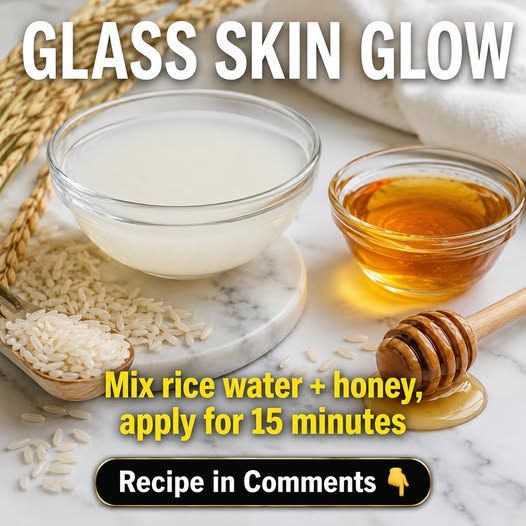
Glass skin refers to a complexion that appears smooth, evenly hydrated and naturally reflective. This look does not come from bleaching the skin or changing its natural colour; it develops when the outer skin layer holds moisture, the barrier remains healthy and surface roughness is reduced. Rice water and honey may provide temporary softness and radiance, but homemade mixtures have not been clinically proven to create permanent “glass skin.” Research is stronger for formulated rice-derived ceramides, honey creams, colloidal oatmeal, glycerin and aloe vera than for ordinary kitchen preparations. For this reason, the remedies below should be used as gentle supporting skincare rather than treatments for acne, eczema, melasma or deep wrinkles. Topical rice-derived ceramides have improved hydration and reduced water loss in human research, while honey-containing formulations have improved moisturisation and smoothness after regular use. (PubMed)
Prepare fresh rice water by rinsing one tablespoon of uncooked rice thoroughly, soaking it in half a cup of clean water for 20 minutes and straining the cloudy liquid. Use it immediately. Do not ferment it or store homemade masks because they contain no controlled preservatives.
Remedy 1: Rice, Yogurt and Honey Radiance Mask for Normal Skin
Ingredients
- 1 tablespoon fresh rice water: supplies a lightweight, starch-containing base
- 1 teaspoon pure honey: attracts moisture to the skin surface
- 1 teaspoon plain unsweetened yogurt: provides moisture and naturally occurring lactate
- 1 teaspoon finely powdered oats: supports softness and barrier comfort
- 1 teaspoon plain aloe vera gel: delivers light hydration
- 1 drop vegetable glycerin: helps the outer skin layer retain water
Scientific Working of Each Ingredient
Rice-derived ceramides have increased skin hydration and reduced transepidermal water loss in clinical research, although homemade rice water contains a much less predictable amount of these compounds. Honey works mainly as a humectant and has produced improvements in hydration and smoothness when incorporated into formulated creams. Aloe vera extracts have increased water content in the outer skin layer after topical use, while glycerin improves hydration and skin-barrier recovery. Colloidal-oatmeal preparations have also improved roughness, hydration and barrier measurements in controlled trials. Yogurt contains some lactate, but it is much weaker and less standardized than the lactic-acid preparations studied for skin smoothness. (PubMed)
Procedure
Combine the rice water and honey until evenly blended. Add the yogurt, aloe and glycerin, then stir in the powdered oats. Apply a thin layer to freshly washed, slightly damp skin. Leave it on for 10 minutes and rinse with lukewarm water without scrubbing.
How Often to Apply
Use once daily for three days. Afterward, reduce use to two applications weekly for up to three weeks.
Initial Results
Within one to three days, normal skin may feel softer and look temporarily more luminous. Pigmentation, scars and wrinkles will not disappear during this period.
Remedy 2: Rice, Soy and Green Tea Mask for Combination Skin
Ingredients
- 2 teaspoons fresh rice water
- 1 teaspoon unsweetened soy milk
- 1 teaspoon cooled green tea
- 1 teaspoon plain aloe vera gel
- 1 teaspoon colloidal oatmeal
- ½ teaspoon cosmetic-grade kaolin clay
Scientific Working of Each Ingredient
Combination skin needs lightweight hydration on the cheeks and mild oil absorption around the forehead, nose and chin. Green-tea extract formulations have produced gradual reductions in facial sebum during 60 days of use, although ordinary brewed tea is weaker. Kaolin absorbs some surface oil and creates a temporary matte finish without permanently changing sebaceous-gland activity. Soy moisturizers containing standardized soy compounds have demonstrated modest improvements in skin tone, pigmentation and photoaged texture. Kitchen soy milk cannot be assumed to deliver identical results, so it is included only as a gentle short-contact ingredient. Rice water, oatmeal and aloe help limit dryness across less oily areas. (PubMed)
Procedure
Mix the rice water, soy milk, green tea and aloe. Add the oatmeal and kaolin gradually to create a soft mask. Apply a thin layer over the T-zone and a slightly thicker layer over the cheeks.
Leave it on for six to eight minutes. Rinse while the mask remains slightly damp; allowing clay to harden completely may cause tightness.
How Often to Apply
Apply on days one, three and five. Continue once or twice weekly if the skin remains balanced.
Initial Results
The T-zone may appear temporarily less shiny after the first application, while the cheeks may feel more comfortable within two or three uses. The remedy cannot permanently shrink pores.
Remedy 3: Green Tea, Flaxseed and Rice Gel for Oily Skin
Ingredients
- 1 tablespoon fresh rice water
- 1 tablespoon strongly brewed, cooled green tea
- 1 teaspoon freshly prepared flaxseed gel
- 1 teaspoon plain aloe vera gel
- ½ teaspoon cosmetic-grade kaolin clay
- 1 teaspoon finely powdered oats
Scientific Working of Each Ingredient
Oily skin may still become dehydrated, especially after frequent washing or harsh masks. Green-tea catechins have shown anti-inflammatory and sebum-modulating effects in clinical studies using standardized topical preparations. A formulated flaxseed-extract microemulgel improved moisture, sebum and elasticity measurements in a small human study, but homemade flaxseed gel is not equivalent to that tested product. It mainly gives this remedy a light gel texture. Aloe supplies water-based hydration, while kaolin absorbs some excess surface lipids. Oatmeal helps reduce the dry, tight feeling that can follow clay use. (PubMed)
Prepare flaxseed gel by simmering one teaspoon of flaxseeds in half a cup of water for approximately five minutes. Strain while warm and allow one teaspoon of the gel to cool completely. Discard the remainder rather than storing it for repeated facial use.
Procedure
Blend the rice water, green tea, flaxseed gel and aloe. Add the oatmeal and kaolin. Apply a very thin layer, avoiding broken pimples and recently squeezed blemishes. Leave it on for five to seven minutes and rinse before it becomes dry.
How Often to Apply
Use every other day for five days, giving three applications. Continue once weekly for three weeks if there is no irritation.
Initial Results
Oiliness may look reduced for several hours, and the skin surface may feel smoother after washing. Acne, blackheads and acne marks require longer-term care.
Remedy 4: Honey, Oat and Sunflower Mask for Dry Skin
Ingredients
- 1 tablespoon fresh rice water
- 1 teaspoon pure honey
- 1 tablespoon colloidal oatmeal
- 1 teaspoon plain aloe vera gel
- ¼ teaspoon cold-pressed sunflower seed oil
- 2 drops vegetable glycerin
Scientific Working of Each Ingredient
Dry skin requires both humectants, which attract water, and emollients, which reduce moisture loss. Honey, glycerin and aloe contribute hydration, while oatmeal supports the outer barrier and reduces roughness. Sunflower seed oil supplies linoleic-acid-rich lipids. In a controlled human study, sunflower oil preserved skin-barrier integrity and improved hydration, whereas olive oil weakened the barrier and caused mild redness. Rice-derived ceramides have also demonstrated moisturising effects, although plain rice water is less concentrated than the preparations used in research. (PubMed)
Procedure
Mix the rice water, honey, aloe and glycerin. Add the oatmeal and allow it to soften for one minute. Blend in the sunflower oil last.
Apply to slightly damp skin for 10–12 minutes. Rinse gently and immediately apply a fragrance-free moisturiser while the face is still slightly damp.
How Often to Apply
Use once daily for three to five days. Continue two or three times weekly for another two weeks.
Initial Results
Dryness, tightness and light flaking may begin to improve within one to three applications. Fine dehydration lines can temporarily look softer, but established wrinkles require long-term care.
Remedy 5: Diluted Rice and Oat Compress for Sensitive Skin
Ingredients
- 1 teaspoon fresh rice water
- 2 teaspoons cooled boiled water
- 1½ teaspoons colloidal oatmeal
- 2 drops vegetable glycerin
- 2 drops sunflower seed oil
- ½ teaspoon plain aloe vera gel, optional
Scientific Working of Each Ingredient
Sensitive skin can become duller when strong treatments cause inflammation, so barrier protection is more important than aggressive brightening. Diluting rice water reduces the concentration of starch and plant material touching the skin. Colloidal-oatmeal creams have significantly improved hydration, skin pH and barrier function in clinical studies. Glycerin supports hydration, while a tiny amount of sunflower oil helps slow moisture loss. Aloe may hydrate the skin, but it can cause irritation in some individuals and should be omitted when there is a history of aloe sensitivity. (PubMed)
Procedure
Mix the rice water with cooled boiled water. Add the oatmeal and leave it for two minutes. Stir in the glycerin, sunflower oil and optional aloe.
Patch-test the mixture for 24 hours. When no reaction develops, apply a very thin layer for five minutes and rinse using only the fingertips.
How Often to Apply
Use every other day for three to five days. Continue once weekly only when the skin remains calm.
Initial Results
The face may feel less tight and look better hydrated after one to three applications. Stop immediately if burning, swelling, itching or prolonged redness occurs.
Final Tips for Maintaining a Glass Skin Glow
Wash with lukewarm water and avoid lemon juice, baking soda, rough sugar scrubs, undiluted essential oils and vigorous facial rubbing. Prepare each home remedy for one application and discard leftovers. Perform a patch test before using honey, aloe, soy, oats or other plant-derived ingredients.
Apply broad-spectrum sunscreen every morning. A randomized trial involving 903 adults found that regular sunscreen use produced 24% less measurable skin aging than discretionary use over approximately four and a half years. Consistent photoprotection is therefore more reliable for maintaining an even, smooth complexion than repeatedly applying brightening masks. (PubMed)
A temporary hydrated glow may become visible within two or three days, while lasting improvement in roughness or uneven tone normally requires several weeks. Continue a well-tolerated remedy for two to three weeks. Consult a dermatologist when persistent dullness occurs with acne, itching, painful rashes, pigmentation patches or recurrent redness. Seek urgent care for facial swelling, blistering or breathing difficulty.
Diet Plan for Naturally Healthy-Looking Skin
Follow this balanced plan for at least four to six weeks alongside gentle topical care.
Breakfast: Choose eggs, oatmeal, beans or unsweetened yogurt with berries, guava, papaya or an orange.
Mid-morning: Eat a whole seasonal fruit and drink water.
Lunch: Fill half the plate with colourful vegetables, one quarter with lentils, beans, fish, chicken or eggs, and one quarter with brown rice or whole-grain bread.
Evening snack: Eat a small handful of unsalted walnuts, almonds, pumpkin seeds or sunflower seeds.
Dinner: Choose fish, lentils, beans or another protein source with spinach, carrots, tomatoes, broccoli, pumpkin or other vegetables.
A randomized crossover trial found that four weeks of high-carotenoid fruit and vegetable intake increased measurable skin yellowness but did not lighten the skin. This supports eating colourful produce for a healthier-looking complexion rather than using restrictive diets or high-dose supplements. (PubMed)
Drink according to thirst unless a doctor has advised fluid restriction, sleep regularly and avoid crash dieting. Continue the diet and skincare routine for at least one month. When dullness persists with unusual tiredness, paleness, hair loss or unexplained weight changes, see a doctor to investigate possible nutritional, hormonal or dermatological causes.
References for the above remedy
- Asai S, Miyachi H. Evaluation of the skin-moisturizing effects of plant ceramides derived from rice.
https://pubmed.ncbi.nlm.nih.gov/17441463/ - Płaczek M, et al. Innovative honey-based product and its beneficial effects on skin hydration and smoothness.
https://pubmed.ncbi.nlm.nih.gov/39770550/ - Capone K, et al. Effects of colloidal oatmeal cream on skin-barrier properties.
https://pubmed.ncbi.nlm.nih.gov/32484623/ - Dal’Belo SE, Gaspar LR, Maia Campos PMBG. Moisturizing effects of formulations containing Aloe vera extract.
https://pubmed.ncbi.nlm.nih.gov/17026654/ - Fluhr JW, Darlenski R, Surber C. Glycerol and its functions in skin hydration and barrier repair.
https://pubmed.ncbi.nlm.nih.gov/18510666/ - Mahmood T, Akhtar N, Khan BA. Effects of topical green tea on facial sebum.
https://pubmed.ncbi.nlm.nih.gov/23935347/ - Danby SG, et al. Effects of olive oil and sunflower seed oil on the adult skin barrier.
https://pubmed.ncbi.nlm.nih.gov/22995032/ - Wallo W, et al. Efficacy of a soy moisturizer in photoaging and uneven skin tone.
https://pubmed.ncbi.nlm.nih.gov/17941363/ - Hughes MCB, Williams GM, Baker P, Green AC. Sunscreen and prevention of skin aging: a randomized trial.
https://pubmed.ncbi.nlm.nih.gov/23732711/ - Pezdirc K, et al. High-carotenoid fruit and vegetable intake and measurable skin changes.
https://pubmed.ncbi.nlm.nih.gov/27160341/