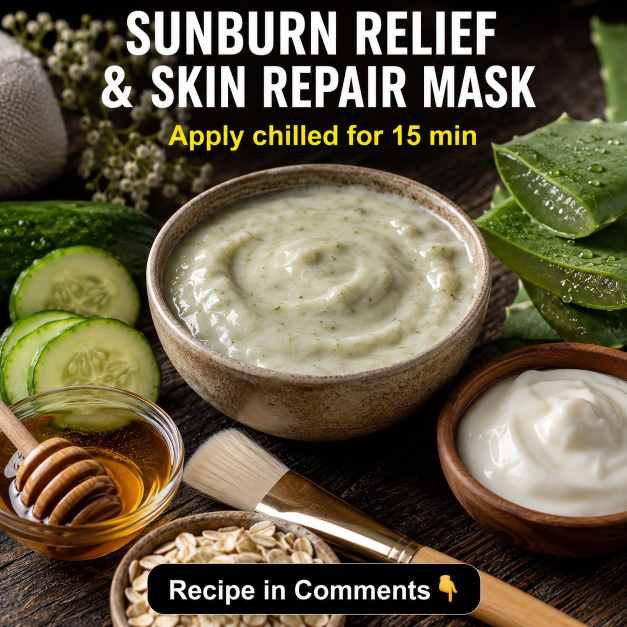
Sunburn is an inflammatory skin injury caused by excessive ultraviolet exposure. It may lead to redness, warmth, tenderness, swelling, tightness and later peeling or blistering. A homemade mask cannot reverse the underlying ultraviolet damage or instantly restore the skin, but appropriate cooling and moisturising care can reduce discomfort while the skin repairs itself. Dermatology guidance supports cool baths or compresses, colloidal oatmeal, aloe- or soy-containing moisturisers and increased fluid intake for mild sunburn. These remedies are designed for intact, mildly sunburned skin only—not blistered, broken, infected or severely swollen skin. (American Academy of Dermatology)
The yoghurt, honey and cucumber mask shown in the image may feel cooling, but ordinary yoghurt and kitchen honey are not clinically established sunburn treatments. Fresh foods may also introduce fragrance compounds, allergens or contamination to damaged skin. The following preparations use simpler ingredients with better evidence for soothing irritation and supporting the skin barrier.
Remedy 1: Cooling Aloe and Oat Mask for Normal Skin
Ingredients and Their Scientific Working
Cool distilled water: 3 tablespoons. Cool water temporarily lowers the skin’s surface temperature and helps reduce burning discomfort. It should be cool rather than freezing because direct ice can further injure sensitive skin.
Pure inner-leaf aloe vera gel: 2 tablespoons. Aloe gel provides a light, water-rich layer that can feel soothing. Dermatologists commonly recommend aloe-containing gels for symptomatic sunburn relief, although clinical evidence that aloe shortens sunburn healing is mixed.
Colloidal oatmeal: 1 teaspoon. Finely milled colloidal oatmeal contains starches, beta-glucans and avenanthramides. Clinical studies suggest it can improve hydration, support the skin barrier and reduce irritation in dry or inflamed skin.
Fragrance-free soy moisturiser: 1 teaspoon. Soy-containing moisturisers are recommended by dermatologists for sunburned skin. Soy compounds have also been studied for supporting barrier recovery and improving signs of photodamaged skin.
Plant-derived glycerin: ¼ teaspoon. Glycerin is a humectant that attracts water into the outer skin layer. Controlled studies show that glycerin-containing preparations improve skin hydration and support barrier recovery. (American Academy of Dermatology)
Procedure
Mix the colloidal oatmeal with cool water until no lumps remain. Stir in the aloe gel, soy moisturiser and glycerin. Apply a thin layer to clean, sunburned skin without rubbing. Leave it on for 10 to 15 minutes, rinse gently with cool water and pat dry. Prepare a fresh batch for every application.
How Often to Apply
Apply two times daily for three to five days. Stop sooner if the skin develops itching, a rash or increased redness.
Initial Results
Cooling and reduced tightness may be noticeable after the first application. During the next one to three days, the skin may feel more comfortable and less dry. Redness may remain because the mask does not immediately reverse inflammation.
Remedy 2: Two-Zone Relief Mask for Combination Skin
Ingredients and Their Scientific Working
Cool distilled water: 4 tablespoons. It cools both oily and dry areas without leaving a heavy residue.
Pure aloe vera gel: 1½ tablespoons. Aloe provides lightweight moisture suitable for the entire face.
Colloidal oatmeal: 1 teaspoon. Oatmeal helps calm irritation while limiting moisture loss.
Plain calamine lotion: 1 teaspoon. Calamine is a mineral-based skin protectant commonly used to relieve itching and discomfort. It is better suited to oilier areas because it may feel drying.
Fragrance-free soy moisturiser: 1 teaspoon. This is used on dry cheeks or jaw areas to reduce tightness.
Plant-derived glycerin: ⅛ teaspoon. A very small amount improves hydration without making the mixture excessively sticky.
Procedure
Mix the water, aloe, colloidal oatmeal and glycerin. Divide the mixture between two clean bowls. Add calamine to the portion intended for the forehead, nose and chin. Add soy moisturiser to the portion intended for dry cheeks and jaw areas. Apply both preparations gently and leave them on for 10 minutes. Rinse with cool water.
How Often to Apply
Use once or twice daily for three to five days. Do not apply calamine repeatedly to areas that are already peeling or very dry.
Initial Results
The oily zone may feel less hot and sticky after the first use, while the moisturising portion may reduce cheek tightness within one to three days. This remedy soothes symptoms but cannot prevent peeling when ultraviolet damage has already occurred. (Mayo Clinic)
Remedy 3: Lightweight Calamine and Aloe Gel for Oily Skin
Ingredients and Their Scientific Working
Cool distilled water: 3 tablespoons. Water delivers cooling without additional oil.
Pure aloe vera gel: 2 tablespoons. Aloe creates a lightweight base that is usually more comfortable for oily skin than heavy creams.
Plain calamine lotion: 1 teaspoon. Calamine can soothe itching and discomfort while producing a less greasy finish.
Colloidal oatmeal: ½ teaspoon. A small quantity provides barrier-supporting oat compounds without creating a thick paste.
Plant-derived glycerin: ⅛ teaspoon. This helps prevent the gel from leaving sunburned skin excessively dry.
Fragrance-free soy moisturiser: ½ teaspoon. Even oily skin requires moisture after a burn because ultraviolet exposure damages the protective barrier.
Procedure
Whisk the water and colloidal oatmeal together. Add the aloe, calamine, glycerin and soy moisturiser. Refrigerate the mixture for approximately 10 minutes, but do not freeze it. Apply a thin layer for 10 minutes and rinse without scrubbing.
How Often to Apply
Use once in the morning and once in the evening for three days. Continue once daily for another two days when needed.
Initial Results
The gel may reduce the sensation of heat soon after application. Over one to three days, the skin may feel calmer and less tight. Do not expect it to control acne, remove a tan or stop natural peeling.
Remedy 4: Oat, Glycerin and Sunflower Recovery Mask for Dry Skin
Ingredients and Their Scientific Working
Cool distilled water: 2 tablespoons. It cools the burn and hydrates the oatmeal.
Pure aloe vera gel: 2 tablespoons. Aloe supplies moisture without the heaviness of butter-based preparations.
Colloidal oatmeal: 2 teaspoons. Oatmeal supports hydration and may reduce dryness and irritation.
Plant-derived glycerin: ½ teaspoon. Glycerin binds water in the stratum corneum and can reduce the tight feeling associated with dry, peeling skin.
Fragrance-free soy moisturiser: 1 teaspoon. This adds emollient support after the skin has been cooled.
High-linoleic sunflower seed oil: 2 drops. Sunflower oil has shown skin-barrier and hydration benefits in adult research. Use it only after the initial heat has settled and only on intact, non-blistered skin. Oils should not be placed on a hot, freshly burned area because an occlusive layer may trap heat. (PubMed)
Procedure
Combine the water and colloidal oatmeal. Add the aloe, glycerin and soy moisturiser. Apply for 10 to 15 minutes and rinse gently. After patting the skin dry, mix two drops of sunflower oil into a small amount of soy moisturiser and spread it lightly over dry areas.
How Often to Apply
Use the mask twice daily for five days. Add the oil step only after approximately 24 hours, provided the skin is no longer intensely hot and has no blisters or open areas.
Initial Results
Dryness and tightness may improve within the first day. Flaking can still develop during days two to four because peeling is part of the body’s response to ultraviolet injury.
Remedy 5: Minimal Oat and Aloe Compress for Sensitive Skin
Ingredients and Their Scientific Working
Cool distilled water: 4 tablespoons. Cool water is the main active component and offers relief without fragrance or plant acids.
Colloidal oatmeal: 1 teaspoon. Oatmeal is commonly used in soothing baths and moisturisers for irritated skin.
Pure aloe vera gel: 1 tablespoon. Use aloe only after a patch test because natural ingredients can still trigger contact reactions.
Plant-derived glycerin: ¼ teaspoon. Glycerin helps retain water in the outer skin layer.
Fragrance-free soy moisturiser: ½ teaspoon. A small amount supports the damaged barrier without creating a thick mask.
Procedure
Patch-test the aloe and soy moisturiser on a small unaffected area. When no reaction appears, dissolve the colloidal oatmeal in the water and mix in the remaining ingredients. Soak a clean, soft cotton cloth in the liquid, wring it gently and place it over the affected skin for 10 minutes. Do not rub or massage.
How Often to Apply
Apply one to two times daily for three days. Stop immediately if burning, itching, swelling or a new rash develops.
Initial Results
The cool compress may ease discomfort immediately. Hydration and tightness may improve over one to three days, but sensitive skin may require longer to recover fully.
Final Tips for Safe Sunburn Recovery
Move indoors or into complete shade as soon as sunburn becomes apparent. Take cool—not icy—showers and pat the skin instead of rubbing it. Drink additional water because sunburn can draw fluid toward the skin and contribute to dehydration. Do not place ice directly on the burn and do not apply lemon juice, vinegar, toothpaste, essential oils, perfume, alcohol-based products, undiluted baking soda or harsh exfoliants.
Do not apply butter, coconut oil or a heavy oil mask while the skin remains hot. Never pop sunburn blisters because intact blisters protect the tissue underneath. Cover the area with loose, soft clothing and avoid additional sunlight until healing is complete. (Mayo Clinic)
Most mild sunburns begin feeling better within two to three days and may heal within approximately one week. More severe burns can take longer. These remedies may improve comfort and hydration, but they cannot remove ultraviolet damage, prevent every blister or erase a tan overnight.
After the skin has recovered, use shade, protective clothing and a broad-spectrum, water-resistant sunscreen with an SPF of at least 30. Consistent sun protection helps prevent future burns, uneven pigmentation, premature wrinkles and skin cancer. A mask does not reduce existing wrinkles; preventing repeated ultraviolet exposure is the more important long-term strategy. (American Academy of Dermatology)
Diet Plan for Supporting Skin Recovery
On waking: Drink one to two glasses of water. An oral rehydration drink may be useful after prolonged sweating, vomiting or diarrhoea, but ordinary water is sufficient for most mild sunburns.
Breakfast: Eat eggs, plain yogurt or oatmeal with berries. Protein provides amino acids required for normal tissue maintenance, while fruit contributes vitamin C and fluid.
Lunch: Choose chicken, fish, lentils or beans with vegetables and brown rice, whole-grain bread or another balanced carbohydrate.
Snack: Have watermelon, an orange, cucumber, plain yogurt or a small handful of nuts.
Dinner: Include a protein source with cooked vegetables and a moderate portion of whole grains or potatoes.
Throughout the day: Drink water regularly and limit alcohol because it may worsen dehydration. No detox drink, juice or supplement can cure sunburn. A balanced diet supports normal healing, but high-dose vitamin C, vitamin E or zinc supplements should not be taken solely for sunburn without professional guidance.
Continue the topical remedy for three to five days and the balanced diet until the skin feels normal. Seek medical care when pain or redness is worsening after two days, symptoms persist beyond a week, or the burn covers a large area. Prompt medical advice is especially important for babies and young children.
See a doctor urgently for widespread blistering, severe swelling, fever, chills, headache, confusion, dizziness, fainting, nausea, vomiting, dehydration, eye pain, signs of infection or sunburn involving the face or genitals. (nhs.uk)
References for the above remedy
- American Academy of Dermatology Association. “How to Treat Sunburn.”
https://www.aad.org/public/everyday-care/injured-skin/burns/treat-sunburn - Mayo Clinic. “Sunburn: Diagnosis and Treatment.”
https://www.mayoclinic.org/diseases-conditions/sunburn/diagnosis-treatment/drc-20355928 - NHS. “Sunburn.”
https://www.nhs.uk/conditions/sunburn/ - Centers for Disease Control and Prevention. “Preventing Sunburn.”
https://www.cdc.gov/skin-cancer/prevention/sunburn.html - Capone, K. et al. “Effects of Colloidal Oatmeal Topical Atopic Dermatitis Cream on Skin Microbiome and Skin Barrier Properties.” Journal of Drugs in Dermatology, 2020.
https://pubmed.ncbi.nlm.nih.gov/32484623/ - Breternitz, M. et al. “Placebo-Controlled, Double-Blind, Randomized Study of a Glycerol-Based Emollient on Eczematous Skin.” Skin Pharmacology and Physiology, 2008.
https://pubmed.ncbi.nlm.nih.gov/18025807/ - Wallo, W. et al. “Efficacy of a Soy Moisturizer in Photoaging: A Double-Blind, Vehicle-Controlled, 12-Week Study.” Journal of Drugs in Dermatology, 2007.
https://pubmed.ncbi.nlm.nih.gov/17941363/ - Maenthaisong, R. et al. “The Efficacy of Aloe Vera Used for Burn Wound Healing: A Systematic Review.” Burns, 2007.
https://pubmed.ncbi.nlm.nih.gov/17499928/ - Danby, S.G. et al. “Effect of Olive and Sunflower Seed Oil on the Adult Skin Barrier.” Pediatric Dermatology, 2013.
https://pubmed.ncbi.nlm.nih.gov/22995032/ - World Health Organization. “The Known Health Effects of Ultraviolet Radiation.”
https://www.who.int/news-room/questions-and-answers/item/radiation-the-known-health-effects-of-ultraviolet-radiation