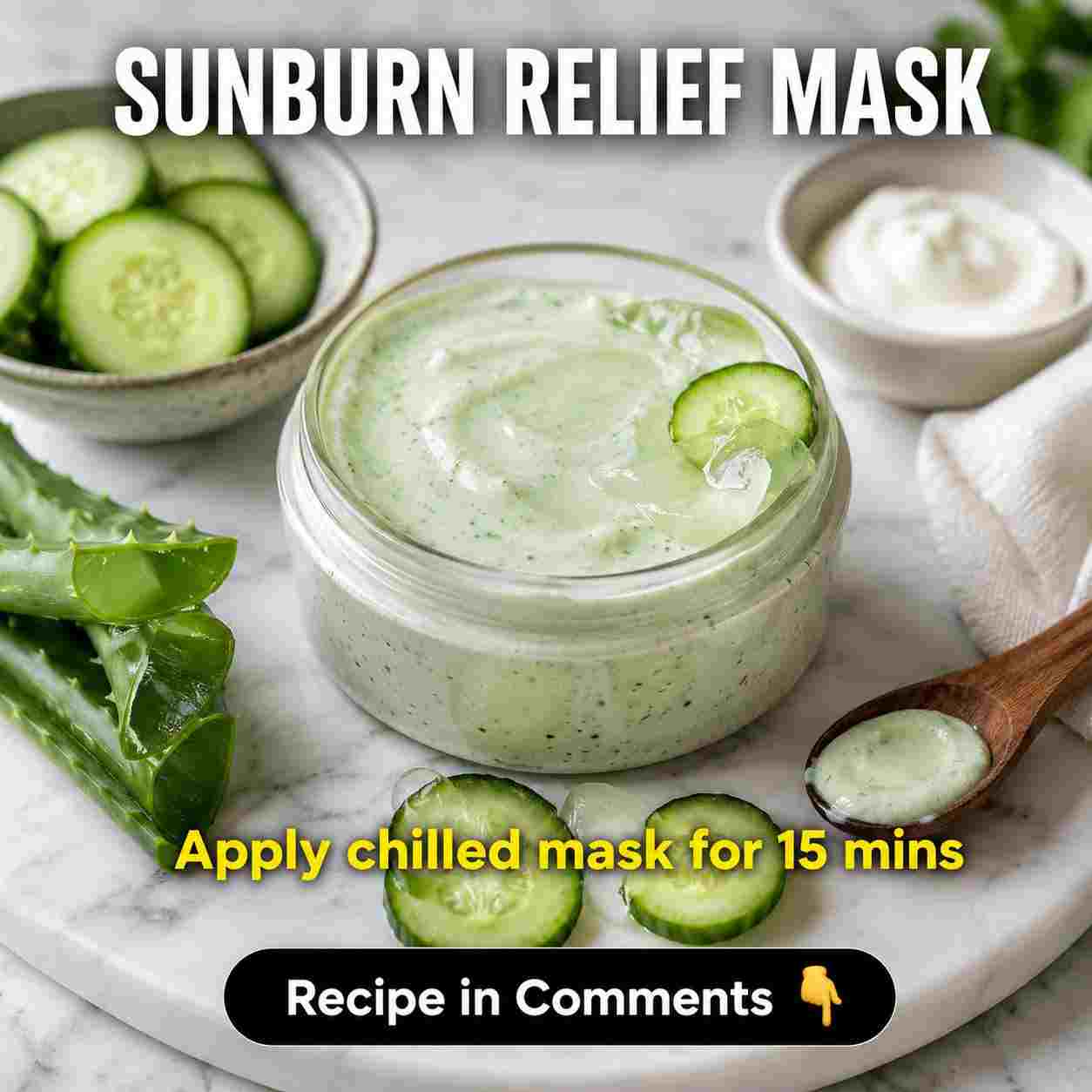
Sunburn is an inflammatory skin injury caused by excessive ultraviolet exposure. It may produce warmth, tenderness, redness, swelling, itching, tightness, and later peeling. Although a chilled mask can make the skin feel more comfortable, no homemade remedy can reverse the ultraviolet damage once it has occurred. The safest goal is to cool the skin, replace lost moisture, reduce friction, and prevent further sun exposure while the damaged barrier repairs itself. Mild sunburn often improves over several days, but blistering, fever, severe pain, dizziness, dehydration, confusion, or widespread burning requires medical attention. (Mayo Clinic)
The cucumber, aloe vera, and yogurt mask shown in the image may feel cooling, but plain yogurt is not a clinically established sunburn treatment. Its natural acids, proteins, fragrances, or contamination can irritate severely inflamed or broken skin. The remedies below therefore use aloe vera, colloidal oatmeal, cool water, green tea, cucumber water, and carefully diluted vegetable glycerin. Research supports the soothing or barrier-related properties of aloe, oatmeal, and glycerol, but the exact homemade combinations have not been tested as medical treatments. Use them only for mild, unbroken sunburn.
Do not apply masks to blisters, bleeding skin, open wounds, infected areas, or burns around the eyes. Never use ice directly, lemon juice, vinegar, toothpaste, butter, essential oils, perfume, baking soda, alcohol-based gel, or numbing ingredients such as benzocaine. (American Academy of Dermatology)
Remedy 1: Aloe and Oat Cooling Mask for Normal Skin
Ingredients and Scientific Working
- 1 tablespoon pure inner-leaf aloe vera gel: Aloe provides lightweight hydration and may support burn-wound healing, although research is stronger for controlled burn treatments than ordinary sunburn masks.
- 1 teaspoon colloidal oatmeal: Oat beta-glucans help retain water, while avenanthramides have antioxidant and anti-inflammatory activity.
- 1 teaspoon freshly strained cucumber water: Its main benefit is temporary physical cooling rather than proven healing.
- 1 teaspoon cooled green tea: Green-tea polyphenols have demonstrated anti-inflammatory effects against ultraviolet-induced redness in experimental research, but kitchen-brewed tea is not a replacement for treatment.
- 1 tablespoon boiled and completely cooled water: This creates a light texture and helps the mask spread without rubbing.
Aloe vera has shown potential to shorten healing time in studies of first- and second-degree burns, while colloidal oatmeal is supported for soothing dry, irritated, itchy skin. These findings do not prove that a homemade mask will cure sunburn, but they explain why the ingredients may improve comfort. (PubMed)
Procedure
Mix the oatmeal and cool water until smooth. Add the aloe gel, green tea, and cucumber water. Refrigerate the mixture for five minutes; it should feel cool, not icy.
Apply a thin layer using clean fingertips without massaging. Leave it on for 8 to 10 minutes. Rinse gently with cool or lukewarm water and pat dry. Discard the remaining mixture.
How Often to Apply
Use once daily for three days. Continue for up to five days if the burn remains mildly dry but is clearly improving.
Initial Results
Heat, tightness, and discomfort may feel reduced after the first application. Redness may begin settling within one to three days, although the skin may still peel while healing.
Remedy 2: Balanced Green Tea and Aloe Mask for Combination Skin
Ingredients and Scientific Working
- 1 tablespoon aloe vera gel: Hydrates the cheeks without covering the oily T-zone in heavy oil.
- 1½ teaspoons colloidal oatmeal: Helps calm dry, irritated areas and supports moisture retention.
- 2 teaspoons cooled green tea: Supplies water and antioxidant polyphenols.
- 2 teaspoons strained cucumber water: Adds a cooling sensation to hot facial skin.
- 2 drops vegetable glycerin: Glycerol is a humectant that supports skin hydration and barrier function; use only a very small amount.
Glycerol has been studied for its ability to improve hydration and support recovery of the skin barrier. Because pure glycerin can feel sticky or irritating when used undiluted, only two drops should be mixed into the water-based mask. (PubMed)
Procedure
Combine the cooled tea and oatmeal. Stir in the aloe, cucumber water, and glycerin.
Apply a slightly thicker layer to dry cheeks and a very thin layer across the forehead, nose, and chin. Leave it on for seven minutes and rinse without using a washcloth or facial brush.
How Often to Apply
Apply once daily for the first three days. After that, use every other day until dryness and tenderness have resolved.
Initial Results
Dry areas may feel less tight within one day, while oily areas should remain comfortable without a greasy coating. Visible redness may take several days to settle.
Remedy 3: Lightweight Green Tea Compress for Oily Skin
Ingredients and Scientific Working
- 2 tablespoons cooled green tea: Creates a lightweight cooling base without heavy oils.
- 1 tablespoon aloe vera gel: Supplies water-based moisture to a damaged barrier.
- 1 teaspoon colloidal oatmeal: Reduces the drying effect that can follow sunburn.
- 1 tablespoon strained cucumber water: Provides temporary cooling and dilution.
- 1 tablespoon boiled and cooled water: Keeps the treatment thin and easy to remove.
Topical green-tea extracts have reduced ultraviolet-induced redness in controlled experiments. However, brewed tea is less concentrated and has not been clinically proven to heal an existing sunburn. Its role in this remedy is supportive cooling rather than guaranteed treatment. (PubMed)
Procedure
Mix all the liquid ingredients and slowly stir in the oatmeal. Soak a clean, soft cotton cloth in the mixture and gently place it over the affected area for five minutes.
Remove the cloth, spread a very thin film of aloe gel over the skin, and allow it to absorb. Do not rub, scrub, or leave a thick mask on overnight.
How Often to Apply
Use the compress once or twice daily for three days, allowing several hours between applications.
Initial Results
The hot or stinging sensation may ease temporarily after application. Oiliness may appear reduced because the remedy contains no heavy oil, but it should not be used as an acne treatment.
Remedy 4: Oat and Glycerin Moisture Mask for Dry Skin
Ingredients and Scientific Working
- 2 teaspoons colloidal oatmeal: Forms a soft, moisture-retaining layer and helps relieve itching.
- 1 tablespoon aloe vera gel: Provides soothing water-based hydration.
- 3 drops vegetable glycerin: Attracts and holds moisture within the outer skin layer.
- 1 tablespoon boiled and cooled water: Dilutes the glycerin and softens the oatmeal.
- 1 teaspoon strained cucumber water: Adds temporary cooling without exfoliation.
This remedy focuses on reducing dryness rather than aggressively treating redness. Colloidal oatmeal has demonstrated moisturizing and anti-inflammatory effects in dry, irritated skin, while glycerol supports hydration and barrier properties. (PubMed)
Procedure
Mix the water and glycerin first. Add the oatmeal and allow it to absorb the liquid for one minute. Stir in the aloe and cucumber water.
Apply a soft layer for seven to eight minutes. Rinse before the mask becomes dry or begins cracking. Pat the area dry and apply a plain fragrance-free moisturizer while the skin remains slightly damp.
How Often to Apply
Apply once daily for three to five days. Stop when the skin is no longer hot, painful, or excessively dry.
Initial Results
Tightness and roughness may improve within one to three days. Peeling can still occur because it is part of the body’s process of shedding ultraviolet-damaged surface cells.
Remedy 5: Minimal Oat Mask for Sensitive Skin
Ingredients and Scientific Working
- 2 teaspoons colloidal oatmeal: Provides the main soothing and barrier-supporting action.
- 2 tablespoons boiled and cooled water: Cools the skin without introducing fragrance or acids.
- 1 teaspoon pure aloe vera gel: Include only after a successful patch test.
- 1 teaspoon strained cucumber water: Offers a mild cooling effect.
- 1 teaspoon very weak cooled green tea: Supplies additional water and antioxidants but should be omitted if tea causes sensitivity.
Sensitive skin benefits from fewer ingredients rather than stronger remedies. Colloidal oatmeal has a long history of dermatological use and research supporting anti-inflammatory, antioxidant, moisturizing, and anti-itch effects. (PubMed)
Procedure
Mix the oatmeal with water. Add the cucumber water and, only when previously tolerated, the aloe and weak green tea.
Apply the mixture first to a small area for three minutes. If there is no burning or increasing redness, apply a thin layer to the remaining affected skin for no longer than five minutes.
Rinse immediately if the skin stings, itches, swells, or becomes more inflamed.
How Often to Apply
Use once daily for the first three days. Do not increase the frequency in an attempt to accelerate healing.
Initial Results
The skin may feel calmer after the first application. Greater comfort may develop within two or three days, but persistent redness or pain should not be repeatedly covered with homemade masks.
Final Tips for Faster and Safer Sunburn Recovery
Take a short cool shower or bath, but do not use freezing water or place ice directly on the burn. Apply a gentle moisturizer while the skin is slightly damp, drink additional water, wear loose cotton clothing, and remain out of direct sunlight until the area heals. Sunburn draws fluid toward the damaged skin and can contribute to dehydration. (American Academy of Dermatology)
Do not pop blisters or pull away peeling skin. Intact blisters protect the tissue underneath, while opening them increases the risk of infection. Avoid exfoliating acids, retinoids, vitamin C serums, facial scrubs, waxing, bleaching, and fragranced skincare until sensitivity has completely resolved. (Mayo Clinic)
Apply broad-spectrum SPF 30 or higher before going outside and combine it with shade, protective clothing, a hat, and sunglasses. A mask cannot prevent premature wrinkles or skin cancer after ultraviolet exposure. Consistent sun protection is what reduces further burning, pigmentation, premature ageing, and cumulative skin damage. (American Academy of Dermatology)
Comfort and hydration may improve within two to three days. Mild sunburn commonly needs several days to heal, while a more intense burn may take longer. Do not judge recovery only by colour, because redness can be less visible on deeper skin tones even when tenderness and ultraviolet injury are present. (Mayo Clinic)
Home Remedy and Diet Plan
Use only one remedy suited to your skin type for three to five days. Stop sooner if the skin becomes more painful, swollen, itchy, blistered, or irritated. Homemade mixtures should be freshly prepared and discarded after every application.
Food cannot remove a sunburn, but adequate fluid, energy, and protein support the body’s normal recovery processes.
Morning: Drink water after waking. Eat oats or eggs with whole-grain bread and a water-rich fruit such as melon, orange, pear, or berries.
Lunch: Choose lentils, beans, chicken, fish, or eggs with vegetables, salad, and rice or whole-grain roti.
Afternoon snack: Have fruit, unsalted nuts, plain yogurt if tolerated, or a simple smoothie without excessive added sugar.
Dinner: Eat a protein source with cooked vegetables and a moderate serving of whole grains.
Fluids: Drink water regularly throughout the day. Oral rehydration may be appropriate when sweating, vomiting, or diarrhoea has caused substantial fluid loss, but severe dehydration needs medical assessment.
Avoid alcohol while recovering because it can contribute to dehydration. Do not take large doses of antioxidant supplements, herbal pills, or oral aloe as a sunburn cure.
See a doctor if the burn covers a large part of the body, develops extensive blisters, affects a baby or young child, or is accompanied by fever, chills, vomiting, headache, dizziness, confusion, faintness, eye pain, worsening swelling, pus, red streaks, or severe pain. Medical advice is also necessary when a significant burn does not begin improving within a few days. (Mayo Clinic)
References for the above remedy
- American Academy of Dermatology. How to treat sunburn.
URL: https://www.aad.org/public/everyday-care/injured-skin/burns/treat-sunburn - Mayo Clinic. Sunburn: First aid.
URL: https://www.mayoclinic.org/first-aid/first-aid-sunburn/basics/art-20056643 - NHS Inform. Sunburn: symptoms, treatment and prevention.
URL: https://www.nhsinform.scot/illnesses-and-conditions/injuries/skin-injuries/sunburn/ - Huang YN, et al. Effects of Aloe Vera on Burn Injuries: A Systematic Review and Meta-Analysis of Randomized Controlled Trials.
URL: https://pubmed.ncbi.nlm.nih.gov/38605441/ - Reynertson KA, et al. Anti-inflammatory activities of colloidal oatmeal in dry, irritated skin.
URL: https://pubmed.ncbi.nlm.nih.gov/25607907/ - Cerio R, et al. Mechanism of action and clinical benefits of colloidal oatmeal for dermatologic practice.
URL: https://pubmed.ncbi.nlm.nih.gov/20865844/ - Elmets CA, et al. Cutaneous photoprotection from ultraviolet injury by green-tea polyphenols.
URL: https://pubmed.ncbi.nlm.nih.gov/11209110/ - Fluhr JW, et al. Glycerol and the skin: origin, functions and dermatological applications.
URL: https://pubmed.ncbi.nlm.nih.gov/18510666/ - American Academy of Dermatology. Sunscreen frequently asked questions and sun-protection recommendations.
URL: https://www.aad.org/media/stats-sunscreen - Centers for Disease Control and Prevention. Sun exposure and ultraviolet-radiation protection.
URL: https://www.cdc.gov/niosh/outdoor-workers/about/sun-exposure.html