
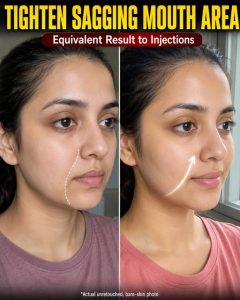
Sagging around the mouth, smile lines, marionette lines, and loose cheek-to-mouth skin can make the face look tired even when the skin is healthy. This area loses firmness because collagen, elastin, hydration, and facial fat support gradually reduce with age, sun exposure, poor sleep, stress, and dehydration. Natural remedies cannot give the same structural lift as injections or medical procedures, but the right ingredients can improve surface plumpness, dryness, dullness, mild fine lines, and skin texture. The best approach is to choose ingredients according to your skin type, use them consistently, protect the skin from sun damage, and support collagen through diet. Research supports ingredients such as aloe vera, green tea, colloidal oatmeal, lactic acid, soy, bakuchiol, honey, and hyaluronic-acid-supporting hydration for improving skin moisture, barrier strength, antioxidant defense, and visible signs of aging. (PMC)
Remedy 1: For Normal Skin
Aloe, Green Tea, Yogurt, Honey, Oat, and Rosehip Firming Mask
Ingredients: Take 1 tablespoon fresh aloe vera gel to hydrate and support collagen-related repair; 1 tablespoon cooled green tea for antioxidant protection against collagen-damaging free radicals; 1 teaspoon plain yogurt for gentle lactic-acid exfoliation; 1 teaspoon raw honey for moisture retention and skin softness; 1 teaspoon finely powdered oatmeal to calm and strengthen the skin barrier; 3 drops rosehip seed oil for fatty-acid nourishment.
Scientific Working: Aloe vera is linked with improved skin elasticity and collagen activity in human skin research, while green tea polyphenols help protect elastic tissue from oxidative stress. Lactic acid improves smoothness and firmness when used appropriately, honey works as a humectant, and oatmeal reduces dryness, roughness, and irritation. (PMC)
Procedure: Mix all ingredients into a smooth paste. Clean your face, then apply a thin layer around the mouth, smile lines, cheeks, and chin. Do not pull the skin downward while applying. Leave it for 12 minutes, then rinse with cool water and pat dry.
How Often to Apply: Use on alternate days for 5 days, then continue twice weekly.
Initial Results: Within 1–3 days, the mouth area may look fresher, smoother, and less dry. Fine lines can appear softer because the skin is better hydrated.
Remedy 2: For Combination Skin
Soy Milk, Aloe, Green Tea, Honey, Oat, and Cucumber Balancing Pack
Ingredients: Use 1 tablespoon unsweetened soy milk for isoflavone support; 1 teaspoon aloe vera gel for hydration; 1 tablespoon cooled green tea for antioxidant protection; 1 teaspoon honey for moisture balance; 1 teaspoon oat powder for barrier comfort; 1 teaspoon cucumber juice for a cooling, water-rich effect.
Scientific Working: Soy-based topical and oral ingredients have been studied for improving wrinkles, uneven tone, and photoaging signs. Green tea supports antioxidant defense, aloe improves hydration and elasticity, and oatmeal helps irritated or dry patches without making oily areas heavy. (PMC)
Procedure: Mix the ingredients until slightly creamy. Apply a thin layer around the mouth and cheeks. On oilier areas, keep the layer lighter; on drier mouth corners, apply a little extra. Leave for 10–12 minutes and rinse gently.
How Often to Apply: Apply once daily for 3 days, then every other day for the next week.
Initial Results: The skin may feel more balanced within 2–3 days. Dry folds around the mouth can look softer while oily areas stay comfortable.
Remedy 3: For Oily Skin
Green Tea, Aloe, Yogurt, Oat, Honey, and Clay Tightening Paste
Ingredients: Take 2 tablespoons cooled green tea; 1 teaspoon aloe vera gel; 1 teaspoon plain yogurt; 1 teaspoon oat powder; ½ teaspoon honey; ½ teaspoon fuller’s earth or cosmetic clay.
Scientific Working: Oily skin still needs hydration because dehydration can make fine lines look deeper. Green tea supports skin against oxidative stress, yogurt provides gentle lactic acid exfoliation, aloe hydrates without heaviness, and oatmeal reduces irritation. Clay helps absorb excess surface oil, but it should be used in a small amount to avoid dryness. (PubMed)
Procedure: Blend everything into a soft paste. Apply around the mouth, chin, and lower cheeks. Avoid applying a thick layer near the lip corners. Keep it for 8–10 minutes only; do not let the mask crack fully. Rinse with cool water.
How Often to Apply: Use every other day for 5 days. After that, use twice weekly.
Initial Results: In 1–3 days, oily shine may reduce, pores may look cleaner, and the mouth area may appear smoother because dead surface cells are removed gently.
Remedy 4: For Dry Skin
Aloe, Honey, Oat, Rosehip, Yogurt, and Avocado Soft-Lift Mask
Ingredients: Use 1 tablespoon aloe vera gel; 1 teaspoon raw honey; 1 tablespoon finely powdered oatmeal; 4 drops rosehip seed oil; ½ teaspoon plain yogurt; 1 teaspoon mashed ripe avocado.
Scientific Working: Dryness makes sagging and mouth folds more visible because the skin surface loses plumpness. Honey and aloe help bind water, oatmeal supports the barrier, yogurt provides mild smoothing through lactic acid, and plant oils help reduce moisture loss. Research on lactic acid supports improvement in skin smoothness and firmness, while oatmeal has evidence for dryness, scaling, and roughness. (PubMed)
Procedure: Mash well until creamy. Apply around the mouth, cheeks, and chin using upward strokes. Leave for 15 minutes. Rinse with lukewarm water, then splash cool water. Pat dry and avoid rubbing with a towel.
How Often to Apply: Apply daily for 3 days if skin is very dry, then 3 times weekly.
Initial Results: Within 1–2 days, the skin may feel softer and look less creased. Lines caused by dehydration can appear reduced.
Remedy 5: For Sensitive Skin
Colloidal Oat, Aloe, Honey, Cucumber, and Chamomile Calm-Firm Gel
Ingredients: Take 1 tablespoon finely ground colloidal oatmeal; 1 tablespoon aloe vera gel; ½ teaspoon honey; 1 teaspoon cucumber juice; 1 tablespoon cooled chamomile tea.
Scientific Working: Sensitive skin needs barrier repair more than aggressive tightening. Colloidal oatmeal has anti-inflammatory and antioxidant activity and has shown clinical improvement in dryness, scaling, roughness, and itch. Aloe and honey add hydration, while cucumber and chamomile provide a cooling feel. Avoid turmeric, lemon juice, baking soda, strong acids, and harsh scrubs on sensitive skin. (PubMed)
Procedure: Mix into a soft gel-paste. Apply a thin layer around the mouth and lower cheeks. Leave for 8–10 minutes. Rinse with cool water. Do not massage strongly.
How Often to Apply: Use once daily for 3 days, then 2–3 times weekly.
Initial Results: Redness, tightness, and rough texture may calm within 1–3 days. The skin may look smoother because irritation-related dryness is reduced.
Final Tips
Always do a patch test on the jaw or behind the ear before applying any remedy around the mouth. Keep towels, bowls, brushes, and hands clean because bacteria can trigger breakouts near the mouth. Do not use lemon juice, toothpaste, baking soda, or harsh scrubbing on sagging skin because irritation can worsen texture. Sleep 7–8 hours, drink enough water, avoid smoking, and use daily broad-spectrum sun protection, because UV exposure is one of the strongest causes of collagen breakdown and photoaging. Sunscreen and photoprotection are strongly supported for preventing wrinkles, sagging, and uneven skin changes. (PMC)
Visible improvement from home remedies usually begins within 2–3 days as hydration and smoothness improve. Real firmness, wrinkle softening, and glow require consistent care for 4–8 weeks. If sagging is sudden, one-sided, painful, associated with facial weakness, swelling, rash, infection, or rapid weight loss, consult a doctor or dermatologist.
Diet Plan for Firmer Skin Around the Mouth
Continue this diet plan for at least 6–8 weeks along with the remedies. In the morning, drink water and eat a protein-rich breakfast such as eggs, yogurt, lentils, or chickpeas with fruit rich in vitamin C, such as orange, guava, berries, or kiwi. At lunch, include vegetables, whole grains, and a protein source such as fish, chicken, beans, tofu, or lentils. Add healthy fats from nuts, seeds, avocado, or olive oil. In the evening, drink green tea or plain water instead of sugary drinks. At dinner, keep the meal light but protein-focused, with vegetables and soup if digestion is slow.
Vitamin C supports collagen synthesis, while adequate dietary protein supplies amino acids needed for skin repair. Oral collagen peptides have shown benefits in some randomized trials and reviews, but results can vary, so a food-first diet remains important. Reduce excess sugar because high sugar intake can contribute to collagen stiffening through glycation. (PMC)
If the sagging mouth area continues to worsen despite 6–8 weeks of skincare, diet, sleep, and sun protection, see a dermatologist. Home remedies can support skin quality, but deeper facial volume loss, strong marionette folds, or significant laxity may need professional assessment.
References for the above remedy
- Cho S. et al. “Dietary Aloe Vera Supplementation Improves Facial Wrinkles and Elasticity and It Increases the Type I Procollagen Gene Expression in Human Skin in vivo.”
URL: https://pmc.ncbi.nlm.nih.gov/articles/PMC2883372/ - Chiu A. E. et al. “Double-blinded, Placebo-controlled Trial of Green Tea Extracts in the Clinical and Histologic Appearance of Photoaging Skin.”
URL: https://pubmed.ncbi.nlm.nih.gov/16029678/ - Reynertson K. A. et al. “Anti-inflammatory Activities of Colloidal Oatmeal Contribute to the Effectiveness of Oats in Treatment of Itch Associated With Dry, Irritated Skin.”
URL: https://pubmed.ncbi.nlm.nih.gov/25607907/ - Yaghoobi R. et al. “Evidence for Clinical Use of Honey in Wound Healing as an Anti-bacterial, Anti-inflammatory, Anti-oxidant and Anti-viral Agent.”
URL: https://pmc.ncbi.nlm.nih.gov/articles/PMC3941901/ - Smith W. P. “Epidermal and Dermal Effects of Topical Lactic Acid.”
URL: https://pubmed.ncbi.nlm.nih.gov/8784274/ - Dhaliwal S. et al. “Prospective, Randomized, Double-blind Assessment of Topical Bakuchiol and Retinol for Facial Photoageing.”
URL: https://pubmed.ncbi.nlm.nih.gov/29947134/ - Natarelli N. et al. “Clinical Efficacy of Topical or Oral Soy Supplementation in Dermatology.”
URL: https://pmc.ncbi.nlm.nih.gov/articles/PMC10299547/ - Bravo B. et al. “Benefits of Topical Hyaluronic Acid for Skin Quality and Signs of Skin Aging.”
URL: https://pmc.ncbi.nlm.nih.gov/articles/PMC10078143/ - Pullar J. M. et al. “The Roles of Vitamin C in Skin Health.”
URL: https://pmc.ncbi.nlm.nih.gov/articles/PMC5579659/ - Guan L. L. et al. “Sunscreens and Photoaging: A Review of Current Literature.”
URL: https://pmc.ncbi.nlm.nih.gov/articles/PMC8361399/