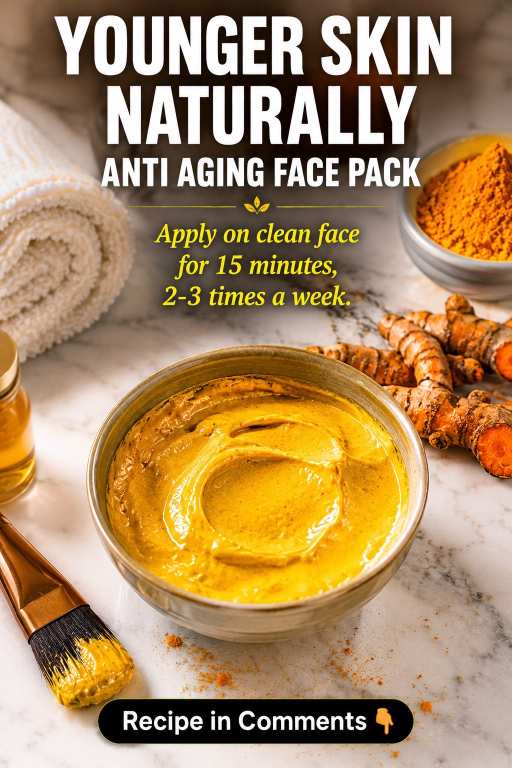
Skin aging is a normal biological process, but ultraviolet exposure, dryness, oxidative stress, smoking, poor sleep and repeated irritation can make fine lines, uneven tone and rough texture more noticeable. Natural ingredients such as turmeric, colloidal oatmeal and honey have useful antioxidant, soothing or moisturizing properties, but a homemade face pack cannot literally reverse aging or erase wrinkles in a few days. Clinical evidence for turmeric suggests potential benefits for several skin conditions, including photoaging, although researchers emphasize that the evidence remains limited. (PubMed) The most useful approach is therefore to combine gentle, skin-type-specific home care with daily sun protection, adequate nutrition and consistent skincare.

Remedy 1: For Normal Skin — Turmeric, Oat and Honey Renewal Pack
Ingredients and Their Scientific Working
1 tablespoon finely ground oats: Oat-based topical preparations can increase hydration and support the skin barrier. Clinical research has also demonstrated improvements in dryness and roughness. (PubMed)
1 teaspoon plain yogurt: Provides moisture and naturally occurring lactic acid, although homemade yogurt should not be considered equivalent to a standardized lactic-acid skincare treatment.
1 teaspoon honey: Honey contains compounds with antioxidant and anti-inflammatory properties, which explains its long history of topical dermatological use. (PubMed)
1 teaspoon aloe vera gel: Provides a cooling, hydrating base. Research involving oral aloe preparations has reported improvements in skin elasticity and collagen-related measurements, but these findings should not be directly interpreted as proof that topical aloe removes wrinkles. (PubMed)
1/8 teaspoon turmeric: Curcumin has antioxidant and anti-inflammatory activity, and clinical research provides preliminary support for turmeric/curcumin in skin health. (PubMed)
Procedure
Mix the ingredients into a smooth paste. Apply a thin layer to freshly cleansed face and neck, avoiding the eyes and lips. Leave it on for approximately 10–15 minutes without allowing the mask to become painfully tight or completely dry. Rinse gently with lukewarm water and moisturize afterward.
How Often to Apply
Use 2–3 times during the first week. If your skin remains comfortable, continue twice weekly for several weeks.
Initial Results
Within 1–3 days, improved hydration can temporarily make the skin feel softer and look smoother. Fine lines caused partly by dehydration may look less obvious, but collagen remodeling and true wrinkle improvement require much longer.
Remedy 2: For Combination Skin — Green Tea, Aloe and Oat Balancing Pack
Ingredients and Their Scientific Working
1 tablespoon cooled brewed green tea: Green-tea polyphenols have antioxidant and anti-inflammatory properties. Human research has investigated them for photoaging, although long-term results have been mixed. (PubMed)
1 tablespoon aloe vera gel: Creates a light hydrating base without requiring a heavy oil.
2 teaspoons finely ground oats: Oat compounds have moisturizing, barrier-supporting and anti-inflammatory properties. (PubMed)
1 teaspoon plain yogurt: Adds moisture and gives the mask a creamy texture.
1/2 teaspoon honey: Works as a natural humectant while supplying antioxidant compounds.
Procedure
Brew unsweetened green tea and let it cool completely. Mix one tablespoon with the remaining ingredients. Apply a thin layer across the face, using slightly less on naturally oily areas. Leave for 10 minutes and rinse thoroughly.
Because brewed tea introduces water and homemade preparations lack preservatives, make this mask fresh and discard leftovers rather than storing them.
How Often to Apply
Apply on alternate days for the first 3–5 days, then approximately twice weekly.
Initial Results
Hydration and temporary softness can become noticeable after the first few applications. The T-zone may feel refreshed while dry areas feel less tight.
Remedy 3: For Oily Skin — Turmeric, Green Tea and Aloe Antioxidant Mask
Ingredients and Their Scientific Working
1 tablespoon aloe vera gel: Provides hydration without relying on a heavy oil base.
1 tablespoon finely ground oats: Helps create a soothing mask while supporting the skin’s moisture barrier.
1 teaspoon cooled green tea: Supplies polyphenolic antioxidants.
1/2 teaspoon honey: Provides humectant and antioxidant properties.
A small pinch (about 1/16–1/8 teaspoon) turmeric: Supplies curcuminoids, including curcumin. A systematic review of human studies found early evidence supporting turmeric/curcumin for skin health, but larger clinical studies are still needed. (PubMed)
Procedure
Combine everything into a smooth paste. Spread a thin layer over clean skin without aggressive rubbing. Leave for 8–10 minutes, rinse thoroughly and follow with a lightweight moisturizer.
Turmeric can temporarily stain pale skin, towels and clothing, so use only a very small amount.
How Often to Apply
Use twice during the first 5 days and then 1–2 times weekly if well tolerated.
Initial Results
Skin may feel softer and less dry immediately after rinsing. Improvements in hydration can create a fresher appearance within 1–3 days, but this should not be confused with permanent wrinkle removal.
Remedy 4: For Dry Skin — Oat, Honey and Aloe Moisture-Restoring Pack
Dry skin can exaggerate the appearance of fine lines, so this remedy concentrates on restoring hydration rather than exfoliation.
Ingredients and Their Scientific Working
1 tablespoon finely powdered oats: Among natural skincare ingredients, colloidal oatmeal has relatively good evidence for improving dryness and supporting barrier function. (PubMed)
1 tablespoon aloe vera gel: Adds water-rich hydration and provides a soothing base.
1 teaspoon honey: Functions as a humectant and contains antioxidant and anti-inflammatory compounds. (PubMed)
1 teaspoon plain full-fat yogurt: Adds moisture and helps produce a creamy consistency.
1/2 teaspoon extra-virgin olive oil: Supplies emollient lipids that can help soften very dry skin.
Procedure
Mix the ingredients until creamy. Apply to damp, freshly cleansed skin. Leave for 10–15 minutes and rinse before the mixture becomes completely dry. Pat rather than rub the face with a clean towel and immediately apply moisturizer.
How Often to Apply
Use every other day for the first 3–5 days if your skin is particularly dry, then reduce to twice weekly.
Initial Results
Hydration can improve the appearance of roughness and dehydration lines relatively quickly. Skin may therefore look plumper after 1–3 days, but structural wrinkles will not disappear this quickly.
Remedy 5: For Sensitive Skin — Gentle Colloidal Oat and Aloe Comfort Mask
Sensitive skin needs fewer ingredients, not stronger ones. Turmeric, acids, essential oils and fragrances are deliberately excluded from this version.
Ingredients and Their Scientific Working
1 tablespoon very finely ground colloidal oatmeal: Oatmeal has evidence supporting anti-inflammatory, moisturizing and barrier-repair properties. (PubMed)
1 tablespoon pure aloe vera gel: Creates a cooling, water-rich base.
1 teaspoon plain yogurt: Adds softness; omit it if fermented dairy products irritate your skin.
1 teaspoon honey: Adds humectant properties, provided honey is tolerated.
1 teaspoon cool water: Adjusts the consistency without adding another potential irritant.
Procedure
Combine everything into a soft paste. Patch-test first. Apply a very thin layer without rubbing or scrubbing. Leave it for only 5–8 minutes initially and rinse with cool-to-lukewarm water.
How Often to Apply
Begin once during the first 3 days. If there is no burning, itching or persistent redness, use once or twice weekly.
Initial Results
The realistic early goal is calmer, softer and better-hydrated skin. Do not expect measurable wrinkle reversal in 1–3 days.
What Actually Makes Skin Look Younger?
Face masks can improve hydration, and better-hydrated skin often appears temporarily smoother and plumper. They cannot, however, replace the most important evidence-based anti-aging measure: protection from ultraviolet radiation.
A randomized controlled trial involving 903 adults found that regular broad-spectrum sunscreen use slowed measurable skin aging over 4.5 years; the daily-sunscreen group experienced 24% less skin aging than the discretionary-use group. (PubMed)
This means an anti-aging routine that uses turmeric every week but ignores daily UV protection is addressing a much smaller part of the problem.
Final Tips for Maintaining Younger-Looking Skin
Patch-test every homemade preparation before applying it to your whole face. Never add lemon juice, baking soda, undiluted essential oils or harsh scrubs to these masks. Do not scrub turmeric into the skin. Prepare water-containing masks fresh instead of keeping them for several days, and always use clean bowls, spoons and hands.
Visible improvements in hydration, softness and glow can begin within 2–3 days, particularly when dryness was making the skin look dull. Wrinkle reduction, improved elasticity and collagen-related changes take substantially longer and cannot responsibly be promised after a few applications.
Most importantly, protect exposed skin from UV radiation every day. Regular sun protection has considerably stronger clinical evidence for preventing premature aging than any homemade anti-aging face pack. (PubMed)
Diet Plan for Supporting Healthy, Younger-Looking Skin
Start breakfast with a protein source such as eggs or plain yogurt, accompanied by oats and vitamin-C-rich fruit such as guava, kiwi, berries or citrus fruit. For lunch, combine lentils, beans, chicken or fish with leafy vegetables, tomatoes and whole grains. A useful afternoon snack is a small serving of unsalted nuts or seeds with fresh fruit. Dinner can include fish, eggs, legumes or lean poultry alongside colorful vegetables.
Drink water according to thirst and environmental conditions rather than trying to force excessive amounts. Include protein regularly because amino acids are required for normal tissue maintenance, and obtain antioxidants primarily through a varied diet of vegetables and fruit.
Some nutritional interventions can affect skin properties, but results require time. For example, randomized trials investigating aloe-derived supplements assessed skin hydration, elasticity and collagen-related outcomes over approximately 12 weeks, rather than a few days. (PubMed)
Follow the skincare and dietary routine consistently for 8–12 weeks while prioritizing daily sun protection. If you develop persistent irritation, unexplained skin changes, rapidly worsening pigmentation, severe acne or a new/changing skin lesion, stop experimenting with home treatments and see a dermatologist or doctor.
References for the above remedy
- Vaughn AR, Branum A, Sivamani RK. Effects of Turmeric (Curcuma longa) on Skin Health: A Systematic Review of the Clinical Evidence. Phytotherapy Research, 2016.
https://pubmed.ncbi.nlm.nih.gov/27213821/ - Hughes MCB, Williams GM, Baker P, Green AC. Sunscreen and Prevention of Skin Aging: A Randomized Trial. Annals of Internal Medicine, 2013.
https://pubmed.ncbi.nlm.nih.gov/23732711/ - Kalaaji AN, Wallo W. A Randomized Controlled Clinical Study to Evaluate the Effectiveness of an Active Moisturizing Lotion with Colloidal Oatmeal Skin Protectant versus Its Vehicle for the Relief of Xerosis. Journal of Drugs in Dermatology, 2014.
https://pubmed.ncbi.nlm.nih.gov/25607563/ - Gunt HB, Levy SB, Lutrario CA. Clinical Improvements in Very Dry Skin from a Natural Ingredient-Based Moisturizing Cream Compared With a Leading Colloidal Oatmeal Control. Journal of Drugs in Dermatology, 2018.
https://pubmed.ncbi.nlm.nih.gov/30005098/ - Capone K, Kirchner F, Klein SL, Tierney NK. Effects of Colloidal Oatmeal Topical Atopic Dermatitis Cream on Skin Microbiome and Skin Barrier Properties. Journal of Drugs in Dermatology, 2020.
https://pubmed.ncbi.nlm.nih.gov/32484623/ - Cho S, Lee S, Lee MJ, et al. Dietary Aloe Vera Supplementation Improves Facial Wrinkles and Elasticity and It Increases the Type I Procollagen Gene Expression in Human Skin in vivo. Annals of Dermatology, 2009.
https://pubmed.ncbi.nlm.nih.gov/20548848/ - Tanaka M, Yamamoto Y, Misawa E, et al. Effects of Aloe Sterol Supplementation on Skin Elasticity, Hydration, and Collagen Score: A 12-Week Double-Blind, Randomized, Controlled Trial. Skin Pharmacology and Physiology.
https://pubmed.ncbi.nlm.nih.gov/28088806/ - Kaminaka C, et al. Effects of Low-Dose Aloe Sterol Supplementation on Skin Moisture, Collagen Score and Objective or Subjective Symptoms: 12-Week, Double-Blind, Randomized Controlled Trial. Journal of Dermatology, 2020.
https://pubmed.ncbi.nlm.nih.gov/32515040/ - Janjua R, Munoz C, Gorell E, et al. A Two-Year, Double-Blind, Randomized Placebo-Controlled Trial of Oral Green Tea Polyphenols on the Long-Term Clinical and Histologic Appearance of Photoaging Skin. Dermatologic Surgery, 2009.
https://pubmed.ncbi.nlm.nih.gov/19469799/ - Yaghoobi R, Kazerouni A, Kazerouni O. Evidence for Clinical Use of Honey in Wound Healing as an Anti-Bacterial, Anti-Inflammatory, Anti-Oxidant and Anti-Viral Agent: A Review.
https://pubmed.ncbi.nlm.nih.gov/24624197/