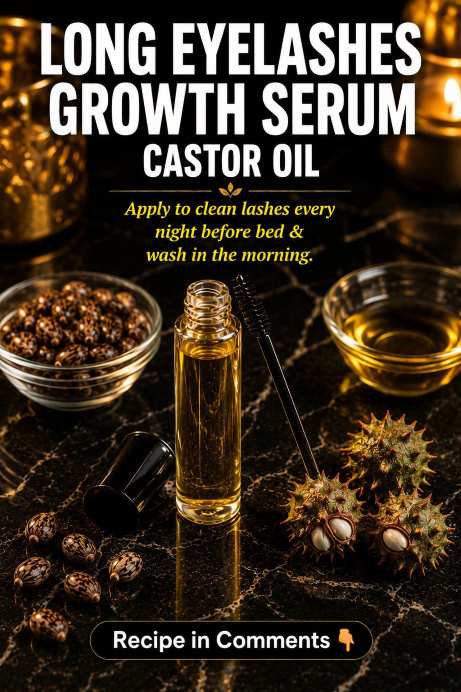
Long, healthy-looking eyelashes can make the eyes appear more defined, but lashes are delicate hairs with their own growth cycle. Repeated rubbing, aggressive makeup removal, waterproof mascara, lash curlers, extensions, and inflammation around the eyelids can contribute to breakage or apparent thinning. Natural oils are often promoted as rapid eyelash-growth treatments, especially castor oil, but the scientific evidence needs to be stated accurately: there is currently no strong clinical evidence that castor oil itself makes eyelashes grow longer or faster. A systematic review found weak evidence that castor oil improves hair quality and luster, but no strong evidence for hair growth. A newer dermatology review describes possible hair-related mechanisms but also concludes that further clinical research is needed. (PubMed)
That does not make natural lash care useless. Carefully chosen oils can condition the lash shaft, reduce dryness and friction, and potentially help existing lashes look healthier by reducing breakage. Because the eye area is particularly sensitive, the following remedies are deliberately gentle. They should be applied only to the lash hairs or external upper lash line, never inside the eye. Unlike the claim in the image, dramatic growth should not be expected in three days; true changes in lash length require weeks because they depend on the natural hair-growth cycle.
Remedy 1: For Normal Skin — Castor and Coconut Lash Conditioning Serum
Ingredients and Their Scientific Working
1 teaspoon cold-pressed castor oil: Castor oil contains predominantly ricinoleic acid and acts as an emollient. Its main realistic cosmetic benefit is coating and conditioning hair rather than proven stimulation of eyelash follicles. Interestingly, a randomized trial applying castor oil to eyelids in people with blepharitis reported improvements in several eyelid signs without adverse events during four weeks, although the trial was not designed to prove eyelash growth. (PubMed)
1 teaspoon virgin coconut oil: Coconut oil has a strong affinity for hair proteins and can penetrate the hair shaft. Research supports its usefulness for reducing hair damage, although studies have predominantly examined scalp hair rather than eyelashes. (PubMed)
1/2 teaspoon extra-virgin olive oil: Provides fatty acids that create a protective emollient coating.
1/4 teaspoon jojoba oil: A lightweight wax ester useful for conditioning without making the mixture excessively heavy.
1/4 teaspoon sunflower oil: Supplies linoleic acid and helps improve spreadability.
Procedure
Combine the oils in a thoroughly cleaned, dry glass container. At night, completely remove eye makeup and wash your hands. Place one tiny drop of the mixture on a clean disposable cotton swab and lightly coat the upper eyelashes from the middle toward the tips. Avoid saturating the roots and do not place oil on the waterline. Wash the external eye area gently the next morning.
How Often to Apply
Use once nightly for 3–5 days initially. If there is no redness, itching, swelling, or eye irritation, it can be continued several nights per week.
Initial Results
Within 1–3 days, lashes may appear smoother, darker and glossier because the oil coats the hair. Actual new lash growth cannot realistically occur in 1–3 days.
Remedy 2: For Combination Skin — Green Tea and Lightweight Lash Treatment
Ingredients and Their Scientific Working
1 tablespoon freshly brewed green tea: Green tea contains epigallocatechin-3-gallate (EGCG). Laboratory and human scalp-follicle research found that EGCG stimulated dermal papilla-cell proliferation and showed hair-growth-promoting activity. However, this evidence does not establish that green tea grows human eyelashes. (PubMed)
1/2 teaspoon castor oil: Conditions and lubricates the lash shaft.
1/2 teaspoon jojoba oil: Provides lightweight emollient conditioning.
1/4 teaspoon coconut oil: Helps protect hair fibers against damage.
1/4 teaspoon sunflower oil: Adds linoleic-acid-rich conditioning.
Because tea and oils separate and a homemade water-containing mixture can become contaminated, do not store this preparation.
Procedure
Brew plain green tea and allow it to cool completely. Take one tablespoon into a clean dish and mix in the oils immediately before use. Dip a clean cotton swab into the preparation, squeeze it almost dry, and gently wipe it over the lash hairs while keeping the eye closed. Discard everything left over.
How Often to Apply
Apply every other evening for 3–5 days. Stop immediately if it stings or causes redness.
Initial Results
The first few applications may leave lashes looking cleaner and more conditioned. Any claim that EGCG will visibly lengthen eyelashes within days would go beyond the available evidence.
Remedy 3: For Oily Skin — Minimal Castor-Jojoba Lash Serum
People with oily eyelid skin generally benefit from a lighter preparation rather than a thick layer of oil.
Ingredients and Their Scientific Working
1 teaspoon jojoba oil: Provides lightweight lubrication.
1/2 teaspoon castor oil: Coats and conditions the lash fibers.
1/2 teaspoon sunflower oil: Helps soften dry or brittle hair.
1/4 teaspoon coconut oil: Can penetrate hair fibers and may reduce structural damage.
1/4 teaspoon olive oil: Adds an occlusive fatty-acid layer that can reduce dryness.
The scientific rationale here is primarily hair-shaft protection, not follicle stimulation. This distinction matters because systematic-review evidence does not support castor oil as a proven hair-growth treatment. (PubMed)
Procedure
Mix everything in a sanitized dry container. After cleansing at night, use a fresh cotton swab to spread the smallest possible amount over the upper lash hairs. The lashes should look lightly coated, not dripping.
How Often to Apply
Use on alternate nights for the first five days. If well tolerated, continue 3–4 evenings per week.
Initial Results
Lashes can appear shinier and more defined after one or two uses. Reduced dryness may also make brittle lashes less prone to mechanical breakage.
Remedy 4: For Dry Skin — Rich Coconut-Castor Lash Conditioning Blend
Ingredients and Their Scientific Working
1 teaspoon virgin coconut oil: The most evidence-supported ingredient in this mixture for protecting the hair shaft. Coconut oil can penetrate hair and has clinical evidence for improving brittle-hair-related outcomes. (PubMed)
3/4 teaspoon castor oil: Provides a thick protective coating and shine.
1/2 teaspoon olive oil: Helps reduce dryness through its emollient fatty acids.
1/4 teaspoon jojoba oil: Improves spreadability and conditioning.
1/4 teaspoon sunflower oil: Provides additional lipid support.
Procedure
Mix the oils thoroughly. Clean the eye area and dry it completely. Apply a microscopic amount to the lashes with a clean disposable applicator. Do not rub the eyelids afterward and never pour or drop the oil directly into the eye.
How Often to Apply
Apply every night for 3–5 days to assess tolerance, then 3–5 nights weekly if comfortable.
Initial Results
Dry lashes may feel softer and look glossier within the first 1–3 days. Improvements from reduced breakage require longer and should not be confused with accelerated follicular growth.
Remedy 5: For Sensitive Skin — Ultra-Simple Diluted Castor Lash Oil
Sensitive eyelids are exactly where a long ingredient list is undesirable. Although many DIY recipes add essential oils, lemon juice, onion juice or fragrances, these should not be used near the eyes.
Ingredients and Their Scientific Working
1/2 teaspoon castor oil: Provides conditioning and lubrication.
1 teaspoon jojoba oil: Dilutes the heavier castor oil and gives a lighter consistency.
1/2 teaspoon sunflower oil: Provides additional emollient fatty acids.
1/4 teaspoon coconut oil: Helps condition the hair shaft.
1/4 teaspoon olive oil: Provides additional lubrication for dry lash fibers.
Castor oil is generally well tolerated, but allergic contact dermatitis has been reported, so “natural” does not automatically mean irritation-free. (PubMed)
Procedure
Patch-test the mixture on the inner arm first. If no reaction occurs, apply a very small amount to clean upper eyelashes using a disposable swab. Keep it away from the waterline, tear duct and inside of the eye.
How Often to Apply
Start every other night for 3–5 days. Discontinue immediately if itching, swelling, burning, excessive tearing or persistent redness occurs.
Initial Results
Expect conditioning, softness and shine rather than measurable lash growth during the first few days.
How Long Does Natural Eyelash Growth Actually Take?
This is important because many online remedies promise unrealistic results. The best-established eyelash-growth evidence comes from prescription bimatoprost, not castor oil. In clinical research, measurable improvements developed over weeks; one review reported an average 25% increase in lash length after 16 weeks of bimatoprost treatment. (PubMed Central (PMC))
Therefore, a natural oil should primarily be viewed as a lash-conditioning treatment. Give a gentle lash-care routine approximately 8–12 weeks before judging whether reduced breakage has improved overall appearance.
Final Tips for Naturally Healthier Eyelashes
Remove mascara gently instead of rubbing or pulling the lashes. Keep mascara wands, curlers and other eye tools clean, avoid sharing eye cosmetics, and take breaks from extensions or adhesives if they are damaging the natural lashes. Never add essential oils, lemon juice, garlic, onion juice or undiluted herbal extracts to an eyelash serum. Perform a patch test before using a new oil, and stop immediately if the eyelids become swollen, itchy or persistently red.
Visible softness and shine may appear within 2–3 days, but new lash growth and increased length should not be promised within that period. If eyelashes suddenly become sparse, fall out in patches, or the eyelid develops scaling, crusting or persistent inflammation, see a dermatologist or ophthalmologist rather than continuing home treatments. Eyelash loss can accompany inflammatory, dermatological and other medical conditions. (PubMed Central (PMC))
Diet Plan for Strong, Healthy Hair and Lashes
Nutrition cannot force healthy eyelash follicles to grow dramatically faster, but adequate nutrition supports normal hair production. Breakfast can include eggs or yogurt with oats and fruit; lunch can combine lentils, beans, chicken or fish with leafy vegetables and whole grains; an afternoon snack can include nuts, seeds and vitamin-C-rich fruit; and dinner can include another protein source with vegetables and whole grains.
Prioritize protein, iron, vitamin D, vitamin C and a varied diet rather than relying on “hair-growth” supplements. Research suggests correcting genuine nutritional deficiencies can matter for hair health, whereas routinely taking high-dose supplements without deficiency is not supported. (PubMed Central (PMC))
Biotin deserves particular caution. Despite its popularity for hair growth, recent reviews have found insufficient high-quality evidence that extra biotin improves hair growth in healthy people who are not deficient. (PubMed)
Continue a balanced diet consistently rather than following a short-term “lash diet.” If significant lash thinning continues for 8–12 weeks, worsens rapidly, occurs in patches, or is accompanied by eyebrow/scalp hair loss, consult a doctor, dermatologist or ophthalmologist.
References for the above remedy
- Phong C, Lee V, Yale K, et al. Coconut, Castor, and Argan Oil for Hair in Skin of Color Patients: A Systematic Review. Journal of Drugs in Dermatology, 2022.
https://pubmed.ncbi.nlm.nih.gov/35816075/ - Girdler K, Cabatu A, Olds H, Potts GA. Use of Castor Oil in Dermatology: A Narrative Review. Cureus, 2026.
https://pubmed.ncbi.nlm.nih.gov/41822610/ - Muntz A, et al. Randomized trial of topical periocular castor oil treatment for blepharitis.
https://pubmed.ncbi.nlm.nih.gov/32422285/ - Kwon OS, Han JH, Yoo HG, et al. Human hair growth enhancement in vitro by green tea epigallocatechin-3-gallate (EGCG). Phytomedicine.
https://pubmed.ncbi.nlm.nih.gov/17092697/ - Ruetsch SB, Kamath YK, Rele AS, Mohile RB. Penetration of coconut and mineral oils into human hair fibers. Journal of Cosmetic Science.
https://pubmed.ncbi.nlm.nih.gov/11413497/ - Patel DP, Swink SM, Castelo-Soccio L. A Review of the Use of Biotin for Hair Loss.
https://pubmed.ncbi.nlm.nih.gov/28879195/ - Jenkins BA, et al. Biotin for Hair Loss: Teasing Out the Evidence.
https://pubmed.ncbi.nlm.nih.gov/39148962/ - Almohanna HM, Ahmed AA, Tsatalis JP, Tosti A. The Role of Vitamins and Minerals in Hair Loss: A Review. Dermatology and Therapy.
https://pmc.ncbi.nlm.nih.gov/articles/PMC6380979/ - Law SK. Bimatoprost in the treatment of eyelash hypotrichosis. Clinical Ophthalmology.
https://pmc.ncbi.nlm.nih.gov/articles/PMC2861943/ - Patel BC, et al. The Eyelash Follicle: Features and Anomalies—A Review.
https://pmc.ncbi.nlm.nih.gov/articles/PMC6147748/