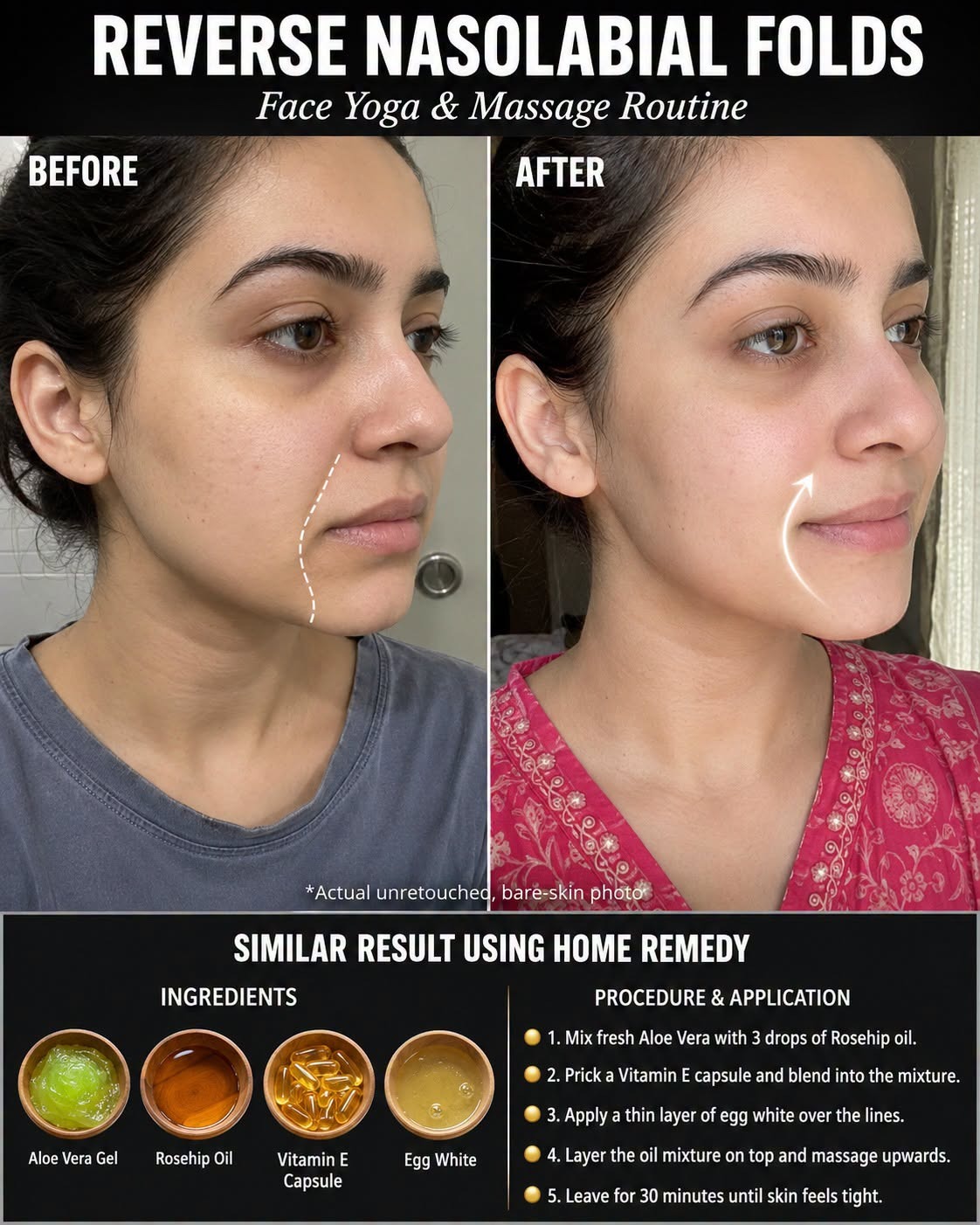
Nasolabial folds are the smile lines that run from the sides of the nose toward the corners of the mouth. They can look deeper because of age-related collagen loss, facial volume changes, dehydration, sun exposure, dryness, and repeated facial movement. Natural remedies cannot permanently “erase” deep folds in a few days, but the right skin-type-based home care can improve hydration, plump the surface, support the skin barrier, soften rough texture, and make the folds look less harsh. For best results, combine each remedy with gentle upward massage and simple face yoga, because pressure-free movement may help relax facial tension and improve the appearance of cheek fullness over time.
Simple Nasolabial Fold Massage to Use with Every Remedy
Before each remedy, wash your hands and face. Apply the remedy or a light layer of aloe gel so fingers glide smoothly. Place two fingers beside the nose, then glide upward toward the cheekbone and ear. Repeat 10 times on each side. Next, make a soft smile without squeezing the eyes, place fingertips on the cheek area, and gently lift upward for 5 seconds. Repeat 5 times. Never pull the skin downward.
Remedy 1: For Normal Skin
Scientific Working of Each Ingredient
Ingredients:
Aloe vera gel, 1 tablespoon: supports hydration and helps the skin feel calmer.
Rosehip oil, 3 drops: contains fatty acids that support softness and elasticity.
Cooled green tea, 1 teaspoon: provides antioxidant catechins that help defend against oxidative stress.
Raw honey, ½ teaspoon: works as a natural humectant to attract moisture.
Vegetable glycerin, 2 drops: binds water to the upper skin layer for a plumper look.
Vitamin E oil, 1 drop: supports the skin’s lipid layer with antioxidant protection.
Procedure: Mix aloe vera gel, green tea, honey, glycerin, rosehip oil, and vitamin E in a clean bowl. Apply a thin layer on the smile-line area and cheeks. Massage upward for 2 minutes using gentle strokes. Leave for 20 minutes, then rinse with cool water.
How Often to Apply: Use once daily for 5 days, preferably in the evening.
Initial Results: Within 1–3 days, normal skin may look fresher, smoother, and slightly more hydrated. The fold may appear softer because the skin surface is better moisturized.
Remedy 2: For Combination Skin
Scientific Working of Each Ingredient
Ingredients:
Aloe vera gel, 1 tablespoon: hydrates without feeling heavy.
Finely ground oat powder, 1 teaspoon: supports the skin barrier and soothes dry patches.
Cucumber juice, 1 teaspoon: gives light hydration and a cooling effect.
Green tea, 1 teaspoon: helps calm the oily T-zone with antioxidant support.
Jojoba oil, 2 drops: behaves like a light waxy oil and helps soften dry areas without excessive greasiness.
Honey, ¼ teaspoon: adds mild moisture where the skin feels tight.
Procedure: Mix all ingredients into a smooth paste. Apply more on the cheek and nasolabial fold area, and use a very thin layer on the nose and chin. Massage upward along the fold for 90 seconds. Keep it on for 15–18 minutes, then rinse.
How Often to Apply: Apply on alternate days for 5 days.
Initial Results: In 1–3 days, dry cheek areas may feel more comfortable while oily areas may look less dull and tired. The folds can appear less sharp when the cheeks are hydrated.
Remedy 3: For Oily Skin
Scientific Working of Each Ingredient
Ingredients:
Fresh aloe vera gel, 1 tablespoon: provides water-based hydration.
Cooled green tea, 2 teaspoons: antioxidant-rich and light for oily skin.
Colloidal oat or very fine oat powder, ½ teaspoon: soothes without clogging.
Cucumber juice, 1 teaspoon: refreshes and lightly hydrates.
Plain unsweetened yogurt, ½ teaspoon: contains lactic acid, which may gently smooth dull surface cells.
Vegetable glycerin, 1 drop: prevents dehydration that can make lines look deeper.
Procedure: Blend the ingredients into a thin mask. Apply only a light layer; oily skin does not need a thick coating. Massage upward from the corner of the mouth toward the cheekbone for 1–2 minutes. Leave for 10–12 minutes only, then rinse well.
How Often to Apply: Use every other day for 3–5 days.
Initial Results: Skin may look cleaner, smoother, and less flat within 1–3 days. The nasolabial area may look more even because surface roughness and dehydration are reduced.
Remedy 4: For Dry Skin
Scientific Working of Each Ingredient
Ingredients:
Aloe vera gel, 1 tablespoon: gives water-based hydration.
Colloidal oatmeal, 1 teaspoon: helps reduce dryness and supports barrier comfort.
Honey, ½ teaspoon: attracts and holds moisture.
Vegetable glycerin, 3 drops: helps reduce water loss from the skin surface.
Rosehip oil, 4 drops: supports softness with essential fatty acids.
Mashed ripe avocado, 1 teaspoon: adds natural lipids for a smoother feel.
Procedure: Mix into a creamy paste. Apply generously on the cheeks and smile lines. Massage very slowly upward for 2 minutes, then leave for 20 minutes. Rinse gently and apply a simple fragrance-free moisturizer if available.
How Often to Apply: Use daily for 5 days, then 3 times weekly.
Initial Results: Dry skin may feel less tight from the first use. In 2–3 days, the fold can look less creased because hydrated dry skin reflects light more evenly.
Remedy 5: For Sensitive Skin
Scientific Working of Each Ingredient
Ingredients:
Colloidal oatmeal, 1 teaspoon: one of the gentlest natural skin-soothing ingredients.
Aloe vera gel, 1 tablespoon: calming and hydrating for many skin types.
Chamomile tea, cooled, 1 teaspoon: traditionally used for soothing irritated skin.
Cucumber juice, 1 teaspoon: cooling and refreshing.
Vegetable glycerin, 1 drop: adds hydration without exfoliation.
Honey, ¼ teaspoon: mild humectant, but skip it if your skin reacts to honey.
Procedure: Mix into a soft gel-paste. Patch test behind the ear first. Apply a very thin layer on the smile-line and cheek area. Do not rub strongly. Use light upward tapping and gliding for only 60 seconds. Leave for 10 minutes and rinse with cool water.
How Often to Apply: Apply once every 2 days for 5 days.
Initial Results: Sensitive skin may look calmer and less dry within 1–3 days. The fold area can appear softer if irritation and dehydration are reduced.
Final Tips
Drink enough water, sleep 7–8 hours, clean towels and makeup tools regularly, avoid harsh scrubs, and use sunscreen during the day because sun damage breaks down collagen and makes folds look deeper. Always patch test every remedy for 24 hours before applying it to your face. Do not massage aggressively; pulling can worsen skin laxity. Visible freshness may begin in 2–3 days, but wrinkle softening and a healthier glow usually need consistent care for 4–8 weeks.
Diet Plan
Continue the home remedies for at least 4 weeks and follow this diet plan for 8–12 weeks. Morning: drink water and eat fruit rich in vitamin C, such as orange, guava, kiwi, or berries. Breakfast: take eggs, yogurt, oats, or lentils for protein. Lunch: include vegetables, beans, chicken, fish, or paneer with whole grains. Evening: drink green tea and eat nuts or seeds, especially walnuts, almonds, chia, or flaxseeds. Dinner: choose protein plus colorful vegetables. Reduce excess sugar, fried foods, and ultra-processed snacks because they may increase oxidative stress and affect collagen quality. If nasolabial folds appear suddenly, become very deep, come with facial weakness, swelling, pain, or the problem persists despite care, see a doctor or dermatologist.
References for the above remedy
- Alam M, et al. Association of Facial Exercise With the Appearance of Aging. JAMA Dermatology. URL: https://jamanetwork.com/journals/jamadermatology/fullarticle/2666801 (JAMA Network)
- Okuda I, et al. Objective analysis of the effectiveness of facial massage using a roller on facial skin blood flow. URL: https://pmc.ncbi.nlm.nih.gov/articles/PMC9907650/ (PMC)
- Cho S, et al. Dietary Aloe Vera Supplementation Improves Facial Wrinkles and Elasticity. URL: https://pmc.ncbi.nlm.nih.gov/articles/PMC2883372/ (PMC)
- Sobhan M, et al. The Efficacy of Colloidal Oatmeal Cream as Add-on Therapy in Dermatology. URL: https://pmc.ncbi.nlm.nih.gov/articles/PMC7103792/ (PMC)
- Oyetakin-White P, et al. Protective Mechanisms of Green Tea Polyphenols in Skin. URL: https://pmc.ncbi.nlm.nih.gov/articles/PMC3390139/ (PMC)
- Yaghoobi R, et al. Evidence for Clinical Use of Honey in Wound Healing as an Anti-bacterial, Anti-inflammatory, Anti-oxidant Agent. URL: https://pmc.ncbi.nlm.nih.gov/articles/PMC3941901/ (PMC)
- Fluhr JW, et al. Glycerol and the Skin: Holistic Approach to Its Origin and Functions. URL: https://pubmed.ncbi.nlm.nih.gov/18510666/ (PubMed)
- Keen MA, et al. Vitamin E in Dermatology. URL: https://pmc.ncbi.nlm.nih.gov/articles/PMC4976416/ (PMC)
- Oargă DP, et al. Rosehip Seed Oil and Skin Aging Mechanisms. URL: https://pmc.ncbi.nlm.nih.gov/articles/PMC11043540/ (PMC)
- Cao C, et al. Diet and Skin Aging: From the Perspective of Food Nutrition. URL: https://pmc.ncbi.nlm.nih.gov/articles/PMC7146365/ (PMC)