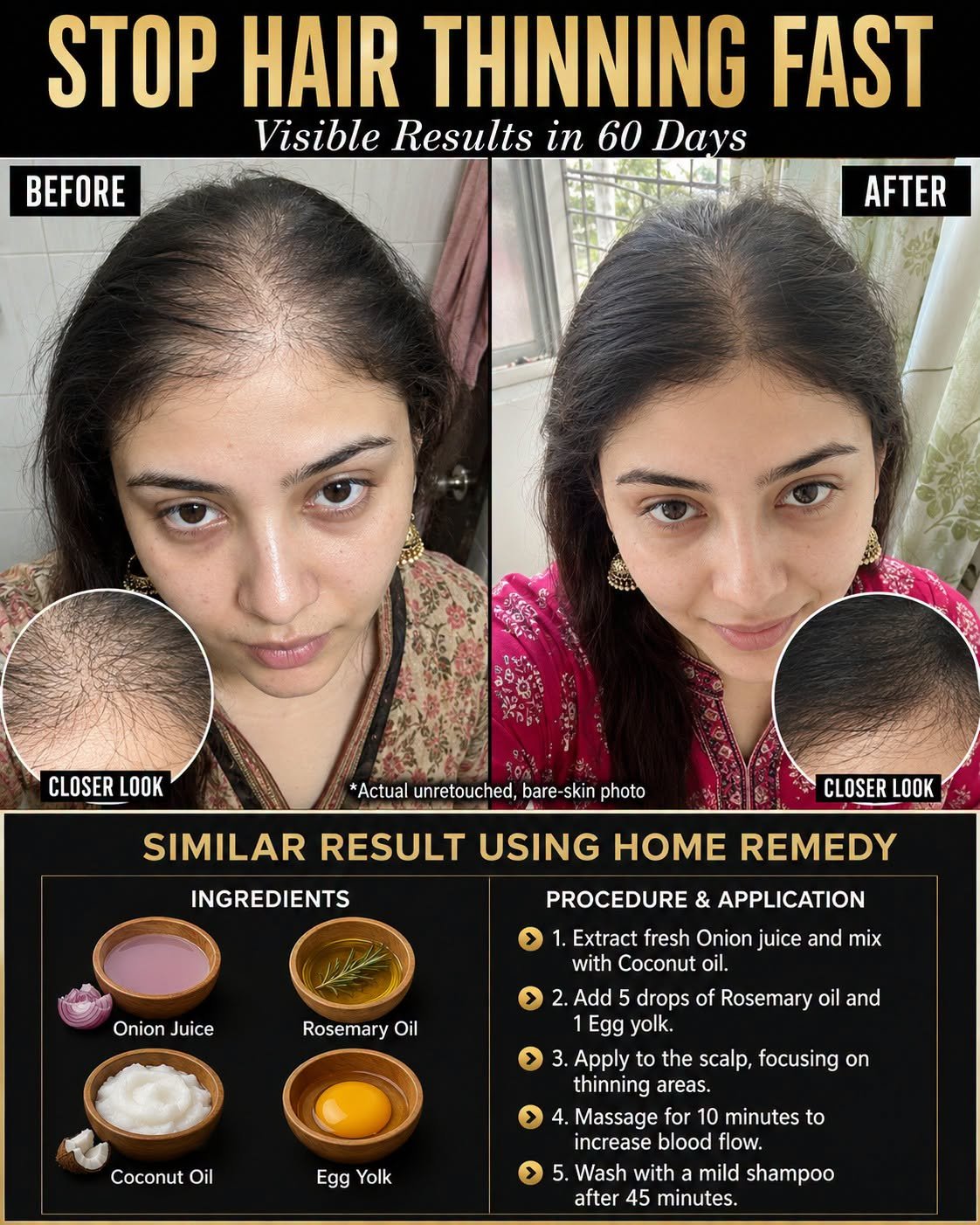
Hair thinning can affect confidence quickly because it changes the way the hairline, crown, and scalp look in photos and daily life. The image topic focuses on reducing visible thinning within 60 days using home care, but it is important to keep expectations realistic: natural remedies may help reduce breakage, improve scalp condition, support healthier-looking density, and in some cases support regrowth, but sudden or severe hair loss needs medical diagnosis. Hair thinning can happen due to stress, low iron or vitamin D, hormonal changes, dandruff, tight hairstyles, harsh chemical treatments, postpartum changes, thyroid issues, or genetic pattern hair loss. The remedies below are arranged by scalp type so the formula does not overload oily scalps, irritate sensitive scalps, or under-nourish dry scalps.
Remedy 1: For Normal Scalp and Normal Hair
Ingredients
Rosemary essential oil, 2 drops: Rosemary oil has human clinical research for androgenetic hair loss and may support microcirculation around follicles.
Pumpkin seed oil, 1 tablespoon: Rich in phytosterols and fatty acids; oral pumpkin seed oil has been studied for hair growth support, and topically it helps nourish the scalp barrier.
Fresh onion juice, 1 teaspoon: Onion juice contains sulfur compounds and has limited clinical evidence in patchy alopecia areata.
Aloe vera gel, 1 tablespoon: Soothes the scalp and reduces dryness or tightness after onion use.
Coconut oil, 1 teaspoon: Helps reduce hair protein loss and protects the hair shaft from breakage.
Green tea, 1 tablespoon brewed and cooled: Provides antioxidant polyphenols that may support follicle health.
Raw honey, ½ teaspoon: Helps calm dryness and flaking while keeping the mix comfortable on the scalp.
Scientific Working of the Ingredients
Rosemary oil is the main follicle-supporting ingredient because it may improve scalp circulation and reduce inflammatory stress around follicles. Onion juice supplies sulfur-containing compounds, which are linked with keratin support, though it can irritate sensitive skin. Coconut oil does not “grow” hair directly, but it reduces protein loss from the hair shaft, so hair looks thicker because less breakage occurs. Pumpkin seed oil adds fatty acids that soften the scalp. Aloe and honey reduce dryness, while green tea adds antioxidant support.
Procedure
Mix pumpkin seed oil and coconut oil in a small bowl. Add rosemary oil and stir well. Add onion juice, aloe gel, green tea, and honey. Part the hair and apply only to thinning areas and the scalp, not the full hair length. Massage gently for 5 minutes using fingertips. Leave for 35–40 minutes. Wash with a mild shampoo and rinse well.
How Often to Apply
Apply on alternate days for the first 5 days, then continue 2–3 times weekly for 8 weeks.
Initial Results
Within 1–3 days, the scalp may feel cleaner and hair may look less dry. In 2–3 weeks, breakage may reduce. Visible density changes usually need 8–12 weeks or longer.
Remedy 2: For Combination Scalp
Ingredients
Fresh onion juice, 1 tablespoon: Supports patchy thinning areas but should be diluted.
Aloe vera gel, 2 tablespoons: Balances the stronger onion juice and cools the scalp.
Jojoba oil, 1 teaspoon: Lightweight oil that suits oily roots and dry ends better than heavy oils.
Rosemary essential oil, 1 drop: Supports scalp stimulation without making the mixture too strong.
Rice water, 2 tablespoons: Adds a light coating effect that can make hair feel fuller.
Green tea, 2 tablespoons: Helps refresh oily areas and adds antioxidant support.
Raw honey, ½ teaspoon: Reduces roughness and supports scalp comfort.
Scientific Working of the Ingredients
Combination scalp needs balance. Onion juice is used in a diluted way so it targets thinning without making oily roots greasy. Aloe vera and green tea reduce heaviness and make the remedy lighter. Jojoba oil is used in a very small amount because it conditions without coating the scalp heavily. Rosemary oil is kept to one drop to reduce irritation risk. Rice water and honey improve the feel of the hair shaft, making hair look smoother and more manageable.
Procedure
Strain fresh onion juice through a clean cloth. Mix it with aloe gel, green tea, rice water, honey, and jojoba oil. Add only 1 drop of rosemary oil. Apply to the scalp using cotton or fingertips. Focus on the crown, part line, and temples. Keep the ends slightly oiled with leftover mixture only if they are dry. Leave for 25–30 minutes. Wash thoroughly.
How Often to Apply
Use every other day for 5 days, then twice weekly for 60 days.
Initial Results
In 1–3 days, oily roots may feel fresher and dry ends may feel softer. Hair fall caused by breakage may look slightly reduced after repeated use.
Remedy 3: For Oily Scalp
Ingredients
Strong green tea, ¼ cup cooled: Helps refresh the scalp and provides antioxidant polyphenols.
Black coffee infusion, 2 tablespoons cooled: Natural caffeine may support follicle activity and scalp stimulation.
Aloe vera gel, 1 tablespoon: Hydrates without adding oil.
Rosemary essential oil, 1 drop: Adds follicle-supporting activity in a low, diluted amount.
Fuller’s earth, 1 teaspoon: Absorbs extra oil from the scalp.
Raw honey, ½ teaspoon: Prevents the mask from becoming too drying.
Cucumber juice, 1 tablespoon: Cools the scalp and reduces greasy feel.
Scientific Working of the Ingredients
Oily scalp often looks thinner because oil separates hair strands and makes the scalp more visible. Green tea and coffee provide lightweight antioxidant and caffeine support without heavy oils. Aloe keeps the scalp hydrated, while fuller’s earth absorbs excess oil. Rosemary oil is used at a very low amount because oily scalps can still become irritated. Honey prevents over-drying, and cucumber juice gives a soothing cooling effect.
Procedure
Mix green tea, coffee infusion, cucumber juice, aloe gel, and honey. Add fuller’s earth slowly until the mixture becomes a thin paste. Add 1 drop rosemary oil and stir. Apply only to the scalp, especially oily thinning areas. Leave for 15–20 minutes only. Rinse well and shampoo lightly.
How Often to Apply
Apply 3 times in the first 5 days if the scalp is very oily, then 2 times weekly for 8 weeks.
Initial Results
Within 1–2 days, the scalp may look less greasy and hair may appear more lifted at the roots. This gives a quick fuller look, although true regrowth takes longer.
Remedy 4: For Dry Scalp and Brittle Hair
Ingredients
Coconut oil, 1 tablespoon: Reduces hair protein loss and protects brittle strands.
Olive oil, 1 teaspoon: Adds softness and reduces rough hair texture.
Egg yolk, 1 yolk: Provides lipids that condition dry hair; rinse with cool water only.
Aloe vera gel, 1 tablespoon: Hydrates the scalp and reduces tightness.
Raw honey, 1 teaspoon: Helps relieve dryness and flaking.
Rosemary essential oil, 2 drops: Supports scalp stimulation.
Yogurt, 1 tablespoon: Adds slip and mild scalp-conditioning comfort.
Scientific Working of the Ingredients
Dry scalp and brittle hair need protection first. Coconut oil is useful because it can penetrate the hair shaft and reduce protein loss, which helps prevent breakage. Egg yolk and olive oil make the hair feel smoother and more flexible. Honey and aloe reduce scalp dryness, while yogurt adds a softening base. Rosemary oil supports scalp circulation, but it must be diluted in oils and never applied directly.
Procedure
Whisk egg yolk and yogurt until smooth. Add coconut oil, olive oil, aloe gel, honey, and rosemary oil. Apply to the scalp and thinning areas, then lightly smooth through the hair length. Cover with a shower cap. Leave for 30 minutes. Rinse first with cool water, then shampoo gently.
How Often to Apply
Use twice in the first 5 days, then twice weekly for 60 days.
Initial Results
In 1–3 days, hair may feel softer, less rough, and less frizzy. Reduced breakage can make hair look fuller within a few weeks.
Remedy 5: For Sensitive Scalp
Ingredients
Pure aloe vera gel, 2 tablespoons: Calms the scalp and provides light hydration.
Oat water, 2 tablespoons: Gentle soothing liquid for irritation-prone scalp.
Coconut oil, ½ teaspoon: Small amount to protect hair shafts without heaviness.
Raw honey, ½ teaspoon: Helps calm flaking and dryness.
Green tea, 2 tablespoons cooled: Mild antioxidant scalp support.
Pumpkin seed oil, ½ teaspoon: Softens scalp without strong fragrance.
Rose water, 1 tablespoon: Adds gentle freshness if tolerated.
Scientific Working of the Ingredients
Sensitive scalp should avoid strong onion juice and essential oils at first. Aloe vera, oat water, honey, and green tea are gentler choices for calming dryness and irritation. Coconut oil is used in a very small quantity to reduce hair shaft damage. Pumpkin seed oil provides lightweight nourishment. Rose water is optional and should be skipped if fragrance causes itching.
Procedure
Mix aloe gel, oat water, green tea, honey, coconut oil, pumpkin seed oil, and rose water. Apply a small amount behind the ear first and wait 24 hours. If there is no itching, apply to the scalp for 20 minutes. Rinse with cool water and mild shampoo.
How Often to Apply
Apply every other day for 3–5 days, then 2 times weekly for 8 weeks.
Initial Results
Within 1–3 days, the scalp may feel calmer and less tight. Hair may look smoother because breakage and dryness are reduced.
Final Tips
Always do a patch test before using onion juice, essential oils, honey, or any new natural ingredient. Never apply rosemary essential oil directly to the scalp without dilution. Avoid tight hairstyles, harsh brushing, excessive heat styling, and frequent chemical treatments during the 60-day routine. Use a clean towel, clean comb, and clean pillowcase to reduce scalp irritation. Massage gently; hard rubbing can worsen shedding. Drink enough water, sleep 7–8 hours, and manage stress because stress-related shedding can be significant. Visible improvement may begin in 2–3 days as reduced oiliness, softer hair, and less breakage, while meaningful hair density improvement usually needs at least 8–12 weeks.
Diet Plan for Hair Thinning
Continue this diet plan for at least 60 days along with the scalp remedy.
Breakfast: 1 boiled egg or Greek yogurt, 1 bowl oats, and a handful of nuts or seeds.
Mid-morning: 1 fruit such as orange, guava, berries, or apple.
Lunch: Lentils, beans, chicken, fish, or paneer with whole wheat roti or brown rice, plus spinach or mixed vegetables.
Evening snack: Roasted chickpeas, walnuts, pumpkin seeds, or a smoothie with yogurt and banana.
Dinner: Protein source such as fish, eggs, lentils, tofu, or chicken with vegetables and whole grains.
Hydration: 8–10 glasses of water daily.
Nutrients to focus on: Protein, iron, zinc, vitamin D, omega-3 fats, vitamin C, and B vitamins. Avoid crash dieting because low-calorie diets and nutrient deficiencies can worsen shedding.
If hair thinning is sudden, patchy, painful, itchy, associated with scalp redness, or continues after 6–8 weeks of consistent care, see a dermatologist or doctor. Also seek medical advice if you have heavy periods, thyroid symptoms, postpartum shedding, unexplained weight loss, or family history of pattern hair loss.
References for the above remedy
- Panahi Y, et al. “Rosemary oil vs minoxidil 2% for the treatment of androgenetic alopecia.” PubMed. URL: https://pubmed.ncbi.nlm.nih.gov/25842469/ (PubMed)
- Sharquie KE, Al-Obaidi HK. “Onion juice, a new topical treatment for alopecia areata.” PubMed. URL: https://pubmed.ncbi.nlm.nih.gov/12126069/ (PubMed)
- Rele AS, Mohile RB. “Effect of mineral oil, sunflower oil, and coconut oil on prevention of hair damage.” PubMed. URL: https://pubmed.ncbi.nlm.nih.gov/12715094/ (PubMed)
- Cho YH, et al. “Effect of pumpkin seed oil on hair growth in men with androgenetic alopecia.” PMC. URL: https://pmc.ncbi.nlm.nih.gov/articles/PMC4017725/ (PMC)
- Dhurat R, et al. “Caffeine-based topical liquid compared with minoxidil in men with androgenetic alopecia.” PMC. URL: https://pmc.ncbi.nlm.nih.gov/articles/PMC5804833/ (PMC)
- Al-Waili NS. “Therapeutic and prophylactic effects of crude honey on chronic seborrheic dermatitis and dandruff.” PubMed. URL: https://pubmed.ncbi.nlm.nih.gov/11485891/ (PubMed)
- Guo EL, Katta R. “Diet and hair loss: effects of nutrient deficiency and supplement use.” PMC. URL: https://pmc.ncbi.nlm.nih.gov/articles/PMC5315033/ (PMC)
- Almohanna HM, et al. “The role of vitamins and minerals in hair loss: a review.” PMC. URL: https://pmc.ncbi.nlm.nih.gov/articles/PMC6380979/ (PMC)
- American Academy of Dermatology. “Hair loss: Diagnosis and treatment.” URL: https://www.aad.org/public/diseases/hair-loss/treatment/diagnosis-treat (aad.org)