
Dark lips can happen because of dryness, sun exposure, lip licking, smoking, irritation from harsh lip products, post-inflammatory pigmentation, certain medicines, or internal issues such as vitamin deficiencies or hormonal disorders. A natural night routine can help when the darkness is linked with dryness, irritation, dull dead skin, and mild pigmentation, but it cannot permanently change genetic lip color or replace dermatology treatments. The safest approach is to repair the lip barrier first, then use gentle pigment-supporting ingredients such as licorice, aloe vera, soy, mulberry, honey, oatmeal, and skin-friendly plant oils. Persistent, one-sided, rapidly spreading, painful, bleeding, or very dark spots on the lips should be checked by a dermatologist or doctor. (PubMed)
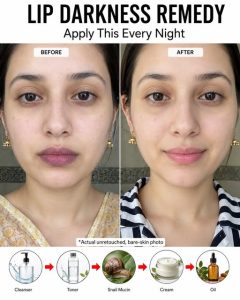
Remedy 1: For Normal Skin
Soy, Licorice, Aloe, Honey, Oat, and Sunflower Night Lip Mask
Ingredients:
- 1 teaspoon unsweetened soy milk: supports a brighter look because soy compounds are studied for reducing visible hyperpigmentation.
- ¼ teaspoon licorice root powder or 1 teaspoon strong licorice tea: contains glabridin, which helps reduce tyrosinase activity involved in melanin formation.
- ½ teaspoon fresh aloe vera gel: contains aloesin and adds water-based hydration.
- ¼ teaspoon raw honey: helps hold moisture and supports a smoother lip surface.
- ¼ teaspoon colloidal oat powder: calms roughness and supports the skin barrier.
- 2 drops sunflower seed oil: seals moisture without feeling too heavy.
Scientific Working of This Remedy
This remedy works by combining pigment support with moisture repair. Licorice and soy target uneven tone, aloe hydrates and supports recovery, honey works as a natural humectant, oatmeal reduces irritation, and sunflower oil helps reduce water loss from the lip surface. These actions can make lips look softer, clearer, and less dull over several nights. (PMC)
Procedure:
- Mix soy milk, licorice, aloe, honey, and oat powder into a smooth paste.
- Apply a thin layer on clean lips at night.
- Keep it on for 8–10 minutes.
- Wipe with a damp cotton pad.
- Tap 2 drops of sunflower oil over the lips to seal hydration.
How Often to Apply: Apply every night for 5 days, then continue 3 nights per week.
Initial Results: In 1–3 days, lips may feel smoother, less dry, and slightly more even because dehydration and surface roughness are reduced.
Remedy 2: For Combination Skin
Mulberry, Soy, Aloe, Honey, Oat, and Jojoba Balancing Lip Pack
Ingredients:
- ¼ teaspoon mulberry powder or a few drops of mulberry extract mixed in water: studied for melasma and uneven pigmentation support.
- 1 teaspoon unsweetened soy milk: helps support a more even tone.
- ½ teaspoon aloe vera gel: hydrates without greasiness.
- ¼ teaspoon raw honey: softens dry patches.
- ¼ teaspoon fine oat powder: reduces irritation around the lip border.
- 1 drop jojoba oil: lightweight sealing oil for lips that get dry but also feel oily around the mouth.
Scientific Working of This Remedy
Combination skin needs balance. Mulberry and soy help with tone-evening pathways, aloe and honey provide hydration, oat powder supports the barrier, and jojoba oil gives a light seal without the heavy feel of thick oils. This is useful when the center of the lips feels dry but the area around the mouth becomes oily or congested. (PubMed)
Procedure:
- Mix mulberry, soy milk, aloe, honey, and oat powder.
- Apply only a thin layer on the lips and lip border.
- Leave for 7–8 minutes.
- Rinse gently with cool water.
- Apply 1 drop jojoba oil before sleeping.
How Often to Apply: Use nightly for 3–5 days, then alternate nights for 2 weeks.
Initial Results: Lips may look less patchy within 2–3 days. Dry flakes can reduce, and the lip border may appear cleaner and calmer.
Remedy 3: For Oily Skin
Licorice, Aloe, Oat, Soy, Honey, and Green Tea Light Gel
Ingredients:
- 1 teaspoon cooled green tea: provides antioxidant support against environmental dullness.
- ½ teaspoon aloe vera gel: hydrates without heaviness.
- ¼ teaspoon licorice tea or a tiny pinch of licorice powder: supports pigmentation control.
- ½ teaspoon soy milk: helps improve the look of uneven tone.
- ¼ teaspoon colloidal oat powder: absorbs slight stickiness and calms irritation.
- ⅛ teaspoon raw honey: gives light moisture without needing a thick balm.
Scientific Working of This Remedy
Oily skin often gets irritated by heavy balms, so this formula stays light. Aloe and green tea provide a fresh gel base, licorice and soy support a brighter-looking tone, oat powder comforts the delicate lip skin, and a tiny amount of honey prevents tightness. The aim is not to scrub the lips but to reduce dullness while keeping the barrier comfortable. (PubMed)
Procedure:
- Mix all ingredients into a thin gel.
- Apply on clean lips at night.
- Leave for 6–8 minutes only.
- Rinse with cool water.
- Do not apply thick oil afterward; use only a tiny drop of sunflower or jojoba oil if lips feel dry.
How Often to Apply: Apply every night for 3 days, then every other night for 10 days.
Initial Results: In 1–3 days, lips may feel cleaner, smoother, and less sticky, with reduced dullness caused by dryness and buildup.
Remedy 4: For Dry Skin
Coconut, Honey, Oat, Licorice, Soy, and Beeswax Comfort Balm
Ingredients:
- ½ teaspoon virgin coconut oil: helps improve moisture and barrier comfort.
- ¼ teaspoon raw honey: attracts and holds water on the lip surface.
- ¼ teaspoon colloidal oatmeal: reduces roughness and tightness.
- 1 teaspoon strong licorice tea: supports uneven pigmentation care.
- ½ teaspoon soy milk: helps improve the look of dull tone.
- A rice-grain-sized amount of beeswax: seals the remedy like a natural protective layer.
Scientific Working of This Remedy
Dry lips look darker because cracks, flakes, and dehydration create shadows. Coconut oil and beeswax help seal moisture, honey draws water into the surface, oatmeal calms the barrier, while licorice and soy support a more even-looking tone. This is best for lips that feel tight, flaky, or rough at night. (PubMed)
Procedure:
- Warm coconut oil and beeswax slightly until soft, not hot.
- Mix in honey, oat powder, licorice tea, and soy milk.
- Apply a very thin coat to the lips.
- Leave for 10 minutes, then gently wipe off excess.
- Apply a tiny layer of plain coconut oil before sleeping.
How Often to Apply: Use nightly for 5 days, then 3 times weekly.
Initial Results: In 1–2 days, dry lines may look softer, lips may feel more elastic, and dark areas caused by cracking may appear less obvious.
Remedy 5: For Sensitive Skin
Oat, Aloe, Soy, Honey, Sunflower Oil, and Diluted Licorice Soothing Compress
Ingredients:
- 1 teaspoon colloidal oat water: supports irritated and sensitive skin.
- ½ teaspoon aloe vera gel: gives cooling hydration.
- ½ teaspoon soy milk: supports gentle tone-evening.
- ⅛ teaspoon honey: softens without strong exfoliation.
- 1 drop sunflower seed oil: seals moisture lightly.
- ½ teaspoon very diluted licorice tea: supports pigmentation without harsh acids.
Scientific Working of This Remedy
Sensitive lips darken easily after irritation, burning, licking, or over-exfoliation. This remedy avoids lemon, baking soda, toothpaste, salt, cinnamon, and strong essential oils. Oatmeal and aloe calm the barrier, honey and sunflower oil reduce dryness, while diluted licorice and soy gently support uneven tone without aggressive peeling. (PubMed)
Procedure:
- Mix oat water, aloe, soy milk, honey, and diluted licorice tea.
- Apply with clean fingers or cotton.
- Leave for only 5–7 minutes.
- Rinse with cool water.
- Seal with 1 drop sunflower oil.
How Often to Apply: Apply once daily for 3 days. If no stinging occurs, continue every other night.
Initial Results: Within 1–3 days, lips may feel calmer, less tight, and less irritated. Brightening is gradual and usually needs several weeks.
Final Tips
Use these remedies only on intact lips, not on bleeding cracks, active cold sores, infected corners, or painful swelling. Always do a patch test near the jawline or behind the ear before applying any mixture to the lips. Avoid licking, biting, and picking because saliva and friction can worsen dryness and irritation. During the day, use a gentle lip balm with SPF 30 or higher before going outdoors, because sun exposure can darken and dry the lips further. (American Academy of Dermatology)
Visible softness can begin in 2–3 days, but true improvement in lip darkness usually needs 4–8 weeks of consistent care, sun protection, hydration, and avoiding irritants. If lip darkness keeps increasing, appears as a single dark patch, spreads to gums, bleeds, hurts, or does not improve after 6–8 weeks, see a doctor or dermatologist.
Diet Plan
Continue this diet plan for 6–8 weeks along with the home remedy. In the morning, drink water and eat a vitamin C-rich fruit such as guava, orange, kiwi, strawberries, or amla. Add protein through eggs, yogurt, lentils, chickpeas, fish, or tofu because skin repair needs amino acids. At lunch, include leafy greens, beans, whole grains, and healthy fats from nuts, seeds, or olive oil. In the evening, avoid smoking, excess tea or coffee, and sugary drinks because dehydration and irritation can make lips appear darker. At dinner, choose a light meal with vegetables, protein, and a source of B vitamins such as dairy, eggs, fish, beans, or fortified foods.
Vitamin C supports normal collagen production and antioxidant protection, while vitamin B12 deficiency can sometimes show skin and mucosal pigmentation changes. If you are vegetarian, have fatigue, mouth ulcers, numbness, dizziness, or darkening of lips and gums together, ask a doctor about checking B12, iron, and general health markers. (PMC)
References for the above remedy
- American Academy of Dermatology Association. “7 Dermatologists’ Tips for Healing Dry, Chapped Lips.”
URL: https://www.aad.org/public/everyday-care/skin-care-basics/dry/heal-dry-chapped-lips - PubMed. “Approaches to the Evaluation of Lip Hyperpigmentation.”
URL: https://pubmed.ncbi.nlm.nih.gov/22715817/ - Hollinger J. C. et al. “Are Natural Ingredients Effective in the Management of Hyperpigmentation? A Systematic Review.”
URL: https://pmc.ncbi.nlm.nih.gov/articles/PMC5843359/ - Yokota T. et al. “The Inhibitory Effect of Glabridin from Licorice Extracts on Melanogenesis and Inflammation.”
URL: https://pubmed.ncbi.nlm.nih.gov/9870547/ - Choi S. et al. “Aloesin Inhibits Hyperpigmentation Induced by UV Radiation.”
URL: https://pubmed.ncbi.nlm.nih.gov/12372097/ - Alvin G. et al. “A Comparative Study of the Safety and Efficacy of 75% Mulberry Extract Oil as a Treatment for Melasma.”
URL: https://pubmed.ncbi.nlm.nih.gov/22052272/ - Natarelli N. et al. “Clinical Efficacy of Topical or Oral Soy Supplementation in Dermatology.”
URL: https://pmc.ncbi.nlm.nih.gov/articles/PMC10299547/ - Reynertson K. A. et al. “Anti-inflammatory Activities of Colloidal Oatmeal Contribute to the Effectiveness of Oats in Treatment of Dry, Irritated Skin.”
URL: https://pubmed.ncbi.nlm.nih.gov/25607907/ - Lin T. K. et al. “Anti-Inflammatory and Skin Barrier Repair Effects of Topical Application of Some Plant Oils.”
URL: https://pmc.ncbi.nlm.nih.gov/articles/PMC5796020/ - Pullar J. M. et al. “The Roles of Vitamin C in Skin Health.”
URL: https://pmc.ncbi.nlm.nih.gov/articles/PMC5579659/