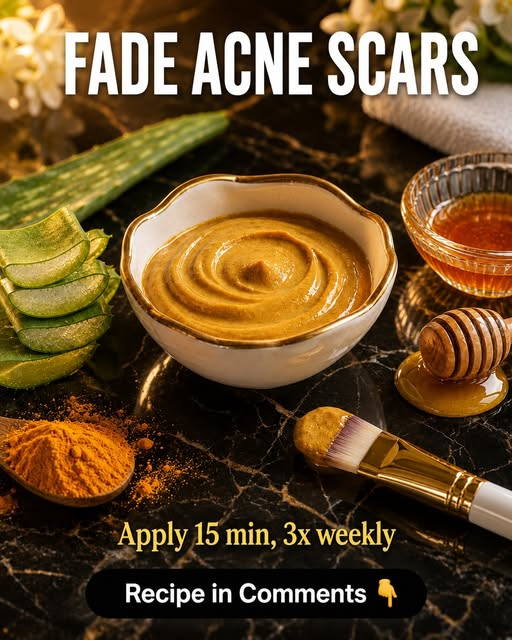
Dark marks left after acne can make the complexion look uneven and may continue affecting confidence even after breakouts have stopped. However, a flat brown, red, purple or grey mark is usually post-inflammatory discoloration rather than a permanent acne scar. True scars change the skin’s texture and may appear as pits, depressions or raised tissue. Natural care may gradually support the fading of flat marks, calm inflammation and prevent new spots, but it cannot rebuild deep scar tissue. (American Academy of Dermatology)
Scientific studies generally investigate standardized botanical extracts or properly formulated preparations—not homemade mixtures. Therefore, the remedies below should be considered gentle, evidence-informed supportive care rather than clinically proven cures. Patch-test every mixture, use clean utensils and continue daily sun protection.
Remedy 1: Aloe, Soy and Rosehip Mask for Normal Skin
Ingredients
Unsweetened soy milk: 2 teaspoons, to provide soy proteins associated with more even-looking pigmentation.
Pure inner-leaf aloe vera gel: 1 teaspoon, for lightweight hydration and soothing care.
Cooled green tea: 1 teaspoon, to supply antioxidant polyphenols.
Finely ground rice flour: 1 teaspoon, to thicken the mask and absorb mild surface oil without harsh scrubbing.
Licorice-root powder: 1/8 teaspoon, as a source of pigmentation-supporting botanical compounds.
Cold-pressed rosehip-seed oil: 2 drops, to provide essential fatty acids that support skin conditioning.
How These Ingredients Work Scientifically
Clinical research on formulated soy preparations suggests that soy-derived serine-protease inhibitors may reduce the transfer of melanin-containing particles into surface skin cells. Aloe contains aloesin, a compound studied for its ability to suppress tyrosinase activity involved in pigmentation. Green-tea polyphenols have anti-inflammatory and antioxidant properties, while topical green-tea extracts may also help control acne and reduce the development of fresh marks. (PubMed)
Licorice contains compounds such as glabridin and liquiritin that have been investigated for uneven pigmentation. Rosehip oil has limited but promising evidence for supporting wound and scar appearance; the evidence concerns formulated topical preparations and postsurgical scars rather than deep acne scars. (PubMed)
Procedure
Stir the soy milk, aloe and green tea together. Add the rice flour and licorice powder, mixing until smooth. Finish with two drops of rosehip oil. Apply a thin layer to clean skin without rubbing. Leave it on for eight to ten minutes, soften it with water and rinse gently.
How Often to Apply
Apply on days one, three and five. Continue twice weekly for eight weeks if no irritation develops.
Initial Results
The skin may feel softer and look more hydrated within one to three days. Flat dark marks normally require several weeks of consistent care before measurable fading becomes visible.
Remedy 2: Centella and Cucumber Balancing Mask for Combination Skin
Ingredients
Fresh cucumber purée: 1 tablespoon, for cooling water-based hydration.
Pure aloe vera gel: 1 teaspoon, to hydrate dry zones without adding heaviness.
Finely powdered Centella asiatica: 1/4 teaspoon, for compounds associated with skin repair.
Colloidal oatmeal: 1 teaspoon, to protect dry or irritated areas.
Kaolin clay: 1/2 teaspoon, to absorb excess surface oil from the T-zone.
Honey: 1/2 teaspoon, to provide humectant moisture and prevent excessive tightness.
How These Ingredients Work Scientifically
Centella asiatica contains triterpenes, including asiaticoside and madecassoside, which have been studied for their influence on collagen formation, inflammation and wound healing. A controlled trial found benefits from a formulated Centella cream in scar prevention, although fresh or powdered Centella cannot be assumed to produce the same concentration or results. (PMC)
Colloidal oatmeal contains avenanthramides with antioxidant and anti-inflammatory activity. Clinical studies show that properly prepared colloidal oatmeal can improve dryness, moisturization and barrier function. Cucumber and aloe provide a light base, while a small amount of kaolin helps manage shine without placing clay over the entire face. (PubMed)
Procedure
Combine cucumber, aloe, Centella, oatmeal and honey. Divide the mixture into two portions. Add kaolin only to the portion intended for the forehead, nose and chin. Use the clay-free portion on the cheeks. Leave both on for seven minutes and rinse without massaging.
How Often to Apply
Use three times over five days, with a rest day between applications. Continue once or twice weekly for six to eight weeks.
Initial Results
The T-zone may look less shiny and the cheeks may feel calmer within one to three days. Pigmentation should be evaluated after at least six to eight weeks.
Remedy 3: Green Tea and Licorice Clarifying Pack for Oily Skin
Ingredients
Strongly brewed and cooled green tea: 2 teaspoons, for antioxidant and acne-supporting polyphenols.
Kaolin clay: 1 teaspoon, to absorb excess surface oil.
Pure aloe vera gel: 1 teaspoon, to prevent excessive dryness.
Colloidal oatmeal: 1/2 teaspoon, to support the protective barrier.
Licorice-root powder: 1/8 teaspoon, for botanical pigmentation support.
Honey: 1/2 teaspoon, to improve spreadability and moisture retention.
How These Ingredients Work Scientifically
A systematic review and meta-analysis found that topical green-tea extracts may reduce inflammatory and non-inflammatory acne lesions without causing significant adverse effects. Fewer breakouts mean fewer opportunities for new dark marks to develop. However, ordinary brewed tea is much weaker and less standardized than the extracts used in research. (PubMed)
Licorice has shown promise as a natural depigmenting ingredient because some of its compounds can affect melanin production and distribution. Aloe and oatmeal reduce the drying effect of clay, helping prevent irritation that could otherwise worsen post-inflammatory pigmentation. Reviews emphasize that evidence for many natural pigmentation ingredients remains limited and varies according to concentration and formulation. (PMC)
Procedure
Mix the green tea and clay until lump-free. Stir in the aloe, oatmeal, licorice and honey. Apply a thin layer only over oily areas and healed marks. Do not place it over open, bleeding or freshly picked pimples. Rinse after five to seven minutes, before the clay becomes completely dry and cracked.
How Often to Apply
Apply on days one, three and five. Thereafter, use no more than twice weekly for eight weeks.
Initial Results
Surface oil and temporary redness may look reduced after several applications. Existing dark marks will not disappear within three days and should fade gradually.
Remedy 4: Avocado and Rosehip Recovery Mask for Dry Skin
Ingredients
Ripe avocado: 1 tablespoon, mashed until completely smooth.
Pure aloe vera gel: 1 teaspoon, to provide water-based hydration.
Colloidal oatmeal: 1 teaspoon, to calm dryness and strengthen the barrier.
Honey: 1/2 teaspoon, to help hold water in the skin.
Rosehip-seed oil: 3 drops, for skin-conditioning fatty acids.
Pure sunflower-seed oil: 3 drops, to reduce moisture loss and support barrier integrity.
How These Ingredients Work Scientifically
Dry or damaged skin is more vulnerable to irritation, and repeated inflammation may make discoloration appear darker. Sunflower-seed oil is rich in linoleic acid and has been shown to preserve stratum-corneum integrity and improve hydration without causing the barrier disruption observed with some other plant oils. (PubMed)
Rosehip oil contains fatty acids and antioxidant compounds that may support wound repair, although high-quality human evidence remains limited. Avocado and honey mainly act as conditioning ingredients, while aloe and oatmeal add hydration and soothing support. This mask may improve the appearance of dryness but cannot fill pitted scars.
Procedure
Mash the avocado until no pieces remain. Blend in the aloe, oatmeal and honey. Add the rosehip and sunflower oils last. Apply a thin layer to clean, slightly damp skin. Leave it on for ten minutes and rinse with lukewarm water.
How Often to Apply
Apply three times during the first five days. Continue twice weekly for eight to twelve weeks if it does not trigger blocked pores.
Initial Results
Dryness and tightness may improve within one to three days. Better hydration can temporarily make the skin appear smoother, but pigment fading takes longer.
Remedy 5: Oat, Cucumber and Centella Compress for Sensitive Skin
Ingredients
Colloidal oatmeal: 1 tablespoon, for barrier-protective and soothing effects.
Fresh cucumber juice: 2 teaspoons, for cooling hydration.
Boiled and fully cooled water: 1 teaspoon, to dilute the mixture.
Pure aloe vera gel: 1 teaspoon, for a gentle water-rich base.
Centella asiatica powder: 1/8 teaspoon, for low-dose botanical support.
Sunflower-seed oil: 2 drops, to reduce water loss.
How These Ingredients Work Scientifically
Sensitive skin requires the simplest and least aggressive approach. Oatmeal supports skin-barrier recovery and can reduce irritation, while sunflower oil improves hydration. Aloe and Centella contain potentially helpful compounds, but both can occasionally cause allergic contact reactions. For this reason, the first application must be tested on a small area and kept brief. (PubMed)
Procedure
Combine the ingredients and place the mixture inside clean, soft cotton gauze. Rest the compress over healed marks for three to five minutes. Do not rub or exfoliate. Remove it, rinse with cool-to-lukewarm water and pat the skin dry.
How Often to Apply
Patch-test first and wait 48 hours. When no reaction appears, use on days one, three and five. Continue once weekly.
Initial Results
The face may feel calmer and less tight within two or three days. Stop using it immediately if burning, swelling, itching or persistent redness occurs.
Final Tips
Use broad-spectrum sunscreen with SPF 30 or higher every morning because ultraviolet and visible light can keep post-acne marks darker. Tinted sunscreen containing iron oxide may provide additional protection against visible-light-induced pigmentation, particularly in deeper skin tones. (American Academy of Dermatology)
Avoid squeezing pimples and do not use lemon juice, toothpaste, baking soda, undiluted vinegar, cinnamon or rough scrubs. Keep brushes, towels and mixing bowls clean, prepare a fresh mask each time and never store water-based homemade mixtures.
Drink adequate water, sleep seven to nine hours and continue a gentle routine. Hydration and glow may improve within two to three days. With continued care, dehydration lines may look softer, but natural masks do not permanently reduce wrinkles or reconstruct depressed acne scars.
Diet Plan for Acne-Prone Skin
Breakfast may include unsweetened oatmeal with seeds, eggs with wholegrain bread, or a chickpea-flour pancake with vegetables. At lunch, choose lentils, beans, fish or chicken with salad, vegetables and wholegrain roti or brown rice. Dinner may include vegetable soup, grilled fish, tofu, beans or chicken. Suitable snacks include whole fruit, cucumber, nuts and roasted chickpeas.
Limit sugary drinks, sweets, refined flour, frequent fried foods and heavily sweetened tea. Research suggests that high-glycaemic diets can modestly worsen acne in some people, while evidence regarding dairy is mixed and varies between individuals. A low-glycaemic eating pattern has improved acne in some clinical trials, but it should support rather than replace medical treatment. (PubMed)
Continue the suitable home remedy and diet plan for eight to twelve weeks. See a dermatologist if painful acne persists after six to eight weeks, new scars continue forming, pigmentation worsens, or the scars are deep, pitted, raised, painful or itchy. Such scars commonly require professional procedures rather than home care.
References for the above remedy
- American Academy of Dermatology. Acne scars: Overview.
https://www.aad.org/public/diseases/acne/derm-treat/scars - American Academy of Dermatology. How to fade dark spots in darker skin tones.
https://www.aad.org/public/everyday-care/skin-care-secrets/routine/fade-dark-spots - Hollinger JC, Angra K, Halder RM. Are Natural Ingredients Effective in the Management of Hyperpigmentation?
https://pubmed.ncbi.nlm.nih.gov/29552273/ - Choi S, et al. Aloesin inhibits hyperpigmentation induced by UV radiation.
https://pubmed.ncbi.nlm.nih.gov/12372097/ - Leyden J, et al. The mechanism of action and clinical benefits of soy for the treatment of hyperpigmentation.
https://pubmed.ncbi.nlm.nih.gov/21332714/ - Kim S, et al. The effects of green tea on acne vulgaris: A systematic review and meta-analysis.
https://pubmed.ncbi.nlm.nih.gov/32812270/ - Capone K, et al. Effects of colloidal oatmeal topical treatment on skin barrier function.
https://pubmed.ncbi.nlm.nih.gov/32484623/ - Jenwitheesuk K, et al. A randomized controlled trial of Centella asiatica extract for scar prevention.
https://pubmed.ncbi.nlm.nih.gov/30310413/ - Danby SG, et al. Effect of olive and sunflower-seed oil on the adult skin barrier.
https://pubmed.ncbi.nlm.nih.gov/22995032/ - Meixiong J, et al. Diet and acne: A systematic review.
https://pubmed.ncbi.nlm.nih.gov/35373155/