
Dandruff causes visible white or yellow flakes, itching and scalp discomfort that can affect confidence. It is considered a mild form of seborrheic dermatitis and is influenced by scalp oil, skin-barrier function, inflammation and sensitivity to Malassezia yeast. It is not caused simply by poor hygiene, and even successful treatment may need to be continued because symptoms can return. Mild dandruff often responds to regular cleansing, while persistent or inflamed cases usually need a properly formulated antifungal shampoo. (Mayo Clinic)
The image recommends apple-cider vinegar, but there is no strong clinical evidence that homemade vinegar mixtures clear dandruff. Even diluted apple-cider vinegar caused irritation in many participants in a controlled skin study. The remedies below therefore use ingredients with better human evidence, including tea tree oil, honey, aloe vera and lemongrass. These homemade mixtures are not identical to the standardised products used in trials, so they should support—not replace—medical treatment. (PubMed)
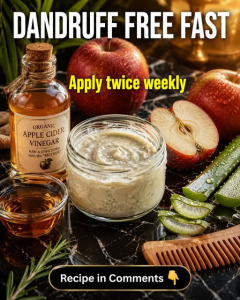
Remedy 1: Tea Tree and Aloe Pre-Shampoo Gel for a Normal Scalp
Ingredients and Their Scientific Benefits
- Pure aloe vera gel – 2 tablespoons: Provides lightweight hydration and may reduce scaling and itching.
- Tea tree essential oil – 4 drops: Has antifungal activity against microorganisms associated with dandruff.
- Colloidal oatmeal – 1 teaspoon: Helps calm itching and supports the scalp barrier.
- Vegetable glycerin – ½ teaspoon: Draws water toward the outer skin layer.
- Cooled boiled water – 1 tablespoon: Makes the treatment easier to distribute.
- Jojoba oil – ½ teaspoon: Reduces friction and helps disperse the essential oil.
How This Remedy Works Scientifically
In a randomised trial, a formulated shampoo containing 5% tea tree oil improved dandruff severity by approximately 41%, compared with 11% in the placebo group after four weeks. This homemade rinse-off gel uses a lower concentration to reduce irritation risk, so its effect may be milder. Aloe and oatmeal support hydration and scalp comfort rather than directly eliminating yeast. (PubMed)
Procedure
Mix the tea tree oil thoroughly into the jojoba oil. Add the aloe, glycerin, oatmeal and water. Patch-test behind the ear for 24 hours.
Apply a thin layer along scalp partings. Leave it on for 10–15 minutes, then shampoo and rinse thoroughly. Never place undiluted tea tree oil directly on the scalp.
How Often to Apply
Use twice weekly for at least four weeks.
Initial Results
Itching may feel calmer after one or two applications. A noticeable reduction in flakes usually requires two to four weeks rather than one day.
Remedy 2: Diluted Honey and Aloe Mask for a Combination Scalp
Ingredients and Their Scientific Benefits
- Raw honey – 2 tablespoons: Has humectant, antifungal and anti-inflammatory properties.
- Warm water – 2 teaspoons: Dilutes the honey and makes it easier to rinse.
- Pure aloe vera gel – 1 tablespoon: Helps soothe dry or irritated areas.
- Colloidal oatmeal – 1 teaspoon: Supports drier sections of the scalp.
- Cooled green tea – 1 tablespoon: Adds lightweight antioxidant support.
- Jojoba oil – ¼ teaspoon: Conditions dry areas without heavily coating oily roots.
How This Remedy Works Scientifically
A small human study involving chronic seborrheic dermatitis and dandruff found that diluted crude honey applied every other day improved scaling, itching and associated hair shedding. The study was small and did not prove that honey permanently cures dandruff, but it provides stronger support than many popular kitchen remedies. (PubMed)
Procedure
Mix the honey with warm water. Add the aloe, oatmeal and green tea. Apply the water-based mixture to the scalp, concentrating on flaky areas. Use the jojoba oil only on dry sections near the hairline.
Leave for 20 minutes and shampoo carefully. Do not use honey on scratched, bleeding or infected skin.
How Often to Apply
Apply every other day for the first five days, then twice weekly for three to four weeks.
Initial Results
The scalp may feel less tight within one to three days. Scaling and itching may begin improving over one to two weeks.
Remedy 3: Lemongrass Rinse-Off Tonic for an Oily Scalp
Ingredients and Their Scientific Benefits
- Aloe vera gel – 1 tablespoon: Provides a light base without adding heavy oil.
- Cooled boiled water – 2 tablespoons: Dilutes the preparation.
- Lemongrass essential oil – 4 drops: Has activity against lipophilic yeasts and has been clinically studied for dandruff.
- Vegetable glycerin – ½ teaspoon: Improves hydration and consistency.
- Jojoba oil – ½ teaspoon: Helps disperse the essential oil before it is mixed into the gel.
- Colloidal oatmeal – ½ teaspoon: Reduces the risk of an overly drying treatment.
How This Remedy Works Scientifically
A randomised, double-blind study tested formulated lemongrass tonics containing 5%, 10% or 15% essential oil. Participants applied the products twice daily, and significant dandruff reduction was measured after seven and fourteen days, with the 10% formula performing best. A professionally formulated tonic disperses essential oil more evenly than a homemade mixture, so this lower-strength treatment must be rinsed off and patch-tested carefully. (PubMed)
Procedure
First mix the lemongrass oil into the jojoba oil. Stir this into the aloe, glycerin, water and oatmeal until evenly combined.
Apply only to the scalp, leave for five minutes during the first treatment and rinse with shampoo. When there is no irritation, future applications may remain on for up to 10 minutes.
How Often to Apply
Use twice weekly for two weeks. Do not apply it twice daily at home.
Initial Results
Oiliness may feel reduced after one or two washes. Clinical improvement should be assessed after seven to fourteen days.
Remedy 4: Coconut, Honey and Oat Pre-Wash Mask for a Dry Scalp
Ingredients and Their Scientific Benefits
- Virgin coconut oil – 1 teaspoon: Conditions dry hair and may influence the scalp microbial environment.
- Raw honey – 1 tablespoon: Helps retain moisture and has limited human evidence for dandruff.
- Pure aloe vera gel – 1 tablespoon: Adds water-based soothing care.
- Colloidal oatmeal – 1 teaspoon: Reduces dryness and itching.
- Sunflower seed oil – ½ teaspoon: Softens dry skin and improves spreadability.
- Cooled boiled water – 1 tablespoon: Creates a lighter mask that rinses more easily.
How This Remedy Works Scientifically
Coconut oil is well supported for reducing protein loss from the hair shaft, and a longitudinal scalp study suggested it may help maintain a healthier microbial balance. However, coconut oil has not been proven to clear dandruff by itself. This remedy is intended for genuinely dry, non-greasy scalps; heavy oiling may be unsuitable when flakes are oily, yellow or associated with seborrheic dermatitis. (PubMed)
Procedure
Soften the coconut oil between the fingertips and blend it with the sunflower oil. Mix in the honey, aloe, oatmeal and water.
Apply sparingly to dry scalp patches and hair ends. Leave for 20 minutes, shampoo thoroughly and avoid scratching loosened flakes.
How Often to Apply
Use twice weekly for three to four weeks.
Initial Results
Dryness and tightness may improve after the first treatment. Reduced flaking normally requires repeated use and appropriate shampooing.
Remedy 5: Minimal Aloe and Oat Gel for a Sensitive Scalp
Ingredients and Their Scientific Benefits
- Pure aloe vera gel – 2 tablespoons: A controlled trial of an aloe emulsion found improvement in scaling and itching associated with seborrheic dermatitis.
- Colloidal oatmeal – 1 tablespoon: Supports the barrier and helps calm irritation.
- Rice starch – 1 teaspoon: Creates a gentle, fragrance-free protective film.
- Vegetable glycerin – ¼ teaspoon: Reduces dehydration.
- Cooled boiled water – 2 tablespoons: Produces a light, easy-to-rinse gel.
- Sunflower seed oil – 2 drops: Adds minimal emollient care without heavily oiling the scalp.
How This Remedy Works Scientifically
A double-blind, placebo-controlled study involving adults with seborrheic dermatitis found that a formulated aloe-vera emulsion significantly improved scaling, itching and the number of affected sites. This simple version avoids essential oils and vinegar, making it more appropriate for easily irritated skin, although it is not equivalent to the researched formulation. (Taylor & Francis Online)
Procedure
Mix all ingredients and patch-test for 24–48 hours. Apply a thin layer to intact scalp skin for 10 minutes and rinse with lukewarm water.
Do not use aloe taken directly from a plant unless the yellow latex beneath the leaf skin has been completely removed, as it may be irritating.
How Often to Apply
Apply every other day for three applications, then twice weekly when well tolerated.
Initial Results
Temporary itching or tightness may improve within one to three days. Stop immediately if redness, burning or swelling increases.
Final Tips for Controlling Dandruff
Wash the scalp regularly enough to prevent oil, flakes and styling-product residue from accumulating. Apply shampoo to the scalp rather than only to the hair, and give an anti-dandruff shampoo the recommended contact time before rinsing. Dermatologists commonly recommend using dandruff shampoo two or three times weekly for straight or wavy hair and less frequently for tightly coiled hair when dryness is a concern. (American Academy of Dermatology)
Avoid scratching, aggressive scalp brushes, baking soda, lemon juice and undiluted essential oils. Change pillowcases regularly and keep combs, scarves and hair tools clean. Manage stress and get adequate sleep because fatigue, stress and seasonal changes may trigger seborrheic-dermatitis flares. (Mayo Clinic)
Home care may begin easing discomfort within two or three days, but continue a suitable treatment for at least two to four weeks. For stubborn dandruff, a medicated shampoo containing an antifungal or scale-reducing active ingredient has much stronger evidence than a food-based mask.
Diet Plan for Scalp Health
No specific food has been clinically proven to cure dandruff. Follow a balanced plan for at least four to eight weeks to support normal skin and hair function.
Breakfast: Eggs or plain yoghurt with oatmeal and fruit.
Mid-morning: Guava, orange, berries or another vitamin-C-rich fruit.
Lunch: Lentils, chickpeas, chicken or fish with vegetables and whole-grain rice or roti.
Snack: A small serving of walnuts, almonds, pumpkin seeds or sunflower seeds.
Dinner: Fish, beans, tofu, eggs or lean meat with leafy and colourful vegetables.
Hydration: Drink according to thirst, weather and activity.
Include adequate protein, zinc, iron, essential fatty acids and B vitamins from varied foods. Do not take high-dose supplements unless testing confirms a deficiency.
Continue home treatment for two to four weeks. See a doctor or dermatologist if dandruff persists, repeatedly returns or becomes severe. Medical assessment is especially important for thick crusts, bleeding, pus, painful bumps, broken hairs, bald patches, intense redness, facial scaling or symptoms that do not improve after four weeks. These signs may indicate psoriasis, fungal infection, eczema, allergic dermatitis or another scalp condition.
References for the above remedy
- American Academy of Dermatology Association. Seborrheic Dermatitis: Diagnosis and Treatment.
https://www.aad.org/public/diseases/a-z/seborrheic-dermatitis-treatment - Satchell AC, et al. Treatment of Dandruff with 5% Tea Tree Oil Shampoo.
https://pubmed.ncbi.nlm.nih.gov/12451368/ - Al-Waili NS. Therapeutic and Prophylactic Effects of Crude Honey on Seborrheic Dermatitis and Dandruff.
https://pubmed.ncbi.nlm.nih.gov/11485891/ - Chaisripipat W, et al. Anti-Dandruff Hair Tonic Containing Lemongrass Oil.
https://pubmed.ncbi.nlm.nih.gov/26566122/ - Vardy DA, et al. A Double-Blind, Placebo-Controlled Trial of Aloe Vera Emulsion in Seborrheic Dermatitis.
https://doi.org/10.3109/09546639909055904 - Saxena R, et al. Longitudinal Study of the Scalp Microbiome and the Effects of Coconut Oil.
https://pubmed.ncbi.nlm.nih.gov/33790324/ - Borda LJ, Wikramanayake TC. Seborrheic Dermatitis and Dandruff: A Comprehensive Review.
https://pmc.ncbi.nlm.nih.gov/articles/PMC4852869/ - Luu LA, et al. Apple-Cider Vinegar Soaks and Skin-Barrier Integrity.
https://pubmed.ncbi.nlm.nih.gov/31328306/ - Mayo Clinic. Dandruff: Symptoms and Causes.
https://www.mayoclinic.org/diseases-conditions/dandruff/symptoms-causes/syc-20353850 - British Association of Dermatologists. Seborrhoeic Dermatitis.
https://www.bad.org.uk/pils/seborrhoeic-dermatitis