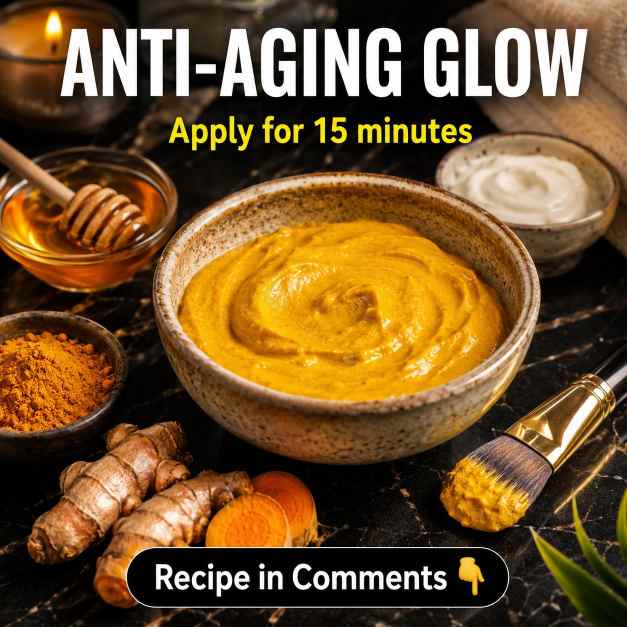
Fine lines, dryness, uneven tone and a dull complexion can make skin appear tired and older, affecting confidence and overall appearance. Natural masks may temporarily improve hydration, softness and surface brightness, but they cannot reverse biological aging, rebuild large amounts of collagen or remove deep wrinkles in a few days. Dermatologists consider daily sunscreen and moisturiser the most effective starting points for preventing premature aging and reducing the appearance of fine lines. Most genuine anti-aging improvements require at least six weeks, while hydration-related glow may appear much sooner. (American Academy of Dermatology)
The turmeric, honey and creamy base shown in the image can be adapted into safer recipes for different skin types. Turmeric contains curcumin, which has antioxidant and anti-inflammatory properties, but available clinical research remains preliminary and has mostly studied standardized preparations rather than kitchen turmeric masks. Turmeric may also stain the skin or cause contact dermatitis in some people. (PubMed)
The scientific evidence below supports individual ingredients or professionally formulated products containing them. The exact homemade combinations have not been tested in clinical trials, so they should be viewed as supportive skincare rather than proven wrinkle treatments.
Remedy 1: Turmeric, Soy and Oat Glow Mask for Normal Skin
Ingredients and Scientific Working
Pure aloe vera gel: 1 tablespoon. Aloe contains water-binding polysaccharides and can improve moisture in the outer skin layer. Human research on formulated aloe preparations found increased skin hydration after regular use. (PubMed)
Unsweetened soy milk: 1 tablespoon. Soy contains isoflavones and protease inhibitors. A controlled study of a stabilized soy moisturiser reported improvements in skin tone, texture, fine lines and blotchy pigmentation during 12 weeks of use. Household soy milk is much less concentrated than the tested formulation. (PubMed)
Colloidal oatmeal: 1 teaspoon. Finely milled oatmeal supports the skin barrier and helps retain moisture. Clinical research has shown improvements in hydration, skin pH and barrier function with colloidal-oat products. (PubMed)
Honey: ½ teaspoon. Honey acts as a humectant and helps reduce surface dryness. Honey-containing creams have improved moisturisation and skin smoothness in human research, although honey alone is not a clinically proven wrinkle remover. (PubMed)
Turmeric powder: A very small pinch, no more than 1/16 teaspoon. Curcumin has antioxidant and anti-inflammatory activity, but evidence for facial anti-aging remains limited. Using more turmeric increases the risk of staining and irritation. (PubMed)
Procedure
Mix the oatmeal and soy milk first and leave them for two minutes. Stir in the aloe, honey and a tiny pinch of turmeric. Apply a thin, even layer to cleansed skin, avoiding the eyes, lips and hairline. Leave it on for eight to ten minutes and rinse gently with lukewarm water. Do not scrub while removing it.
How Often to Apply
Apply on days one, three and five. When the skin remains comfortable, continue twice weekly for six weeks.
Initial Results
Within one to three days, the skin may feel softer, smoother and temporarily more radiant because of improved hydration. Fine lines caused by dryness may look less noticeable, but structural wrinkles will not disappear in this period.
Remedy 2: Two-Zone Green Tea Mask for Combination Skin
Ingredients and Scientific Working
Cooled green tea: 2 tablespoons. Green tea contains polyphenols with antioxidant and anti-inflammatory properties. A randomized study of a formulated green-tea cream reported improvements in elasticity, dullness and facial wrinkles over four to eight weeks. (PubMed)
Pure aloe vera gel: 1 tablespoon. Aloe adds lightweight moisture without creating a greasy layer.
Unsweetened soy milk: 1 tablespoon. Soy supports a smoother and more even-looking complexion when used in properly stabilized topical formulations.
Colloidal oatmeal: 1 teaspoon. Oatmeal helps protect dry cheeks and reduces moisture loss.
Cosmetic-grade kaolin clay: ½ teaspoon. Kaolin absorbs excess surface oil. It does not stimulate collagen or remove wrinkles, so it should be used only on oily facial areas.
Plant-derived glycerin: 2 drops. Glycerin attracts water into the outer skin layer. A randomized human study demonstrated increased skin moisture after applying a glycerol-based preparation. (PubMed)
Procedure
Mix the green tea, aloe, soy milk and glycerin, then divide the mixture between two bowls. Add kaolin to the portion intended for the forehead, nose and chin. Add colloidal oatmeal to the portion intended for the cheeks and jawline. Apply both mixtures lightly and rinse after eight minutes, before the clay becomes completely dry.
How Often to Apply
Use on alternate evenings for five days. Continue once or twice weekly when no dryness or irritation develops.
Initial Results
The T-zone may appear less shiny, while the cheeks may feel softer within one to three days. A more balanced surface can create a fresher appearance, but lasting wrinkle improvement requires several weeks.
Remedy 3: Green Tea, Aloe and Clay Mask for Oily Skin
Ingredients and Scientific Working
Strong cooled green tea: 2 tablespoons. Green-tea antioxidants may help protect against oxidative stress, although a short mask cannot provide the same effect as a standardized leave-on extract.
Pure aloe vera gel: 1 tablespoon. Aloe gives oily skin water-based hydration without a heavy oily finish.
Cosmetic-grade kaolin clay: 1 teaspoon. Kaolin temporarily absorbs excess sebum and reduces surface shine.
Colloidal oatmeal: ½ teaspoon. Oatmeal prevents the clay mixture from becoming excessively drying.
Unsweetened soy milk: 1 teaspoon. Soy contributes mild conditioning and may support a more even appearance.
Procedure
Combine the green tea and aloe. Add kaolin, oatmeal and soy milk, stirring until a thin paste forms. Apply a light layer and leave it on for six to eight minutes. Rinse while the mask remains slightly damp. Allowing clay to crack completely can leave oily skin dehydrated and irritated.
How Often to Apply
Use twice during the first three days and once again on day five. Continue no more than twice weekly.
Initial Results
Excess shine may decrease after the first use, and skin may feel cleaner and smoother within one to three days. The mask will not permanently shrink pores or remove wrinkles.
Remedy 4: Honey, Soy and Oat Moisture Mask for Dry Skin
Ingredients and Scientific Working
Pure aloe vera gel: 1 tablespoon. Aloe supplies lightweight hydration and may improve water content in the outer skin layer.
Honey: 1 teaspoon. Honey helps attract and retain moisture, supporting a smoother surface.
Unsweetened soy milk: 1 tablespoon. Soy compounds have clinical evidence for improving several visible features of photodamaged skin when delivered in a stabilized moisturiser. (PubMed)
Colloidal oatmeal: 1½ teaspoons. Oatmeal supports the damaged or dry skin barrier and reduces roughness.
Plant-derived glycerin: ¼ teaspoon. Glycerin provides stronger humectant support for skin that feels tight or flaky.
Procedure
Soak the oatmeal in soy milk for three minutes. Add the aloe, honey and glycerin and mix until creamy. Apply to clean, slightly damp skin for 10 to 12 minutes. Rinse gently and immediately apply a fragrance-free moisturiser while the face remains slightly damp.
How Often to Apply
Apply once daily for three days, followed by applications on days four and six. Continue two or three times weekly for six weeks when tolerated.
Initial Results
Dryness, tightness and roughness may improve within one to three days. Moisture can temporarily plump superficial lines and make the complexion appear brighter. Deep lines will remain.
Remedy 5: Minimal Oat and Aloe Mask for Sensitive Skin
Ingredients and Scientific Working
Cool distilled water: 2 tablespoons. It provides a simple fragrance-free base and reduces the number of potential irritants.
Colloidal oatmeal: 1 teaspoon. Oatmeal is the primary soothing and barrier-supporting ingredient.
Pure aloe vera gel: 1 teaspoon. Aloe may improve hydration, but it must be patch-tested because natural aloe can occasionally irritate sensitive skin.
Unsweetened soy milk: 1 teaspoon. Soy provides mild conditioning, although people with soy allergy should omit it.
Plant-derived glycerin: 1 drop. A single drop supports hydration without making the mixture heavy or sticky.
Procedure
Combine the ingredients and leave the mixture for five minutes. Patch-test it on the inner forearm before facial use. When no reaction develops, apply a very thin layer for five minutes and rinse with cool or lukewarm water. Do not massage or exfoliate.
How Often to Apply
Apply once on day one. When there is no itching, swelling or prolonged stinging, repeat on days three and five. Continue once weekly.
Initial Results
Sensitive skin may feel calmer and less tight within one to three days. Stop immediately if redness, burning, itching or swelling increases.
Final Tips for Maintaining an Anti-Aging Glow
Use only one mask suited to your skin type. Applying several remedies together can increase irritation rather than accelerate results. Prepare a fresh portion each time, clean bowls and brushes thoroughly and never apply a mask over broken, infected, sunburned or actively inflamed skin.
Complete a patch test for four to five days before using turmeric, aloe, soy or honey across the face. Turmeric can cause allergic contact dermatitis in susceptible individuals and may leave a temporary yellow stain. (American Academy of Dermatology)
Apply broad-spectrum, water-resistant sunscreen with SPF 30 or higher every morning. Sun exposure is a major contributor to premature wrinkles, uneven pigmentation and loss of firmness. Reapply sunscreen approximately every two hours when outdoors and combine it with shade, protective clothing and sunglasses. (American Academy of Dermatology)
Wash gently, avoid rough scrubs and stop using anything that repeatedly burns or stings. Irritation can weaken the barrier and make the complexion look redder, drier and older. Adequate sleep, hydration and clean skincare tools also support a healthier appearance.
A moisturising mask may create visible softness and glow within two to three days. Improvements in fine lines, texture or pigmentation generally require six to twelve weeks of consistent care. No homemade mask can provide facelift-like results or permanently reverse skin aging. (American Academy of Dermatology)
Diet Plan for Supporting Healthy, Glowing Skin
Breakfast: Eat oatmeal with berries, eggs with whole-grain bread, or plain yogurt with fruit. These meals provide protein, fibre and micronutrients without relying heavily on refined sugar.
Lunch: Fill half the plate with colourful vegetables. Add beans, lentils, fish, chicken or eggs for protein and include a moderate serving of whole grains.
Snack: Choose an orange, guava, berries, cucumber, carrots or a small handful of unsalted nuts.
Dinner: Eat vegetables with fish, beans, lentils, tofu or another protein source. Keep highly processed and heavily fried meals occasional.
Daily routine: Drink water regularly and limit smoking, frequent alcohol consumption, sugary drinks and excessive refined carbohydrates. Dermatology guidance notes that a balanced diet containing fruits and vegetables may support healthier aging, while diets high in sugar and refined carbohydrates may contribute to premature aging. (American Academy of Dermatology)
Continue the selected mask for six weeks and follow the balanced diet and sun-protection routine for at least eight to twelve weeks. Consult a dermatologist when wrinkles, pigmentation or persistent dryness do not improve, or when you develop recurring rashes, painful cracking, unexplained facial swelling or a skin lesion that changes shape, size or colour.
References for the above remedy
- American Academy of Dermatology Association. “How to Select Anti-Aging Skin Care Products.”
https://www.aad.org/public/everyday-care/skin-care-secrets/anti-aging/selecting-anti-aging-products - American Academy of Dermatology Association. “11 Ways to Reduce Premature Skin Aging.”
https://www.aad.org/public/everyday-care/skin-care-secrets/anti-aging/reduce-premature-aging-skin - Vaughn, A.R., Branum, A. and Sivamani, R.K. “Effects of Turmeric on Skin Health: A Systematic Review of the Clinical Evidence.”
https://pubmed.ncbi.nlm.nih.gov/27213821/ - Wallo, W., Nebus, J. and Leyden, J.J. “Efficacy of a Soy Moisturizer in Photoaging: A Double-Blind, Vehicle-Controlled, 12-Week Study.”
https://pubmed.ncbi.nlm.nih.gov/17941363/ - Wisuitiprot, W. et al. “Effect of Green Tea Extract Loaded Chitosan Microparticles on Facial Skin.”
https://pubmed.ncbi.nlm.nih.gov/34965006/ - Capone, K. et al. “Effects of Colloidal Oatmeal Topical Cream on Skin Barrier Properties.”
https://pubmed.ncbi.nlm.nih.gov/32484623/ - Dal’Belo, S.E., Gaspar, L.R. and Maia Campos, P.M.B.G. “Moisturizing Effect of Cosmetic Formulations Containing Aloe Vera Extract.”
https://pubmed.ncbi.nlm.nih.gov/17026654/ - Chrit, L. et al. “An In Vivo Randomized Study of Human Skin Moisturization by a Glycerol-Based Hydration Cream.”
https://pubmed.ncbi.nlm.nih.gov/16679823/ - Tanaś, J. et al. “Innovative Honey-Based Product and Its Beneficial Effects Measured by Skin Techniques.”
https://pubmed.ncbi.nlm.nih.gov/39770550/ - Chaudhari, S.P., Tam, A.Y. and Barr, J.A. “Curcumin: A Contact Allergen.”
https://pubmed.ncbi.nlm.nih.gov/26705440/