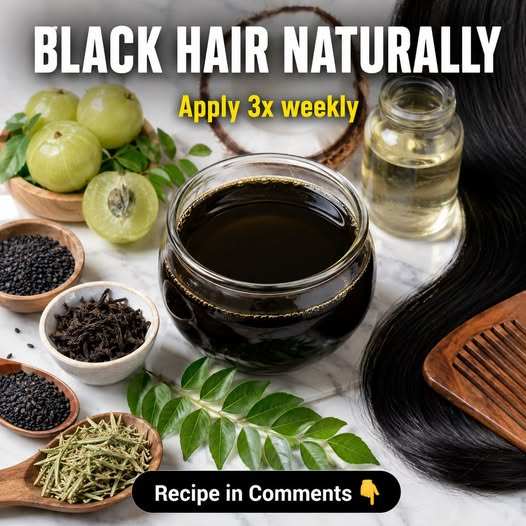
Grey or faded-looking hair can affect confidence, especially when it appears earlier than expected. Yet “black hair naturally” should be approached honestly. Hair becomes grey when pigment production inside the follicle declines, and an established white strand usually cannot be permanently turned black by a kitchen remedy. Natural treatments may still make hair appear deeper, smoother and shinier by coating the shaft, reducing roughness and supporting scalp health. The remedies below are tailored to normal, combination, oily, dry and sensitive scalps.
What Science Can Realistically Promise
Black tea contains polyphenols that can attach to the hair surface and produce temporary darkening, although the strongest evidence comes from laboratory hair-dye formulations rather than ordinary brewed tea. Coconut oil has evidence for reducing hair-protein loss. Rosemary oil has limited clinical evidence for supporting hair count after months of use, while amla has preliminary evidence for hair-growth support. None is clinically proven to restore melanin permanently to established grey hair. (PubMed)
Remedy 1: Black Tea and Amla Gloss for Normal Scalp
Scientific Working of the Ingredients
Black tea may leave a temporary darker cast. Coconut oil protects the fibre, amla supplies antioxidant plant compounds, aloe adds slip and diluted rosemary supports general scalp and hair-growth care rather than pigmentation. (PubMed)
Ingredients
- Strong cooled black tea, 1 cup: temporary colour deposit.
- Amla powder, 1 tablespoon: antioxidant support.
- Pure aloe gel, 1 tablespoon: hydration and slip.
- Virgin coconut oil, 1 teaspoon: reduced protein loss.
- Rosemary essential oil, 2 drops: diluted scalp support.
Procedure
Mix the rosemary essential oil into the coconut oil. Stir in the amla and aloe, then add enough black tea to make a thin mask. Apply it evenly to the scalp and hair lengths. Leave it on for 20 minutes and rinse with lukewarm water.
How Often to Apply
Use three times weekly for four weeks.
Initial Results
Within one to three days, the hair may feel softer and look glossier or slightly deeper in colour. This is temporary surface toning, not new pigment production.
Remedy 2: Dual-Zone Tea Pack for Combination Scalp
Scientific Working of the Ingredients
Green-tea scalp formulations have shown sebum reduction after several weeks. Black tea provides temporary toning, oatmeal supports the skin barrier, and coconut oil conditions dry ends without coating oily roots. (PubMed)
Ingredients
- Strong black tea, ½ cup: mild darkening rinse.
- Green tea, ½ cup: lightweight root care.
- Amla powder, 1 tablespoon: antioxidant support.
- Colloidal oatmeal, 1 tablespoon: soothing barrier support.
- Aloe gel, 1 tablespoon: light hydration.
- Coconut oil, 1 teaspoon: protection for the ends only.
Procedure
Mix the teas, amla, oatmeal and aloe into a smooth liquid paste. Apply this mixture mainly to the scalp and roots. Smooth the coconut oil over the lower half of the hair, avoiding the scalp. Leave it on for 20 minutes and rinse thoroughly.
How Often to Apply
Use on alternate days for the first five days, followed by twice-weekly applications for one month.
Initial Results
The roots may feel lighter and the ends smoother after the first two applications. Meaningful changes in scalp oiliness usually require several weeks.
Remedy 3: Oil-Free Tea and Rosemary Rinse for Oily Scalp
Scientific Working of the Ingredients
This rinse avoids heavy oils that can make an oily scalp feel coated. Green tea may help reduce scalp greasiness with continued use, while black tea can mildly stain the outside of the hair fibre. Rosemary and amla support the overall hair-care routine but are not proven cures for grey hair. (PubMed)
Ingredients
- Green tea, 1 cup: lightweight scalp care.
- Black tea, 1 cup: temporary darker appearance.
- Dried rosemary, 1 tablespoon: diluted herbal infusion.
- Amla powder, 1 tablespoon: antioxidant compounds.
- Aloe gel, 1 tablespoon: oil-free slip and hydration.
Procedure
Simmer the rosemary and amla in two cups of water for five minutes. Remove the pan from the heat, add one black-tea bag and one green-tea bag, and steep for another five minutes. Cool and strain the liquid through a clean cloth. Mix in the aloe gel.
After shampooing, pour the rinse over the scalp and hair. Leave it on for ten minutes before rinsing lightly with cool water.
How Often to Apply
Use up to three times weekly for four to six weeks.
Initial Results
Hair may look cleaner, shinier and slightly darker after one to three applications. Existing grey roots will not change permanently.
Remedy 4: Coconut-Amla Moisture Mask for Dry Scalp
Scientific Working of the Ingredients
Dry and porous strands reflect light unevenly, which can make naturally dark hair appear faded. Coconut oil can reduce protein loss, while oatmeal and aloe provide a moisture-supporting base. Black tea may add temporary depth. Amla and rosemary remain supportive ingredients rather than proven repigmenting treatments. (PubMed)
Ingredients
- Virgin coconut oil, 2 tablespoons: fibre protection.
- Strong black tea, ½ cup: temporary darker tone.
- Amla powder, 1 tablespoon: antioxidant support.
- Colloidal oatmeal, 1 tablespoon: soothing texture.
- Aloe gel, 1 tablespoon: hydration and slip.
- Rosemary essential oil, 2 drops: fully diluted scalp support.
Procedure
Blend the rosemary essential oil into the coconut oil. In a separate bowl, combine the black tea, amla, oatmeal and aloe. Mix the two preparations and apply to slightly damp hair, concentrating on the dry lengths.
Leave it on for 25 minutes and wash with a gentle shampoo.
How Often to Apply
Use twice weekly for six weeks.
Initial Results
Dry hair may feel softer and look richer after the first application because a smoother hair shaft reflects more light and shine.
Remedy 5: Gentle Oat and Weak-Tea Pack for Sensitive Scalp
Scientific Working of the Ingredients
Sensitive scalps should avoid cloves, lemon juice, baking soda and concentrated essential oils. Colloidal oatmeal has clinical evidence for improving skin hydration and barrier function. Weak tea provides very mild temporary toning, while coconut oil protects the hair lengths. Any natural ingredient can still cause an allergy, making patch testing essential. (PubMed)
Ingredients
- Weak black tea, ½ cup: gentle temporary toning.
- Weak green tea, ¼ cup: lightweight rinse base.
- Colloidal oatmeal, 2 tablespoons: barrier support.
- Aloe gel, 1 tablespoon: dilution and slip.
- Coconut oil, 1 teaspoon: protection for the ends.
Procedure
Mix the cooled teas with the oatmeal and aloe. Apply a thin layer to the scalp and hair, keeping most of the coconut oil on the ends. Leave the treatment on for only ten minutes during the first application.
Rinse immediately if burning, itching or redness develops.
How Often to Apply
Begin with one weekly application. When no irritation occurs after two uses, increase to twice weekly for four weeks.
Initial Results
The scalp may feel less tight and the hair smoother within one to three days. Darkening will be minimal because the tea mixture is deliberately weak.
Final Tips
Patch-test every remedy for 48 hours before applying it to the whole scalp. Prepare tea rinses fresh and discard any leftover mixture within 24 hours. Keep combs, towels, bowls and application tools clean.
Avoid undiluted rosemary or clove essential oil, frequent lemon juice, baking soda and other harsh mixtures. These ingredients can irritate the scalp or roughen the hair fibre. Never assume that a preparation labelled “black henna” is completely herbal because some products contain PPD, a strong sensitizer associated with serious reactions. (U.S. Food and Drug Administration)
Drink enough water, sleep regularly, manage stress, avoid smoking and protect the scalp from intense sunlight. Softness and shine may become visible within two to three days, but reduced breakage takes several weeks and changes in new hair growth take months. Permanent reversal of established grey hair should not be expected.
Diet Plan for Dark, Healthy-Looking Hair
For breakfast, choose eggs, dairy or a fortified plant-based alternative with fresh fruit. These foods provide protein and may contribute vitamin B12 and other nutrients needed for normal hair development.
At lunch, combine lentils, chickpeas, beans or lean meat with leafy vegetables. Include a vitamin-C-rich food such as guava, citrus fruit, tomatoes or bell peppers to support iron absorption.
For a snack, have plain yogurt, pumpkin seeds, sesame seeds or a small handful of mixed nuts. At dinner, include fish, chicken, tofu, lentils or beans with mixed vegetables and a whole grain.
Premature greying has been associated in some studies with low vitamin B12, folate, ferritin, vitamin D and calcium levels, as well as thyroid abnormalities. These associations do not mean that high-dose supplements will automatically restore hair colour. Blood testing should guide any supplementation. (PubMed)
Continue the selected home remedy for four to six weeks and follow the balanced diet for at least eight to twelve weeks. Stop the remedy if irritation or increased shedding occurs. See a dermatologist or doctor if greying starts suddenly, appears unusually early, progresses rapidly, or occurs with hair loss, fatigue, unexplained weight changes, numbness or other symptoms.
References for the above remedy
- American Academy of Dermatology. What causes gray hair, and can I stop it?
https://www.aad.org/public/everyday-care/hair-scalp-care/hair/gray-hair-causes - Tobin DJ, et al. The biology of human hair greying.
https://pubmed.ncbi.nlm.nih.gov/32965076/ - Rele AS, Mohile RB. Effect of mineral oil, sunflower oil, and coconut oil on prevention of hair damage.
https://pubmed.ncbi.nlm.nih.gov/12715094/ - Panahi Y, et al. Rosemary oil vs minoxidil 2% for androgenetic alopecia.
https://pubmed.ncbi.nlm.nih.gov/25842469/ - Akhbari M, et al. Amla fruit and female androgenetic alopecia: a randomized controlled trial.
https://pubmed.ncbi.nlm.nih.gov/37487962/ - Yeh MI, et al. Black tea extracts in hair-dye formulations.
https://pubmed.ncbi.nlm.nih.gov/23676188/ - Nualsri C, et al. Green tea hair tonic for greasy scalp treatment.
https://pubmed.ncbi.nlm.nih.gov/29394016/ - Capone K, et al. Colloidal oatmeal and skin-barrier properties.
https://pubmed.ncbi.nlm.nih.gov/32484623/ - Bhat RM, et al. Premature graying of hair: systematic review and meta-analysis.
https://pubmed.ncbi.nlm.nih.gov/32654282/ - U.S. Food and Drug Administration. Hair dyes.
https://www.fda.gov/cosmetics/cosmetic-products/hair-dyes