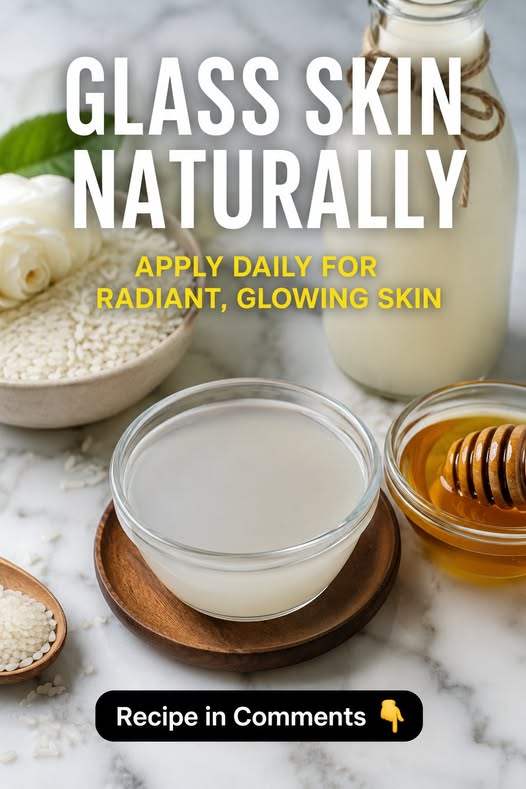
“Glass skin” describes a complexion that looks exceptionally smooth, hydrated, even and naturally luminous. The glossy appearance is not created by literally changing the structure of the skin; it comes mainly from maintaining hydration, a healthy skin barrier, minimal irritation and an even surface that reflects light well. Natural ingredients such as finely ground oats and carefully chosen botanical preparations can support some of these goals, but rice water, honey or any homemade mask cannot permanently create glass skin after one application. Clinical research on colloidal oatmeal, for example, demonstrates measurable improvements in skin hydration and barrier function, supporting the principle that healthier hydration can improve the appearance and feel of skin. (PubMed) The following routines use different combinations for each skin type and avoid harsh DIY ingredients that can undermine the skin barrier.
Remedy 1: For Normal Skin – Rice Water, Oat and Honey Glow Mask
Ingredients
- 2 tablespoons freshly prepared rice water
- 1 tablespoon pure aloe vera gel
- 1 tablespoon finely ground oats
- ½ teaspoon honey
- 1 teaspoon cucumber puree
- 1 teaspoon plain unsweetened yogurt
Scientific Working of Each Ingredient
Rice water: Rice-derived ingredients contain starches and other compounds that are widely used in cosmetic formulations. However, clinical evidence specifically proving that homemade fermented or soaked rice water produces “glass skin” is limited. It is therefore used here primarily as a mild water-based ingredient rather than being presented as a miracle treatment.
Finely ground oats: Oats are one of the more scientifically defensible natural skincare ingredients. Clinical research on colloidal-oat preparations has demonstrated improvements in hydration and skin-barrier measurements. (PubMed)
Honey: Provides a humectant-like, conditioning consistency and has been investigated for antimicrobial and wound-related dermatological properties.
Aloe vera: Creates a lightweight, soothing gel base.
Cucumber: Primarily supplies water and a cooling sensation.
Plain yogurt: Gives the mixture a creamy texture and moisture, although homemade yogurt masks are not clinically proven to produce glass skin.
Procedure
To make simple rice water, rinse uncooked rice first. Soak a small quantity of clean rice in fresh water for about 20–30 minutes, stir, and strain.
Mix two tablespoons of the freshly prepared liquid with aloe, finely ground oats, honey, cucumber and yogurt. Apply a thin layer to freshly cleansed skin.
Leave for 10–15 minutes, then rinse gently with lukewarm water. Do not scrub the oats against the face.
How Often to Apply
Use once daily or every other day for the first 3–5 days. After that, 2–3 times weekly is sufficient.
Initial Results
Skin may feel softer and more hydrated within 1–3 applications. Better surface hydration can create an immediate temporary glow, but major changes in texture or pigmentation require considerably longer.
Remedy 2: For Combination Skin – Rice Water, Green Tea and Aloe Hydration Gel
Ingredients
- 2 tablespoons fresh rice water
- 1 tablespoon cooled brewed green tea
- 1 tablespoon aloe vera gel
- 1 teaspoon finely ground oats
- 1 teaspoon cucumber juice
- ½ teaspoon honey
Scientific Working of the Remedy
Combination skin needs enough hydration for dry areas without applying a heavy layer of oil to the T-zone.
Green tea contains catechin polyphenols. In a placebo-controlled human study, topical formulations containing green tea significantly reduced facial sebum secretion during 60 days of treatment. (PubMed) This makes green tea particularly interesting for combination and oily skin, although homemade brewed tea is not equivalent to the standardized formulation studied.
Oats support the moisture barrier, while aloe and cucumber provide a lightweight base.
Rice water supplies the watery component of the mask, but its benefits should not be exaggerated. There is insufficient high-quality evidence to promise that homemade rice water shrinks pores or permanently whitens skin.
Procedure
Prepare weak green tea and allow it to cool completely.
Mix it with fresh rice water, aloe, oats, cucumber and honey. Apply evenly, using only a thin layer across oilier areas.
Leave for 10 minutes before rinsing.
How Often to Apply
Use once daily for the first 3–5 days if well tolerated, then approximately three times weekly.
Initial Results
You may notice improved softness and a temporarily plumper, more luminous appearance within several applications. Oil control requires longer-term consistency.
Remedy 3: For Oily Skin – Green Tea, Rice Water and Oat Glow Mask
Ingredients
- 2 tablespoons cooled green tea
- 1 tablespoon fresh rice water
- 1 tablespoon aloe vera gel
- 1 tablespoon finely ground oats
- 1 teaspoon cucumber juice
Why This Remedy Works
This version contains no added facial oil, making it lighter for oily or acne-prone skin.
The most relevant evidence concerns green tea. A human split-face study found statistically significant reductions in facial sebum with topical green-tea-containing formulations after continued treatment. (PubMed)
Oats provide barrier support instead of attempting to strip excess oil. Clinical research involving colloidal oatmeal has found improvements in skin hydration, pH and barrier function. (PubMed)
This distinction is important: oily skin still requires a healthy barrier. Trying to create glass skin by aggressively stripping every trace of oil can produce irritation rather than radiance.
Procedure
Combine the cooled green tea and rice water. Add aloe and finely ground oats, followed by cucumber juice.
Spread a thin layer across clean skin. Leave for approximately 10 minutes and rinse gently.
How Often to Apply
Apply once daily for 3–5 days initially. Then use 2–3 times per week.
Initial Results
The skin may feel fresher and less rough after the first few applications. Do not expect pores, acne scars or pigmentation to disappear within several days.
Remedy 4: For Dry Skin – Oat, Honey and Rice Water Moisture Mask
Ingredients
- 1½ tablespoons finely ground oats
- 2 tablespoons fresh rice water
- 1 tablespoon aloe vera gel
- 1 teaspoon honey
- 1 teaspoon plain yogurt
- ½ teaspoon virgin coconut oil
Scientific Working of Each Ingredient
Dry skin often looks dull because a rough, dehydrated surface scatters light unevenly. Improving hydration can therefore produce a smoother and more luminous appearance.
Oats are the central evidence-supported ingredient. In a clinical study, an oatmeal-containing moisturizer significantly increased hydration and reduced transepidermal water loss, dryness and roughness. (PubMed)
Additional research found that colloidal oat extracts exhibit antioxidant and anti-inflammatory activity and that an oat-containing preparation improved dryness, scaling, roughness and itch. (PubMed)
Honey and aloe contribute to the moisturizing consistency, while coconut oil supplies additional emollience for dry skin.
Rice water provides a lightweight liquid base.
Procedure
Mix the oats with rice water first and allow them to soften for several minutes. Add aloe, honey, yogurt and coconut oil.
Apply without rubbing. Leave for 10–15 minutes before rinsing with lukewarm water.
How Often to Apply
Use once daily or every other day for 3–5 days. Continue 2–3 times weekly if beneficial.
Initial Results
Dryness and roughness may begin improving within several applications, which can make the skin look naturally brighter and more reflective.
Remedy 5: For Sensitive Skin – Simple Oat and Rice Water Barrier Mask
Sensitive skin needs fewer ingredients rather than an elaborate “glass skin” recipe.
Ingredients
- 2 tablespoons fresh rice water
- 1½ tablespoons finely ground oats
- 1 tablespoon pure aloe vera gel
- 1 tablespoon clean cool water
- 1 teaspoon cucumber juice
Scientific Working of the Remedy
This formula deliberately removes fragrance, essential oils, acidic fruit juices and multiple active botanicals.
Finely ground oats are the main ingredient of interest. Controlled clinical research on colloidal-oat preparations demonstrates improved hydration and barrier function, including in sensitive, eczema-prone skin. (PubMed)
Aloe and cucumber primarily create a lightweight, cooling base.
Rice water is kept fresh rather than extensively fermented. DIY fermentation can introduce unpredictable microorganisms, so there is no need to leave homemade rice water sitting at room temperature for days.
Procedure
Mix everything into a thin paste. Patch-test first.
Apply a small amount for only 5–10 minutes. Rinse immediately if you experience burning, itching or unusual redness.
How Often to Apply
Begin every other day for 3–5 days. If your skin remains comfortable, continue 2–3 times weekly.
Initial Results
Sensitive skin may feel softer and less tight within a few applications. The goal is healthy hydration without provoking irritation.
Does Rice Water Really Give You Glass Skin?
Rice water has a long history as a traditional beauty ingredient, but social-media claims often go beyond the available clinical evidence.
There is not strong clinical evidence that homemade rice water alone produces permanent poreless, flawless “glass skin.” Its most sensible role in these remedies is as a gentle water-based ingredient combined with better-supported barrier-care practices.
For genuine glass-skin appearance, maintaining the skin barrier, hydration and sun protection matters much more than relying on one kitchen ingredient.
Also avoid keeping homemade rice water for long periods. Fresh DIY preparations contain no standardized preservative system. Make small amounts, use clean utensils, refrigerate promptly if storing briefly, and discard anything with an altered smell, color or texture.
Final Tips for Naturally Radiant Skin
Cleanse gently instead of repeatedly scrubbing your face. Avoid picking acne and keep pillowcases, makeup brushes, facial towels and skincare tools clean. Adequate sleep, hydration and a balanced diet can support overall skin health.
Avoid applying lemon juice, baking soda, toothpaste, undiluted vinegar or abrasive sugar/salt scrubs in an attempt to achieve faster brightness. Irritation and barrier damage can leave the complexion looking worse rather than more luminous.
Most importantly, protect the skin from UV radiation. The American Academy of Dermatology recommends broad-spectrum, water-resistant SPF 30 or higher when outdoors. (American Academy of Dermatology) Sunscreen should generally be reapplied about every two hours outdoors and after swimming or sweating. (American Academy of Dermatology)
You may notice better hydration, softness and temporary glow within 2–3 days, but improvement in uneven pigmentation, acne or significant texture requires substantially more time.
Diet Plan for Healthy, Glowing Skin
A “glass skin diet” cannot create poreless skin, but a nutrient-rich eating pattern supports normal skin function.
For breakfast, have oats with berries, kiwi, guava or another fresh fruit. Add unsweetened yogurt, eggs, nuts or seeds for protein and healthy fats.
For lunch, combine leafy greens, tomatoes, carrots, bell peppers and another colorful vegetable with lentils, beans, chickpeas, fish, chicken, eggs or tofu. Include a moderate portion of whole grains.
For an afternoon snack, choose fruit with nuts or seeds, plain yogurt or roasted chickpeas instead of sugary drinks and highly processed snacks.
For dinner, include vegetables with a good protein source and whole-grain carbohydrate. Foods containing vitamin C, carotenoids, vitamin E, protein, zinc and healthy fats contribute to balanced nutrition.
Drink according to thirst and your individual needs rather than forcing excessive amounts of water. Hydration is important, but drinking huge quantities of water will not independently create glass skin.
Follow the gentle skincare routine and balanced diet consistently for at least 4–8 weeks before assessing longer-term improvement. Sun protection should remain an everyday habit.
If you develop persistent acne, severe redness, itching, scaling, unexplained pigmentation, painful lesions, or your skin continues worsening despite several weeks of gentle care, see a doctor or dermatologist. Home remedies should complement basic skincare, not delay treatment of an underlying skin condition.
References for the above remedy
- Capone K, Kirchner F, Klein SL, Tierney NK. Effects of Colloidal Oatmeal Topical Atopic Dermatitis Cream on Skin Microbiome and Skin Barrier Properties. Journal of Drugs in Dermatology. 2020.
URL: https://pubmed.ncbi.nlm.nih.gov/32484623/ - Gunt HB, Levy SB, Lutrario CA. Clinical Improvements in Very Dry Skin from a Natural Ingredient-Based Moisturizing Cream Compared With a Leading Colloidal Oatmeal Control. Journal of Drugs in Dermatology. 2018.
URL: https://pubmed.ncbi.nlm.nih.gov/30005098/ - Kalaaji AN, Wallo W. A randomized controlled clinical study to evaluate the effectiveness of an active moisturizing lotion with colloidal oatmeal skin protectant versus its vehicle for the relief of xerosis. Journal of Drugs in Dermatology.
URL: https://pubmed.ncbi.nlm.nih.gov/25607563/ - Reynertson KA, Garay M, Nebus J, et al. Anti-inflammatory activities of colloidal oatmeal contribute to the effectiveness of oats in treatment of itch associated with dry, irritated skin. Journal of Drugs in Dermatology.
URL: https://pubmed.ncbi.nlm.nih.gov/25607907/ - Mahmood T, Akhtar N. A comparison of the effects of topical green tea and lotus on facial sebum control in healthy humans. Hippokratia.
URL: https://pubmed.ncbi.nlm.nih.gov/23935347/ - American Academy of Dermatology. How do I know if I’m using the right sunscreen?
URL: https://www.aad.org/public/everyday-care/sun-protection/shade-clothing-sunscreen/choosing-right-sunscreen - American Academy of Dermatology. How to apply sunscreen.
URL: https://www.aad.org/public/everyday-care/sun-protection/shade-clothing-sunscreen/how-to-apply-sunscreen - American Academy of Dermatology. How to decode a sunscreen label.
URL: https://www.aad.org/public/everyday-care/sun-protection/shade-clothing-sunscreen/understand-sunscreen-labels - American Academy of Dermatology. Sunscreen FAQs.
URL: https://www.aad.org/media/stats-sunscreen