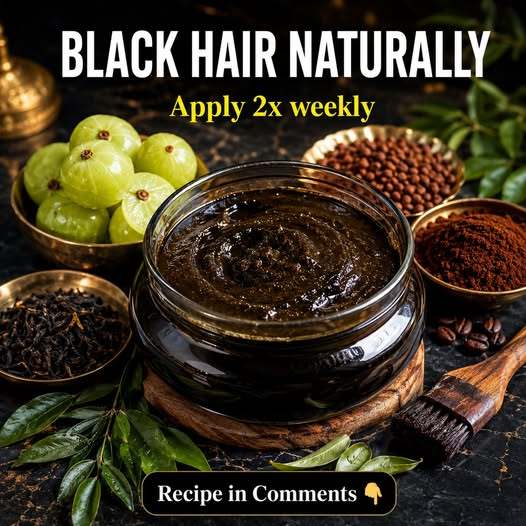
Hair that appears prematurely gray, faded, dry, or dull can affect confidence. However, natural remedies must be discussed realistically: once pigment-producing cells in a follicle stop making melanin because of genetics or normal aging, no kitchen treatment has been clinically proven to restart permanent black pigmentation. Natural plant dyes can safely camouflage gray strands when properly used, while conditioning masks may protect existing dark hair from dryness, breakage, and loss of shine. Unusually early or sudden graying can sometimes be associated with vitamin B12 deficiency, thyroid disorders, low ferritin, or other medical factors. (American Academy of Dermatology)
The remedies below use ingredients with evidence-supported coloring, conditioning, or scalp-care functions. The exact homemade combinations have not been tested as complete formulas, so they should not be presented as guaranteed cures for gray hair.
What Natural Remedies Can Realistically Do
Henna and indigo deposit pigments onto the hair shaft, producing brown-to-black shades without restoring melanin inside the follicle. Amla and black tea may make naturally dark hair look richer temporarily, but they cannot reliably recolor completely white hair. Coconut oil can reduce protein loss, while rosemary oil has limited clinical evidence for supporting hair density after several months—not for reversing gray hair. (PubMed Central (PMC))
Remedy 1: Henna and Indigo Treatment for Normal Scalp
Ingredients
- 50 grams pure henna powder
- 1 tablespoon amla powder
- 100–150 ml warm water
- 50 grams pure indigo powder
- 100 ml room-temperature water
- 1 tablespoon plain aloe-vera gel
Scientific Working of the Ingredients
Henna contains lawsone, a natural pigment that binds with keratin and creates a lasting orange-red base. Indigo deposits blue pigment over the henna base; together, the colors visually combine into dark brown or black. Amla contains acids, tannins, and antioxidant polyphenols that may reduce excessive reddish warmth, although it has not been clinically proven to reverse graying. Aloe gel adds moisture and makes the plant paste easier to distribute. (PubMed Central (PMC))
Procedure
Mix henna, amla, and warm water into a thick, smooth paste. Cover it and leave it for four to six hours. Apply to clean, dry hair from the roots to the ends. Cover the hair and leave for approximately two hours before rinsing with water.
Immediately prepare the indigo by mixing it with room-temperature water and aloe gel. Apply it over the henna-treated hair, leave for 60–90 minutes, and rinse thoroughly. Avoid shampooing for the first 24 hours.
How Often to Apply
Apply once every three to four weeks. Full-head application twice weekly is unnecessary and may leave the hair dry.
Initial Results
Gray hair may appear dark brown immediately and deepen during the following 24–48 hours. Perform a strand test because the result depends on the original color, hair porosity, and henna-to-indigo ratio.
Remedy 2: Amla and Black-Tea Gloss for Combination Scalp
Ingredients
- 1 cup strongly brewed black tea, cooled
- 1½ tablespoons amla powder
- 1 tablespoon aloe-vera gel
- 1 teaspoon honey
- ½ teaspoon coconut oil
- 1 tablespoon finely mashed cooked rice
Scientific Working of the Ingredients
Black tea contains tannins that can attach temporarily to the hair surface and create a slightly deeper appearance. Amla provides plant polyphenols but should not be described as a proven gray-hair cure. Honey retains water, aloe improves slip, and mashed rice thickens the mask while leaving a light smoothing film. Coconut oil can enter the hair shaft and reduce protein loss during washing. (PubMed Central (PMC))
Procedure
Blend the ingredients into a smooth paste. Apply a thin layer to the scalp and spread the remaining mixture through the hair. Leave it on for 25–30 minutes. Rinse with lukewarm water and use a gentle cleanser if any residue remains.
How Often to Apply
Use twice during the first week and then once weekly for three to four weeks.
Initial Results
Hair may feel smoother and look glossier after one to three applications. Tea can produce mild, temporary toning, but it will not completely cover white roots.
Remedy 3: Rosemary, Amla, and Tea Rinse for Oily Scalp
Ingredients
- 1 cup cooled black-tea infusion
- 1 tablespoon amla powder
- 1 tablespoon aloe-vera gel
- 1 teaspoon coconut oil
- 2 drops rosemary essential oil
- ½ cup clean water
Scientific Working of the Ingredients
Tea tannins provide temporary surface toning, while amla supplies antioxidant compounds. Aloe creates a lightweight base. Coconut oil dilutes the essential oil and helps protect the hair fiber. A randomized study found improved hair count after six months of rosemary-oil use in people with androgenetic alopecia, but rosemary did not produce significant results at three months and was not tested for hair repigmentation. (PubMed)
Procedure
Mix the rosemary essential oil thoroughly into the coconut oil. Combine this with aloe, then stir in the tea, amla, and water. Apply to the scalp and hair, massage gently for two minutes, and leave for 20 minutes. Shampoo thoroughly afterward.
Never apply undiluted rosemary oil directly to the scalp.
How Often to Apply
Use twice weekly for four weeks. Hair-density benefits, when they occur, normally require several months.
Initial Results
After one to three applications, oily hair may feel fresher and appear shinier. This treatment will not make gray roots permanently black.
Remedy 4: Coconut-Amla Moisture Mask for Dry Hair
Ingredients
- 2 tablespoons coconut oil
- 1 tablespoon sesame oil
- 1 tablespoon amla powder
- 2 tablespoons plain unsweetened yogurt
- 1 teaspoon honey
- 1 tablespoon aloe-vera gel
Scientific Working of the Ingredients
Coconut oil contains lauric acid and can penetrate the hair fiber, helping reduce protein loss. Sesame oil provides lubrication that can reduce friction between dry strands. Amla may enhance the rich appearance of naturally dark hair without restoring lost pigment. Yogurt supplies water, fat, and protein, while honey and aloe improve moisture retention and spreadability. (PubMed)
Procedure
Warm the oils slightly and mix them with the amla powder. Add yogurt, honey, and aloe. Apply primarily to dry lengths and flaky scalp areas. Leave for 30 minutes, rinse, and shampoo gently.
How Often to Apply
Apply twice weekly for three to four weeks, followed by once-weekly maintenance.
Initial Results
Improved softness, reduced frizz, and greater shine may appear within one to three days. Smoother strands can make naturally black hair look richer, but white hair will remain visible.
Remedy 5: Oat and Aloe Gloss for Sensitive Scalp
Ingredients
- 1 tablespoon finely ground colloidal oatmeal
- 2 tablespoons plain aloe-vera gel
- ½ cup weak black tea
- 2 tablespoons strained amla infusion
- ½ teaspoon coconut oil
- ½ cup clean water
Scientific Working of the Ingredients
Finely ground oatmeal forms a soothing protective film, while aloe adds hydration without essential oils. Weak tea may leave a temporary tint on the hair surface. Using strained amla water instead of powder reduces gritty contact. A small quantity of coconut oil decreases friction, and additional water prevents the mixture from becoming too concentrated.
Procedure
Mix the oatmeal with water and leave it for five minutes. Add aloe, tea, amla infusion, and coconut oil. Test the mixture on a small area first. When no irritation develops, spread it through the hair, leave for 15 minutes, and rinse thoroughly.
How Often to Apply
Use once weekly for three weeks. A sensitive scalp should not be exposed to several botanical ingredients twice weekly.
Initial Results
The hair may feel softer and less rough within one to three days. This remedy is intended for comfort and shine rather than dependable gray coverage.
Final Tips for Naturally Darker-Looking Hair
Use only pure, clearly labeled henna and indigo powders. Avoid products advertised as “black henna,” as some may contain para-phenylenediamine, or PPD, a strong allergen capable of causing serious skin reactions. Patch-test every coloring formula before each full application, wear gloves, and never dye an irritated, scratched, or inflamed scalp. (U.S. Food and Drug Administration)
Keep combs, towels, brushes, and mixing bowls clean. Minimize very hot water, aggressive brushing, smoking, excessive sun exposure, and repeated heat styling. Hydration, adequate sleep, stress management, and a balanced diet support overall hair health. Shine and softness may improve within two or three days, while reduced breakage normally requires several weeks.
Diet Plan to Support Hair Pigment and Strength
Follow this balanced pattern for eight to twelve weeks:
Breakfast: Two eggs with whole-grain bread, or fortified cereal with milk or yogurt. Add guava, orange, or another vitamin-C-rich fruit.
Mid-morning: Eat a small handful of almonds, peanuts, pumpkin seeds, or sesame seeds.
Lunch: Choose lentils, chickpeas, chicken, fish, or lean meat with spinach or another leafy vegetable. Add whole-grain roti, brown rice, and salad.
Evening snack: Have yogurt, fruit, roasted chickpeas, or a boiled egg.
Dinner: Eat fish, chicken, beans, or tofu with mixed vegetables. Include dairy or fortified foods regularly.
Protein, vitamin B12, iron, vitamin D, folate, calcium, and copper contribute to normal hair development or pigmentation pathways. However, associations between deficiencies and premature graying do not prove that supplements will reverse genetic gray hair. Iron, copper, vitamin D, or other supplements should only be used when a deficiency has been identified. (PubMed Central (PMC))
Continue a suitable conditioning remedy for four weeks and the diet plan for at least eight to twelve weeks. Consult a dermatologist or doctor when graying begins suddenly, appears unusually early, develops in patches, or occurs with hair loss, fatigue, weight changes, pale skin, scalp inflammation, or skin depigmentation. A clinician may recommend blood-count, ferritin, vitamin B12, vitamin D, and thyroid testing. Genetic or age-related gray hair usually needs cosmetic coloring rather than medical reversal.
References for the above remedy
- American Academy of Dermatology Association. “What Causes Gray Hair, and Can I Stop It?”
https://www.aad.org/public/everyday-care/hair-scalp-care/hair/gray-hair-causes - Kumar, A. B. et al. “Premature Graying of Hair: Review with Updates.” International Journal of Trichology.
https://pmc.ncbi.nlm.nih.gov/articles/PMC6290285/ - “Premature Hair Graying: A Multifaceted Phenomenon.”
https://pmc.ncbi.nlm.nih.gov/articles/PMC12008612/ - Yuen, C. W. M. et al. “Recent Advancements in Natural Plant Colorants Used for Hair Dye Applications.”
https://pmc.ncbi.nlm.nih.gov/articles/PMC9692289/ - Rele, A. S., and Mohile, R. B. “Effect of Mineral Oil, Sunflower Oil, and Coconut Oil on Prevention of Hair Damage.”
https://pubmed.ncbi.nlm.nih.gov/12715094/ - Panahi, Y. et al. “Rosemary Oil vs Minoxidil 2% for the Treatment of Androgenetic Alopecia.”
https://pubmed.ncbi.nlm.nih.gov/25842469/ - Li, H. et al. “Hair Dye Ingredients and Potential Health Risks from Exposure to Hair Dyeing.”
https://pmc.ncbi.nlm.nih.gov/articles/PMC9214764/ - United States Food and Drug Administration. “Hair Dyes.”
https://www.fda.gov/cosmetics/cosmetic-products/hair-dyes - Sienkiewicz-Szłapka, E. et al. “Quantification of Lawsone and p-Phenylenediamine in Natural Henna Products for Hair Colouring.”
https://pubmed.ncbi.nlm.nih.gov/39756814/ - Almohanna, H. M. et al. “The Role of Vitamins and Minerals in Hair Loss: A Review.”
https://pmc.ncbi.nlm.nih.gov/articles/PMC6380979/