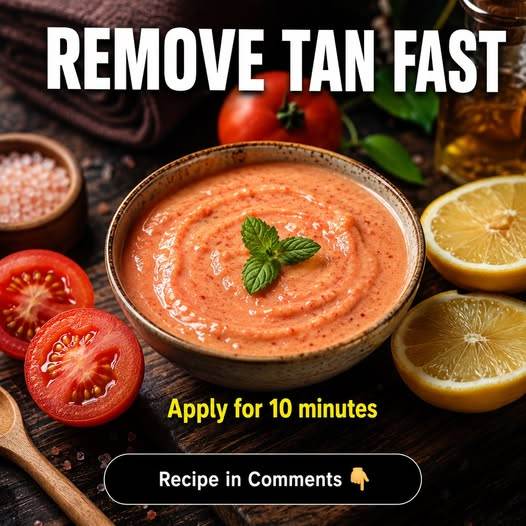
A suntan develops when ultraviolet light stimulates the skin to produce more melanin. Although a fresh tan may look darker within hours, it cannot be safely “removed” in ten minutes because the pigment lies inside living skin cells. The safest approach is to prevent additional ultraviolet exposure, support the skin barrier, and allow excess pigment to fade gradually as the surface renews. Hydrating masks can make the skin appear fresher within one to three days, but noticeable tan reduction usually takes several weeks. Daily broad-spectrum sun protection is essential because repeated exposure can maintain pigmentation and cause premature aging. (American Academy of Dermatology)
The image suggests a tomato-and-lemon mask. However, raw lemon juice should not be applied to sun-exposed skin. Citrus juice can react with ultraviolet light and cause painful inflammation, blistering, and darker pigmentation called phytophotodermatitis. The remedies below therefore avoid lemon and abrasive scrubbing. (PubMed)
The exact homemade mixtures have not been tested as complete clinical treatments. They use gentle ingredients whose individual extracts or related preparations have evidence for supporting hydration, barrier repair, antioxidant protection, or a more even-looking complexion.
Remedy 1: Green Tea, Aloe and Soy Mask for Normal Skin
Ingredients
- 2 tablespoons cooled green tea
- 1 tablespoon pure aloe-vera gel
- 1 tablespoon finely ground colloidal oatmeal
- 1 tablespoon unsweetened soy milk
- 1 teaspoon cucumber juice
- ½ teaspoon honey
Scientific Working of Each Ingredient
Green tea contains catechins with antioxidant and anti-inflammatory activity. Human studies of formulated topical green-tea extracts suggest that they can reduce some ultraviolet-related cellular damage, although brewed tea is weaker and must not replace sunscreen. (PubMed)
Aloe contains compounds such as aloesin that have demonstrated an ability to influence tyrosinase, an enzyme involved in melanin production. However, ordinary aloe gel does not contain a standardized aloesin concentration, so gradual rather than dramatic improvement should be expected. (PubMed)
Soy contains proteins and naturally occurring compounds that may reduce the transfer of melanin-containing structures into surrounding skin cells. A controlled study of a formulated soy moisturizer found improvements in mottled pigmentation and overall tone beginning after approximately two weeks. (PubMed)
Colloidal oatmeal supports hydration and barrier function, while cucumber and honey provide a cooling, moisture-rich base. These ingredients improve the appearance of dullness but do not directly bleach the skin.
Procedure
Mix all ingredients into a soft, spreadable paste. Apply a thin layer to clean skin without rubbing. Leave it on for 10–12 minutes, rinse with cool or lukewarm water, and pat dry. Follow with a gentle moisturizer.
How Often to Apply
Apply once daily for three days and then on alternate days for the next two weeks.
Initial Results
The skin may feel softer and look less dull within one to three days. Meaningful fading of established tan is more likely to require two to six weeks with consistent sun protection.
Remedy 2: Oat, Aloe and Turmeric Gel for Combination Skin
Ingredients
- 1 tablespoon pure aloe-vera gel
- 1 tablespoon cooled green tea
- 1 tablespoon finely powdered oatmeal
- 1 tablespoon unsweetened soy yogurt
- 1 teaspoon cucumber pulp
- A very small pinch of turmeric
Scientific Working of Each Ingredient
Aloe provides a lightweight hydrating base for both oily and dry facial areas. Oatmeal contains soothing compounds and can support the surface barrier without aggressive exfoliation. Clinical research involving colloidal-oat preparations has shown improved hydration, skin pH, and barrier function. (PubMed)
Soy yogurt provides moisture and soy-derived compounds, but it should not be treated as equivalent to the stabilized extracts used in clinical studies. Green tea supplies antioxidant polyphenols, and cucumber reduces the heavy feeling that richer masks can leave on the oily T-zone.
Turmeric contains curcumin and has antioxidant and anti-inflammatory activity. Clinical evidence for topical turmeric is still early, and kitchen turmeric can stain the skin yellow. Only a tiny quantity should be used. (PubMed)
Procedure
Mix the aloe, tea, oatmeal, yogurt, and cucumber until smooth. Add only a tiny pinch of turmeric. Apply a thinner layer over the forehead, nose, and chin and a slightly thicker layer over dry cheek areas. Leave for 8–10 minutes before rinsing.
How Often to Apply
Use once every other day for five days, followed by twice weekly for three weeks.
Initial Results
Dry areas may feel smoother and the oily zone may feel cleaner after one to three applications. The skin can appear brighter because it is hydrated, but the underlying pigment will fade more slowly.
Remedy 3: Cooling Green-Tea and Oat Rinse for Oily Skin
Ingredients
- ¼ cup freshly prepared, cooled green tea
- 1 tablespoon aloe-vera gel
- 2 teaspoons colloidal oatmeal
- 1 tablespoon cucumber juice
- 1 tablespoon unsweetened soy milk
- ½ teaspoon honey
Scientific Working of Each Ingredient
This remedy uses a high-water, low-oil base so that it does not leave a greasy film. Green tea catechins provide antioxidant support, while aloe and cucumber add hydration without heavy oils. Topical green-tea extracts have shown protective effects against some ultraviolet-related changes, but their sun-protection factor is too low to work as sunscreen. (PubMed)
Oatmeal helps calm irritation and supports the barrier. This matters because harsh scrubs, repeated cleansing, and acidic masks can inflame oily skin and make pigmentation appear more noticeable. Soy contributes compounds associated with gradual improvements in uneven pigmentation when used in properly formulated preparations. (PubMed)
Procedure
Whisk the ingredients into a thin liquid. Soak clean cotton pads or soft reusable pads in the mixture and place them over the tanned areas for five minutes. Remove them, apply another light layer with clean fingers, wait an additional five minutes, and rinse. Do not scrub with the oatmeal particles.
How Often to Apply
Apply once daily for three to five days. After that, use two or three times weekly.
Initial Results
The skin may feel cooler, calmer, and less greasy after the first few uses. Redness-related darkness may look reduced, but a true ultraviolet tan will not disappear within three days.
Remedy 4: Avocado, Oat and Aloe Mask for Dry Skin
Ingredients
- 1 tablespoon mashed ripe avocado
- 1 tablespoon colloidal oatmeal
- 1 tablespoon aloe-vera gel
- 1 tablespoon unsweetened soy milk
- 1 teaspoon honey
- ¼ teaspoon sunflower oil
Scientific Working of Each Ingredient
Dry skin reflects light unevenly, which can make tanning and pigmentation look deeper. Avocado and sunflower oil provide fatty substances that soften rough surface cells, while honey and aloe help retain water. These ingredients mainly improve suppleness rather than directly reducing melanin.
Colloidal oatmeal has clinical evidence for improving hydration and reducing water loss from compromised skin. Soy-derived ingredients have stronger pigmentation evidence when used in standardized formulations, but soy milk may still provide a gentle conditioning base. (PubMed)
Procedure
Mash the avocado until completely smooth. Mix in the oatmeal, aloe, soy milk, honey, and sunflower oil. Apply without rubbing and leave for 12–15 minutes. Rinse with lukewarm water and moisturize while the skin is slightly damp.
How Often to Apply
Use on alternate days for five days, followed by twice weekly for four weeks.
Initial Results
Tightness, flaking, and roughness may improve within one to three days. Better hydration can make fine lines look temporarily softer and the complexion appear brighter, but it will not instantly remove sun-induced pigment.
Remedy 5: Minimal Oat and Aloe Compress for Sensitive Skin
Ingredients
- 1 tablespoon finely ground colloidal oatmeal
- 1 tablespoon pure aloe-vera gel
- 2 tablespoons cooled boiled water
- 1 tablespoon weak, cooled green tea
- 1 teaspoon strained cucumber juice
Scientific Working of Each Ingredient
Sensitive skin should be exposed to as few ingredients as possible. Colloidal oatmeal supports hydration and barrier repair, while aloe and cucumber create a cooling base. Weak green tea supplies a small amount of antioxidant polyphenols, but it should be omitted when tea causes stinging or redness. (PubMed)
This remedy contains no citrus, essential oils, fragrance, concentrated acids, or rough granules. It is designed to soothe the skin while natural pigment turnover occurs, not to bleach it.
Procedure
Mix the oatmeal and water and allow them to stand for five minutes. Add the aloe, tea, and strained cucumber juice. Spread the mixture over a clean piece of soft cotton or gauze and place it on the skin for 5–7 minutes. Remove and rinse gently.
How Often to Apply
Use once every other day for at least five days. Stop immediately if burning, itching, swelling, or persistent redness occurs.
Initial Results
Sensitive skin may feel calmer and better hydrated within one to three applications. Pigment changes should be assessed after four weeks rather than after a single treatment.
Final Tips for Faster and Safer Tan Fading
Apply broad-spectrum, water-resistant SPF 30 or higher to exposed skin every morning. Reapply approximately every two hours outdoors and after sweating or swimming. Seek shade, wear a wide-brimmed hat, and cover the arms and neck when sunlight is strong. Sun protection prevents new melanin stimulation and gives existing pigmentation an opportunity to fade. (American Academy of Dermatology)
Avoid raw lemon, lime, undiluted vinegar, baking soda, bleach, toothpaste, rough sugar scrubs, and aggressive daily exfoliation. Citrus exposure followed by sunlight can produce inflammation, blisters, and additional pigmentation rather than removing a tan. (PubMed)
Continue the home remedy for four weeks and the diet plan for eight to twelve weeks. See a dermatologist when pigmentation remains unchanged after six to eight weeks, becomes patchy, is accompanied by itching or scaling, appears without clear sun exposure, or looks like melasma or another pigment disorder.
References for the above remedy
- American Academy of Dermatology Association. “Sunscreen FAQs.”
https://www.aad.org/media/stats-sunscreen - American Academy of Dermatology Association. “How Dermatologists Treat Sun-Damaged Skin.”
https://www.aad.org/public/everyday-care/sun-protection/sun-damage-skin/wrinkles-sun-damage-can-be-treated - American Academy of Dermatology Association. “Melasma: Self-Care.”
https://www.aad.org/public/diseases/a-z/melasma-self-care - Camouse, M. M. et al. “Topical Application of Green and White Tea Extracts Provides Protection from Solar-Simulated Ultraviolet Light in Human Skin.”
https://pubmed.ncbi.nlm.nih.gov/19492999/ - Choi, S. et al. “Aloesin Inhibits Hyperpigmentation Induced by UV Radiation.”
https://academic.oup.com/ced/article/27/6/513/6626925 - Leyden, J. and Wallo, W. “The Mechanism of Action and Clinical Benefits of Soy for the Treatment of Hyperpigmentation.”
https://pubmed.ncbi.nlm.nih.gov/21332714/ - Wallo, W. et al. “Efficacy of a Soy Moisturizer in Photoaging: A Double-Blind, Vehicle-Controlled, 12-Week Study.”
https://pubmed.ncbi.nlm.nih.gov/17941363/ - Capone, K. et al. “Effects of Colloidal Oatmeal Topical Atopic Dermatitis Cream on Skin Microbiome and Skin Barrier Properties.”
https://pubmed.ncbi.nlm.nih.gov/32484623/ - Rizwan, M. et al. “Tomato Paste Rich in Lycopene Protects Against Cutaneous Photodamage in Humans In Vivo.”
https://pubmed.ncbi.nlm.nih.gov/20854436/ - Harshman, J. et al. “Lemons in the Arizona Sunshine: Furocoumarins Leading to Phytophotodermatitis and Burn-Like Injuries.”
https://pubmed.ncbi.nlm.nih.gov/29324427/