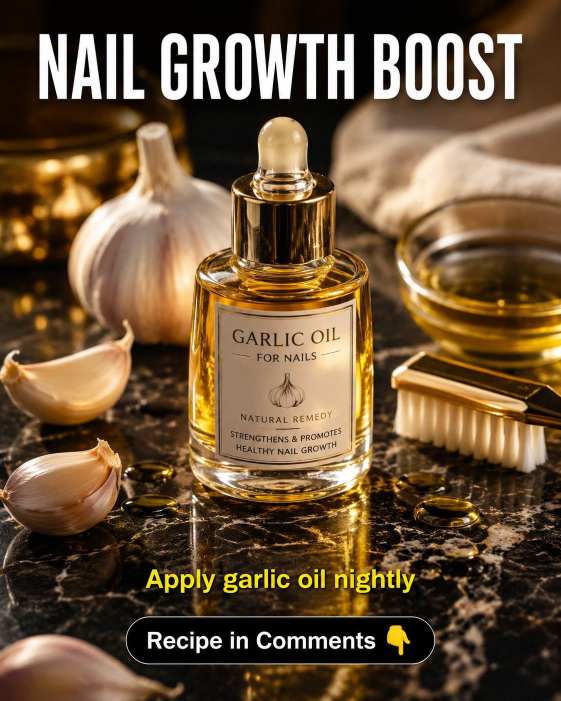
Long, smooth nails can improve the appearance of the hands and make them look better groomed. However, frequent washing, detergents, acetone, gel manicures, nail biting and repeated exposure to water can dehydrate the nail plate, causing peeling, splitting and breakage. This often creates the impression that the nails are not growing when, in reality, they are breaking before gaining visible length. Healthy fingernails generally grow about 3.47 millimetres per month, so no natural treatment can produce dramatically longer nails in only a few days. The realistic goal of home care is to moisturize the nail plate, protect the cuticles and reduce breakage so the nails can retain their natural growth. (PubMed)
Garlic oil is frequently promoted as a rapid nail-growth treatment. Garlic contains sulfur compounds with antimicrobial activity, but there is no strong clinical evidence that rubbing garlic or garlic oil on healthy nails accelerates their growth. Raw garlic can cause severe irritation, contact dermatitis and even second-degree chemical burns, particularly when it is crushed, covered or left on the skin overnight. For this reason, the following routines do not use raw garlic. They concentrate on safer, scientifically supported moisturizing and protective ingredients. (PubMed)

Remedy 1: For Normal Skin
Sunflower, Jojoba and Aloe Nail-Conditioning Serum
Ingredients
- 1 teaspoon high-linoleic sunflower seed oil
- ½ teaspoon jojoba oil
- ½ teaspoon virgin coconut oil
- 1 teaspoon plain aloe vera gel
- ¼ teaspoon vegetable glycerin
Scientific Working of Each Ingredient
Sunflower seed oil supplies skin-softening lipids and helps reduce moisture loss around the nail folds. Jojoba is technically a liquid wax and forms a lightweight protective layer without making the fingers excessively greasy. A small clinical study found that jojoba esters combined with glycerin produced longer-lasting skin hydration than glycerin alone.
Coconut oil acts as an emollient and has improved skin hydration in controlled trials. Aloe gel provides water and helps soften the cuticle area, while glycerin is a humectant that attracts and retains water. These ingredients do not stimulate the nail matrix directly; their benefit comes from improving flexibility and reducing dehydration-related splitting. (PubMed)
Procedure
Place all the ingredients in a clean bowl and whisk for 30 seconds. The mixture may separate because it contains both water-based and oil-based ingredients, so stir it immediately before application.
Wash and dry the hands. Massage one small drop over each nail, cuticle and surrounding skin for approximately one minute. Leave it on for at least 30 minutes or apply it before sleeping. Prepare a fresh portion rather than storing the mixture.
How Often to Apply
Apply every night for five days. Afterward, use it three or four nights weekly.
Initial Results
Within one to three days, the cuticles may feel smoother and the nail surface may look shinier. Reduced peeling and improved length retention usually require several weeks.
Remedy 2: For Combination Skin
Two-Zone Oatmeal and Honey Nail Mask
Ingredients
- 1 tablespoon finely ground colloidal oatmeal
- 1 tablespoon cooled boiled water
- 1 teaspoon plain aloe vera gel
- ½ teaspoon honey
- ¼ teaspoon vegetable glycerin
- ½ teaspoon sunflower seed oil
Scientific Working of Each Ingredient
Combination skin around the nails may have dry cuticles but relatively comfortable fingertips. Colloidal oatmeal contains starches and beta-glucans that support hydration and soothe the skin barrier. Glycerin binds water, while sunflower oil reduces water loss after washing.
Aloe provides light hydration without the heaviness of a thick balm. Honey acts as a humectant and helps give the mask a smooth consistency. Water hydrates the oatmeal and prevents it from behaving like a harsh physical scrub. Oatmeal-based topical care has been shown to improve skin hydration and barrier properties, which is helpful when dry cuticles contribute to hangnails and breakage. (PubMed Central (PMC))
Procedure
Mix the oatmeal and water and allow them to stand for two minutes. Add the aloe, honey and glycerin. Apply this lighter mixture over the fingers and cuticles.
Mix the sunflower oil into the remaining portion and apply the richer mixture directly over the nail plates and any particularly dry areas. Leave it on for 10 minutes, then rinse gently with lukewarm water. Do not scrape or push back the softened cuticles.
How Often to Apply
Use once daily for three days, followed by every alternate day for one week.
Initial Results
Dry edges may feel softer after the first treatment. The nails may appear smoother and less dull within two or three days.
Remedy 3: For Oily Skin
Lightweight Green Tea and Aloe Cuticle Gel
Ingredients
- 2 tablespoons cooled, freshly brewed green tea
- 1 tablespoon plain aloe vera gel
- 1 teaspoon colloidal oatmeal
- ¼ teaspoon vegetable glycerin
- ¼ teaspoon jojoba oil
Scientific Working of Each Ingredient
People with oily or sweaty hands may dislike heavy oils, but the nails still require protection. Aloe and green tea create a lightweight aqueous base. Green tea supplies antioxidant polyphenols, although it has not been clinically proven to increase nail growth.
Colloidal oatmeal helps hold water against the skin, glycerin supports hydration and the small quantity of jojoba reduces moisture evaporation without leaving a thick coating. The treatment may make the cuticles more flexible, helping prevent picking, cracking and hangnails. It should be viewed as conditioning care rather than a nail-growth stimulant. (PubMed)
Procedure
Mix the green tea and oatmeal and wait three minutes. Stir in the aloe and glycerin, followed by the jojoba oil. Massage a small amount around each nail for one minute. Leave it on for 10 minutes and rinse lightly, or remove the excess with a damp cloth.
Discard unused mixture immediately because fresh tea and aloe preparations do not contain preservatives.
How Often to Apply
Apply once daily for five days. Continue three times weekly when needed.
Initial Results
The skin should feel hydrated without becoming heavily coated. Within two or three days, rough cuticle edges may become less noticeable.
Remedy 4: For Dry Skin
Coconut and Sunflower Overnight Nail Balm
Ingredients
- 1 teaspoon virgin coconut oil
- 1 teaspoon sunflower seed oil
- 1 teaspoon jojoba oil
- ½ teaspoon shea butter
- ¼ teaspoon natural beeswax
Scientific Working of Each Ingredient
Dry nails benefit from emollients and occlusive substances that slow water loss. Coconut oil has demonstrated moisturizing effects in controlled clinical research. Sunflower oil supplies barrier-supporting fatty acids, while jojoba spreads easily over the nail plate and skin.
Shea butter softens dry cuticles, and beeswax creates a surface film that helps keep the oils in place overnight. Nail-care reviews recommend regular moisturization with oily or occlusive ingredients because altered hydration is an important contributor to brittle nails. (PubMed)
Procedure
Place the beeswax, shea butter and oils in a heat-safe bowl. Set the bowl over warm water until everything melts. Remove it from the heat, mix thoroughly and allow it to cool.
Massage a rice-grain-sized amount over each nail and cuticle. Wear clean, loose cotton gloves overnight. Do not use the balm over broken, infected or inflamed skin.
How Often to Apply
Use nightly for at least five days. Continue every night for two to four weeks if the nails remain dry.
Initial Results
Cuticles may feel softer the following morning. Surface shine and flexibility may improve within three days, but noticeable reduction in splitting generally takes several weeks.
Remedy 5: For Sensitive Skin
Minimal Oat and Glycerin Nail Compress
Ingredients
- 1 tablespoon colloidal oatmeal
- 2 tablespoons cooled boiled water
- ¼ teaspoon vegetable glycerin
- ¼ teaspoon sunflower seed oil
- ½ teaspoon plain aloe vera gel, only if previously tolerated
Scientific Working of Each Ingredient
Sensitive skin should be treated with fewer ingredients and no raw garlic, lemon juice, essential oils or fragrance. Colloidal oatmeal helps soothe and support a weakened barrier. Glycerin increases water retention, while sunflower oil helps seal hydration into the skin.
Cooled water allows the oatmeal to form a soft compress without friction. Aloe can add hydration, but it should be omitted when there is any history of aloe sensitivity. This remedy works by improving the condition of the skin surrounding the nail, not by forcing faster nail production. (PubMed Central (PMC))
Procedure
Soak the oatmeal in the water for five minutes. Add the glycerin, sunflower oil and aloe. Apply the mixture around the nails for five minutes, then rinse gently and pat dry.
Test the mixture on a small area for 24 hours before applying it to every finger. Stop using it if itching, burning, swelling or redness occurs.
How Often to Apply
Apply once daily for three days. If well tolerated, continue every alternate day for two weeks.
Initial Results
Tightness and roughness may improve within one to three applications. Sensitive skin should be treated gradually rather than repeatedly exposed to intensive overnight mixtures.
Final Tips for Faster-Looking Nail Growth
Keep nails short while they are peeling so damaged edges cannot catch and split further. File in one direction rather than using a back-and-forth sawing motion. Do not cut or aggressively push back the cuticles because they protect the nail root from bacteria and other microorganisms.
Wear gloves while washing dishes, handling detergents or cleaning. Repeated wetting and drying can progressively dehydrate the nail plate. Apply oil or moisturizer after washing the hands, especially when using frequent hand sanitizer. Take breaks from acrylic nails, gel polish and acetone removers because repeated filing and chemical exposure can leave natural nails thin, brittle and dry. (American Academy of Dermatology)
Softer cuticles and a healthier surface shine may become noticeable within two or three days. However, meaningful improvement in breakage generally takes six to twelve weeks, and complete fingernail replacement can take several months. Home remedies cannot repair the already damaged portion from inside; that section must gradually grow out.
Diet Plan for Stronger Nails
Follow a balanced diet for at least eight to twelve weeks because new nail tissue forms slowly.
Breakfast: Eat cooked eggs with whole-grain bread, or oatmeal with yogurt, seeds and nuts. Eggs, fish, nuts and seeds contain naturally occurring biotin and protein.
Mid-morning: Choose guava, orange, berries or another vitamin-C-rich fruit.
Lunch: Include lentils, chickpeas, beans, chicken or fish with vegetables and whole-grain roti or brown rice. Combine plant-based iron sources such as lentils and spinach with vitamin-C-rich vegetables to improve iron absorption.
Evening snack: Eat a small portion of almonds, walnuts, pumpkin seeds or plain yogurt.
Dinner: Select fish, chicken, tofu, beans or lentil soup with cooked vegetables and salad.
Drink enough water according to thirst and activity. Avoid relying on high-dose biotin supplements unless a qualified clinician recommends them. Evidence supporting biotin for healthy people is limited, and large supplemental doses can interfere with laboratory tests, including some thyroid and heart-related tests. (U.S. Food and Drug Administration)
Continue the appropriate home remedy for two to four weeks and maintain protective nail care for at least three months. See a doctor or dermatologist if the nails become yellow, thick, painful, separated from the nail bed, suddenly spoon-shaped, deeply ridged or surrounded by red and swollen skin. Unexplained changes may be associated with fungal infection, psoriasis, iron deficiency, thyroid disease or another health condition. (nhs.uk)
References for the above remedy
- Yaemsiri, S. et al. “Growth rate of human fingernails and toenails in healthy American young adults.”
https://pubmed.ncbi.nlm.nih.gov/19744178/ - Colombo, V.E. et al. “Pathogenesis, Clinical Signs and Treatment Recommendations in Brittle Nails: A Review.”
https://pmc.ncbi.nlm.nih.gov/articles/PMC6994568/ - American Academy of Dermatology Association. “What can make my hands look younger?”
https://www.aad.org/public/cosmetic/younger-looking/what-makes-hands-look-younger - American Academy of Dermatology Association. “How to trim your nails.”
https://www.aad.org/public/everyday-care/nail-care-secrets/basics/how-to-trim-nails - Agero, A.L.C. and Verallo-Rowell, V.M. “A randomized double-blind controlled trial comparing extra virgin coconut oil with mineral oil as a moisturizer for xerosis.”
https://pubmed.ncbi.nlm.nih.gov/15724344/ - Gruber, J.V. et al. “Evaluation of additive effects of hydrolyzed jojoba esters and glycerol.”
https://pubmed.ncbi.nlm.nih.gov/19146603/ - Xu, S. et al. “Chemical burn caused by topical application of garlic under occlusion.”
https://pubmed.ncbi.nlm.nih.gov/24456964/ - Gavaric, N. et al. “Garlic burn injuries: A systematic review of reported cases.”
https://pubmed.ncbi.nlm.nih.gov/33571752/ - National Institutes of Health, Office of Dietary Supplements. “Biotin Fact Sheet for Consumers.”
https://ods.od.nih.gov/factsheets/biotin-Consumer/ - NHS. “Nail problems.”
https://www.nhs.uk/symptoms/nail-problems/