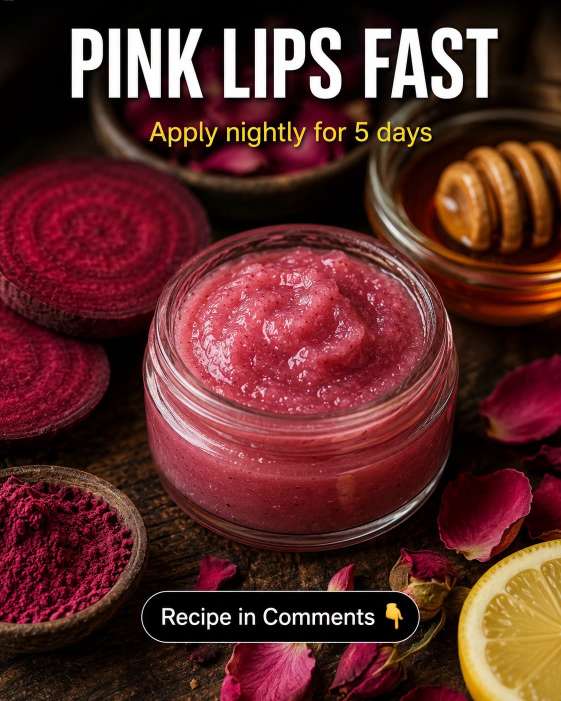
Dark, dry, or uneven-looking lips can affect facial appearance and confidence. Common contributors include repeated lip licking, dehydration, sun exposure, smoking, irritating cosmetics, allergic contact reactions, and inflammation. Natural care may restore softness, reduce surface flaking, and create a healthier rosy appearance, but it cannot safely change genetically dark lips into permanently pink lips within five days. Beetroot can leave a temporary pink-red stain, while moisturising ingredients help the lips reflect light more evenly. Persistent or newly developed lip pigmentation may have several causes and sometimes needs medical assessment. (PubMed)
The lemon shown in the image should not be applied to the lips. Lemon juice is acidic and can cause burning, dryness, irritation, and inflammation. When citrus residue is exposed to sunlight, it may also trigger phytophotodermatitis and leave darker pigmentation. The remedies below therefore use beetroot for temporary colour and evidence-supported emollients for barrier repair.
The remedies are organised according to the condition of the lips and surrounding facial skin. The lip surface does not behave exactly like oily or combination facial skin, so the “oily” and “combination” categories refer mainly to the skin around the mouth.
Remedy 1: Beetroot and Aloe Night Gel for Normal Skin
Ingredients
- 1 teaspoon fresh beetroot juice
- 1 teaspoon plain aloe-vera gel
- ½ teaspoon pure honey
- ¼ teaspoon sunflower-seed oil
- ½ teaspoon finely ground colloidal oatmeal
- 1 teaspoon cooled boiled water
Scientific Working of Each Ingredient
Beetroot: Beetroot contains water-soluble betalain pigments responsible for its red-purple colour. These pigments can temporarily stain the outer lip surface, creating a rosy appearance. This is a cosmetic tint rather than permanent melanin reduction. Betalain colour also breaks down with heat, oxygen, ultraviolet light, and prolonged storage, so the mixture should be prepared fresh. (PubMed)
Aloe vera: Topical aloe preparations have demonstrated moisturising activity by increasing surface hydration. Aloe creates a lightweight gel base and may reduce the tight feeling associated with dryness, although it has not been proven to permanently lighten lips. (PubMed)
Honey: Honey holds water and gives the mixture a smooth texture. Clinical research mainly supports medical-grade honey for selected wounds rather than ordinary honey for lip pigmentation, so its role here is moisturising and conditioning. (PubMed)
Sunflower oil: Sunflower-seed oil contains linoleic acid and can work as a light emollient. Research on adult skin found that it preserved barrier integrity and improved hydration, unlike olive oil, which weakened the barrier in that study. (PubMed)
Colloidal oatmeal: Finely ground oatmeal contains soothing compounds and supports hydration and barrier function. It also thickens the remedy without requiring harsh sugar or salt crystals. (PubMed)
Procedure
Combine the oatmeal and cooled water and leave them for two minutes. Add the aloe, honey, sunflower oil, and beetroot juice. Mix until smooth.
Apply a very thin layer to clean lips before bed. Leave it on for 15 minutes, rinse gently, and apply one drop of sunflower oil to slightly damp lips. Avoid leaving fresh food-based mixtures on overnight because they can become contaminated.
How Often to Apply
Use nightly for five days. Prepare a fresh portion each evening and discard leftovers.
Initial Results
Within one to three days, the lips may feel softer, look smoother, and show a temporary rosy tint. Permanent changes in natural lip colour should not be expected.
Remedy 2: Green Tea and Beet Lip Mask for Combination Skin
Ingredients
- 1 teaspoon cooled green tea
- ¾ teaspoon beetroot juice
- 1 teaspoon aloe-vera gel
- ½ teaspoon honey
- ½ teaspoon oat flour
- 2 drops sunflower-seed oil
Scientific Working of Each Ingredient
Green tea supplies antioxidant catechins and creates a lightweight water base. Aloe hydrates without leaving the surrounding mouth area excessively greasy. The tiny quantity of sunflower oil reduces moisture loss, while oatmeal makes the treatment less runny.
Beetroot contributes temporary colour, and honey improves spreadability. None of these ingredients has been clinically shown to turn naturally dark lips permanently pink, but supporting the barrier may make dehydrated lips appear brighter and more even.
Procedure
Brew green tea without sugar, let it cool completely, and measure one teaspoon. Mix it with the remaining ingredients.
Apply the mask over the lips, keeping it inside the natural lip border. Leave it on for eight to ten minutes and rinse with lukewarm water. Pat dry rather than rubbing.
How Often to Apply
Apply on alternate nights for five days and then twice weekly for another two weeks.
Initial Results
The dry portions of the lips may become smoother within one to three applications. Beetroot may produce a subtle pink tint that lasts several hours, depending on eating, drinking, and lip licking.
Remedy 3: Oil-Free Aloe, Oat and Licorice Treatment for Oily Skin
Ingredients
- 1 teaspoon aloe-vera gel
- 1 teaspoon cooled green tea
- ½ teaspoon beetroot juice
- ½ teaspoon colloidal oatmeal
- ½ teaspoon strained licorice-root infusion
- ¼ teaspoon honey
Scientific Working of Each Ingredient
Licorice contains compounds such as glabridin that have shown activity against pathways involved in melanin formation. However, much of the strongest evidence involves standardised extracts in formulated creams or laboratory studies—not homemade licorice tea applied to lips. A clinical study using a cream containing licorice with other botanical extracts reported pigmentation improvement over 60 days, not five days. (PubMed)
This mask contains no added oil, making it suitable when the surrounding mouth area is prone to clogged pores. Aloe, tea, and oatmeal provide a light base, while beetroot gives temporary colour.
Procedure
Make a weak licorice infusion by soaking a small piece of dried licorice root in hot water for five minutes. Cool and strain it thoroughly.
Combine the measured infusion with aloe, green tea, beetroot, honey, and oatmeal. Apply only to the lips for seven minutes and rinse carefully.
Do not lick or swallow the treatment. People who are pregnant, have high blood pressure, or take medication should avoid experimenting with concentrated licorice preparations.
How Often to Apply
Use once every other night for five days. Continue no more than twice weekly unless the lips remain comfortable.
Initial Results
The lips may feel less rough after two or three uses, and the beetroot can provide a short-lived rosy colour. True pigmentation changes would require considerably longer and are not guaranteed.
Remedy 4: Coconut, Shea and Beet Balm for Dry Lips
Ingredients
- ½ teaspoon virgin coconut oil
- ½ teaspoon sunflower-seed oil
- ½ teaspoon unrefined shea butter
- ¼ teaspoon honey
- ¼ teaspoon aloe-vera gel
- ¼ teaspoon beetroot powder
- ¼ teaspoon finely ground oatmeal
Scientific Working of Each Ingredient
Virgin coconut oil has been tested as a moisturiser for dry skin. In a double-blind trial, it significantly improved skin hydration and surface lipid levels over two weeks. Another controlled trial found improvements in barrier measurements among participants with atopic dermatitis. These studies involved skin rather than lips, so the evidence supports moisturising—not lip lightening. (PubMed)
Shea butter and the oils reduce friction and form an emollient layer. Honey and aloe supply moisture, while beetroot powder adds temporary colour. Oatmeal should be ground extremely finely so it does not behave like an abrasive scrub.
Procedure
Place the coconut oil and shea butter in a clean bowl and soften them using the warmth of your fingers. Do not heat them excessively. Mix in the sunflower oil, honey, aloe, beetroot powder, and finely ground oatmeal.
Massage one small drop over damp lips for approximately 20 seconds. Leave it on for 15 minutes, remove excess with a damp cloth, and apply a plain layer of the oil-and-shea mixture before sleeping.
How Often to Apply
Use nightly for five days. Afterward, apply the plain oil-and-shea mixture whenever the lips feel dry.
Initial Results
Dryness, tightness, and visible flaking may improve within one to three nights. Better hydration can temporarily soften vertical lip lines and make the lips look fuller and healthier.
Remedy 5: Minimal Oat and Aloe Compress for Sensitive Lips
Ingredients
- 1 teaspoon colloidal oatmeal
- 2 teaspoons cooled boiled water
- ½ teaspoon aloe-vera gel
- ¼ teaspoon sunflower-seed oil
- ¼ teaspoon honey
- 2 drops beetroot juice
Scientific Working of Each Ingredient
Sensitive lips benefit from a minimal formula. Oatmeal provides a soothing base, while aloe adds water-based hydration. Sunflower oil supplies a small amount of barrier-supporting lipid. Only two drops of beetroot are included to reduce the possibility of irritation while still providing mild temporary colour.
Honey should be omitted when there is a known pollen, bee-product, or honey allergy. Aloe can also cause contact reactions in some individuals, so testing is necessary.
Procedure
Soak the oatmeal in cooled water for five minutes. Strain it through clean cloth to produce a smooth oat liquid. Add the aloe, sunflower oil, honey, and beetroot.
Patch-test a small amount beside the mouth and wait 24 hours. When no reaction develops, soak a clean cotton pad in the mixture and press it against the lips for five minutes. Rinse and pat dry.
How Often to Apply
Use on alternate nights for at least five days. Stop immediately if burning, itching, swelling, blistering, or persistent redness develops.
Initial Results
The lips may feel calmer and less tight after one to three applications. Sensitive lips should be treated slowly; rapid peeling or strong tingling is irritation, not evidence that a remedy is working.
Final Tips for Naturally Soft and Healthy-Looking Pink Lips
Avoid lemon juice, baking soda, toothpaste, cinnamon, undiluted essential oils, and rough sugar scrubs. These can damage the fragile lip barrier and may worsen pigmentation through inflammation.
Do not lick, bite, peel, or repeatedly rub the lips. Saliva evaporates quickly and can leave lips drier. Clean reusable applicators regularly, avoid sharing lip products, drink enough water, and use a humidifier when indoor air is dry.
Protect the lips outdoors with a non-irritating broad-spectrum SPF 30 or higher lip treatment and reapply it approximately every two hours. The American Academy of Dermatology recommends sun protection because ultraviolet exposure can burn and aggravate dry lips. (American Academy of Dermatology)
Softness and a temporary beetroot tint may appear within two or three days. Lasting improvement in chapping usually requires consistent protection for two to three weeks. Hydration may make fine lines look softer, but home remedies do not permanently erase lip wrinkles or genetically determined pigmentation.
Diet Plan for Healthy Lips
Follow this balanced plan for at least eight weeks:
Breakfast: Eat eggs, fortified cereal, milk, yogurt, or lentils with a vitamin-C-rich fruit such as guava, orange, kiwi, or strawberries.
Mid-morning: Choose a handful of almonds, pumpkin seeds, peanuts, or sunflower seeds.
Lunch: Include chicken, fish, lean meat, beans, chickpeas, or lentils with leafy vegetables and whole-grain roti or rice.
Evening snack: Have yogurt, fruit, roasted chickpeas, or a boiled egg.
Dinner: Eat a protein source with mixed vegetables. Include foods containing iron, folate, vitamin B12, zinc, and riboflavin regularly.
A balanced diet supports normal skin and mucosal health, but food alone will not turn naturally brown lips permanently pink. Do not start high-dose iron or vitamin supplements without medical advice and appropriate testing.
Continue a suitable home remedy for five days and maintain gentle moisturising and sun protection for two to three weeks. See a dermatologist or doctor when darkening appears suddenly, affects only one area, continues to spread, or occurs with pain, sores, bleeding, swelling, persistent scaling, or colour changes inside the mouth. Medical review is also important when chapped lips do not improve after two to three weeks, because allergic cheilitis, infection, nutritional deficiency, medication reactions, or sun-related actinic cheilitis may require treatment. (PubMed)
References for the above remedy
- American Academy of Dermatology Association. “7 Dermatologists’ Tips for Healing Dry, Chapped Lips.”
https://www.aad.org/public/everyday-care/skin-care-basics/dry/heal-dry-chapped-lips - Alawi, F. “Approaches to the Evaluation of Lip Hyperpigmentation.” International Journal of Dermatology.
https://pubmed.ncbi.nlm.nih.gov/22715817/ - “Cheilitis: A Diagnostic Algorithm and Review of Underlying Etiologies.”
https://pubmed.ncbi.nlm.nih.gov/38422211/ - Agero, A. L. C. and Verallo-Rowell, V. M. “A Randomized Double-Blind Controlled Trial Comparing Extra Virgin Coconut Oil with Mineral Oil as a Moisturizer for Mild to Moderate Xerosis.”
https://pubmed.ncbi.nlm.nih.gov/15724344/ - Danby, S. G. et al. “Effect of Olive and Sunflower Seed Oil on the Adult Skin Barrier.”
https://pubmed.ncbi.nlm.nih.gov/22995032/ - Dal’Belo, S. E., Gaspar, L. R. and Maia Campos, P. M. B. G. “Moisturizing Effect of Cosmetic Formulations Containing Aloe Vera Extract.”
https://pubmed.ncbi.nlm.nih.gov/17026654/ - Yokota, T. et al. “The Inhibitory Effect of Glabridin from Licorice Extracts on Melanogenesis and Inflammation.”
https://pubmed.ncbi.nlm.nih.gov/9870547/ - Capone, K. et al. “Effects of Colloidal Oatmeal Topical Atopic Dermatitis Cream on Skin Microbiome and Skin Barrier Properties.”
https://pubmed.ncbi.nlm.nih.gov/32484623/ - Jull, A. B. et al. “Honey as a Topical Treatment for Wounds.” Cochrane Database of Systematic Reviews.
https://pubmed.ncbi.nlm.nih.gov/25742878/ - Esatbeyoglu, T. et al. “Coloring Attributes of Betalains: A Key Emphasis on Stability and Future Applications.”
https://pubmed.ncbi.nlm.nih.gov/28262892/