
Smooth-looking skin begins with adequate hydration, a healthy protective barrier and reduced surface roughness. When the outer skin layer loses water, it becomes flaky and reflects light unevenly, making fine lines, pores and dullness appear more noticeable. Aloe vera, oatmeal, glycerin, seed gels and gentle massage may temporarily improve softness and radiance, but no homemade treatment can permanently lift the face or erase established wrinkles in five minutes. A small human study found that five minutes of facial-roller massage temporarily increased circulation in the treated cheek; it did not prove immediate collagen production or permanent tightening. (PubMed)
The exact recipes below have not been tested as complete clinical formulations. Their ingredients were selected because standardized versions have human evidence for hydration, barrier support, oil control or smoother texture. Prepare each remedy for one application, patch-test it for 24 hours and avoid storing preservative-free mixtures.
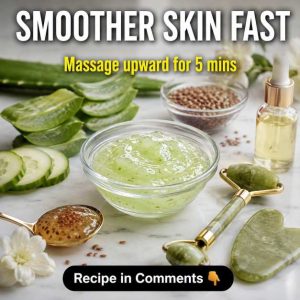
Remedy 1: For Normal Skin
Aloe, Chia and Honey Hydration Gel
Ingredients
- 1 teaspoon plain aloe vera gel: supplies lightweight surface hydration
- 1 teaspoon freshly prepared chia gel: creates a moisture-rich, slippery texture
- 1 teaspoon cooled green tea: supplies antioxidant tea polyphenols
- 1 teaspoon colloidal oatmeal: helps reduce roughness and support the barrier
- ½ teaspoon pure honey: binds moisture to the skin’s surface
- 1 drop vegetable glycerin: helps the outer skin layer retain water
Scientific Working of Each Ingredient
Aloe vera extracts have increased stratum-corneum water content after topical application. A formulated chia-seed extract cream also improved hydration in a small human trial, although ordinary chia gel is not equivalent to that standardized extract. Honey-containing creams have produced measurable improvements in moisturisation and smoothness after several weeks. Glycerin works as a humectant and supports hydration, elasticity and barrier recovery, while colloidal oatmeal helps reduce dryness and tactile roughness. (PubMed)
Procedure
Soak one teaspoon of chia seeds in four tablespoons of clean water for 15 minutes. Strain and measure one teaspoon of the gel. Combine it with aloe, honey and green tea, then stir in the oatmeal and glycerin.
Apply a thin layer to clean, slightly damp skin. Leave it on for eight minutes. Moisten your fingertips and massage gently upward and outward for one minute before rinsing.
How Often to Apply
Apply once daily for three days. Continue two or three times weekly for another three weeks if the skin remains comfortable.
Initial Results
The face may feel softer and look more hydrated within one to three days. Fine dehydration lines may appear temporarily smoother, but deeper wrinkles will not disappear.
Remedy 2: For Combination Skin
Soy, Green Tea and Rice Split-Zone Mask
Ingredients
- 1 teaspoon unsweetened soy milk: provides a lightweight conditioning base
- 1 tablespoon strongly brewed, cooled green tea: may support gradual sebum balance
- 1 teaspoon plain aloe vera gel: hydrates without a heavy oily coating
- 1 teaspoon rice starch: gives a smooth, mildly absorbent texture
- 1 teaspoon colloidal oatmeal: supports dry cheek areas
- 2 drops sunflower seed oil: supplement lipids on dry outer areas
Scientific Working of Each Ingredient
A stabilized soy moisturizer improved overall texture, dullness, fine lines and uneven tone during a 12-week controlled study. Kitchen soy milk contains less predictable amounts of active compounds, so its effects will be milder. A topical green-tea formulation gradually reduced facial sebum over 60 days, while rice starch supported the recovery of experimentally weakened skin barriers. Sunflower seed oil preserved barrier integrity and improved hydration in human research. (PubMed)
Procedure
Mix the soy milk, green tea and aloe. Add the rice starch and oatmeal. Divide the mixture in half and add the sunflower oil to one portion.
Apply the oil-free portion over the forehead, nose and chin. Spread the oil-enriched portion lightly over the cheeks. Leave it on for seven to eight minutes and rinse before it becomes dry.
How Often to Apply
Use on days one, three and five. Continue twice weekly for four weeks when no irritation or clogged bumps develop.
Initial Results
The cheeks may feel less tight after two or three applications, while the T-zone may look temporarily less shiny. This mask cannot permanently shrink pores.
Remedy 3: For Oily Skin
Flaxseed, Green Tea and Gentle Clay Gel
Ingredients
- 1 tablespoon cooled green tea: supplies catechin antioxidants
- 1 teaspoon freshly prepared flaxseed gel: gives lightweight slip and moisture
- 1 teaspoon cosmetic-grade kaolin clay: absorbs some surface oil
- 1 teaspoon plain aloe vera gel: provides non-oily hydration
- 1 teaspoon rice starch: creates a smoother, less sticky texture
- 1 teaspoon colloidal oatmeal: helps prevent excessive tightness
Scientific Working of Each Ingredient
Green-tea formulations have shown gradual reductions in facial sebum rather than immediate control. A small study of a professionally formulated flaxseed-extract microemulgel reported improvements in moisture, sebum and elasticity measurements, but homemade flaxseed gel is much less standardized. Kaolin mainly absorbs surface oil and gives a temporary matte finish; it does not switch off oil glands. Aloe, oatmeal and rice starch help protect the barrier so that the clay does not leave the face overly dry. (PubMed)
Procedure
Simmer one teaspoon of flaxseeds in half a cup of water for approximately five minutes. Strain while warm and allow the gel to cool completely.
Mix one teaspoon of gel with green tea and aloe. Add the rice starch, oatmeal and kaolin. Apply a very thin layer without rubbing active pimples. Leave it on for five minutes and rinse while it remains slightly moist.
How Often to Apply
Apply every other day for five days, providing three applications. Continue no more than once weekly afterward.
Initial Results
The face may look less shiny and feel smoother after the first few uses. Blackheads, inflammatory acne and acne scars will require appropriate long-term treatment.
Remedy 4: For Dry Skin
Coconut, Honey and Oat Cushion Mask
Ingredients
- ¼ teaspoon virgin coconut oil: supplies emollient lipids
- 1 teaspoon pure honey: helps attract moisture
- 1 teaspoon plain aloe vera gel: provides water-based hydration
- 1 tablespoon colloidal oatmeal: softens rough, flaky texture
- 2 drops vegetable glycerin: supports water retention
- 1 teaspoon cooled boiled water: creates a spreadable consistency
Scientific Working of Each Ingredient
In a randomized double-blind study, virgin coconut oil significantly improved hydration and surface lipid levels in people with mild-to-moderate xerosis. Honey creams have improved skin moisturisation and smoothness, while oatmeal formulations have reduced dryness and supported barrier function. Glycerin helps maintain water within the outer skin layer, and aloe provides short-term hydration. These effects may make dry skin look plumper, but they do not rebuild lost facial volume. (PubMed)
Procedure
Soak the oatmeal in cooled water for one minute. Mix in the aloe, honey and glycerin. Soften the coconut oil between clean fingertips and blend it into the mask.
Apply to slightly damp skin for 10 minutes. Rinse gently and apply a simple fragrance-free moisturizer immediately afterward.
How Often to Apply
Use once daily for three to five days. Continue three times weekly for another three weeks.
Initial Results
Tightness and flaking may begin to improve after one to three applications. Dehydration lines can look softer as moisture improves.
Remedy 5: For Sensitive Skin
Fragrance-Free Oat and Rice Compress
Ingredients
- 1 tablespoon cooled boiled water: creates a simple, fragrance-free base
- 1½ teaspoons colloidal oatmeal: supports irritated or reactive skin
- 1 teaspoon rice starch: provides a soft, non-abrasive texture
- 2 drops sunflower seed oil: helps reduce moisture loss
- 1 drop vegetable glycerin: improves water retention
- ½ teaspoon aloe vera gel, optional: adds hydration when tolerated
Scientific Working of Each Ingredient
Sensitive skin often appears rougher when irritation weakens its barrier. Clinical research found that a 1% colloidal-oatmeal cream improved hydration, skin pH and barrier function. Rice starch improved the recovery of detergent-damaged skin, while sunflower seed oil preserved barrier integrity. Glycerin further supports hydration and skin mechanical properties. Aloe is optional because botanical gels may irritate certain individuals. (PubMed)
Procedure
Soak the oatmeal and rice starch in cooled boiled water for two minutes. Mix in the glycerin, sunflower oil and optional aloe.
Patch-test for 24 hours. Apply a thin layer for five minutes and rinse with lukewarm water. Do not use a facial roller or massage sensitive, inflamed skin.
How Often to Apply
Use every other day for three to five days. Continue once weekly only if the face remains completely calm.
Initial Results
Mild tightness and roughness may improve after one to three uses. Stop immediately if burning, swelling, itching or persistent redness appears.
How to Perform a Safe Five-Minute Upward Facial Massage
Apply enough aloe gel or moisturizer to prevent pulling. Begin at the centre of the chin and glide toward the ears. Move from the sides of the nose toward the temples, then from the eyebrows toward the hairline. Use light pressure and slow movements rather than pushing firmly.
A study involving a small number of participants found that five minutes of roller massage increased local facial blood flow for at least ten minutes. Five weeks of regular use also changed vascular responses in the treated area. These findings do not prove that massage permanently lifts sagging skin, removes wrinkles or stimulates major collagen growth. (PubMed)
Avoid massage over inflamed acne, rosacea flares, sunburn, broken skin, infection or recently treated cosmetic areas.
Final Tips for Maintaining Smoother Skin
Use lukewarm water, keep rollers and facial tools clean and avoid rough scrubs. Do not apply lemon juice, baking soda, undiluted essential oils or coarse sugar to the face. Patch-test all natural ingredients and discard homemade mixtures after one application.
Apply broad-spectrum sunscreen every morning. In a randomized trial, daily sunscreen users developed 24% less measurable skin aging than people who used sunscreen at their discretion over approximately four and a half years. Consistent sun protection is therefore more reliable for preserving smooth texture than repeated massage alone. (PubMed)
Visible softness and hydration may begin within two or three days. Continue one suitable remedy for three to four weeks. Hydration can soften fine surface lines, but established wrinkles, acne scars and persistent rough patches may require professional treatment. See a dermatologist if the problem persists, becomes painful or occurs with itching, peeling, swelling or repeated redness.
Diet Plan for Naturally Smooth, Healthy-Looking Skin
Follow this balanced plan for at least four to six weeks alongside gentle skincare.
Breakfast: Choose eggs, oatmeal, beans or unsweetened yogurt with papaya, berries, guava or an orange.
Lunch: Eat fish, chicken, lentils or chickpeas with leafy vegetables and a moderate serving of brown rice or whole-grain bread.
Snack: Have a whole fruit with a small handful of unsalted walnuts, almonds, pumpkin seeds or sunflower seeds.
Dinner: Include protein with carrots, spinach, tomatoes, broccoli, pumpkin or peppers.
Drink according to thirst, maintain regular sleep and avoid crash diets. A randomized crossover trial found that four weeks of high-carotenoid fruit and vegetable intake increased measurable skin yellowness without changing skin lightness. This supports eating colourful produce for a healthier-looking complexion rather than relying on supplements or whitening claims. (PubMed)
Continue the home remedy and diet plan for at least one month. When persistent roughness occurs with severe fatigue, hair loss, widespread dryness or unexplained weight changes, consult a doctor to investigate possible dermatological, hormonal or nutritional causes.
References for the above remedy
- Miyaji A, Sugimori K, Hayashi N. Short- and long-term effects of using a facial massage roller on facial skin blood flow and vascular reactivity.
https://pubmed.ncbi.nlm.nih.gov/30477852/ - Dal’Belo SE, Gaspar LR, Maia Campos PMBG. Moisturizing effect of cosmetic formulations containing Aloe vera extract.
https://pubmed.ncbi.nlm.nih.gov/17026654/ - Huber KL, et al. A novel topical chia seed extract that improves skin hydration.
https://pubmed.ncbi.nlm.nih.gov/32378329/ - Capone K, et al. Effects of colloidal oatmeal cream on skin-barrier properties.
https://pubmed.ncbi.nlm.nih.gov/32484623/ - Fluhr JW, Darlenski R, Surber C. Glycerol and the skin: hydration and barrier functions.
https://pubmed.ncbi.nlm.nih.gov/18510666/ - Wallo W, Nebus J, Leyden JJ. Efficacy of a soy moisturizer in photoaging, texture and fine lines.
https://pubmed.ncbi.nlm.nih.gov/17941363/ - De Paepe K, et al. Effect of rice starch on impaired skin-barrier function.
https://pubmed.ncbi.nlm.nih.gov/12353708/ - Agero ALC, Verallo-Rowell VM. Virgin coconut oil as a moisturizer for mild-to-moderate xerosis.
https://pubmed.ncbi.nlm.nih.gov/15724344/ - Hughes MCB, Williams GM, Baker P, Green AC. Sunscreen and prevention of skin aging: a randomized trial.
https://pubmed.ncbi.nlm.nih.gov/23732711/ - Pezdirc K, et al. High-carotenoid fruit and vegetable intake and measurable skin changes.
https://pubmed.ncbi.nlm.nih.gov/27160341/