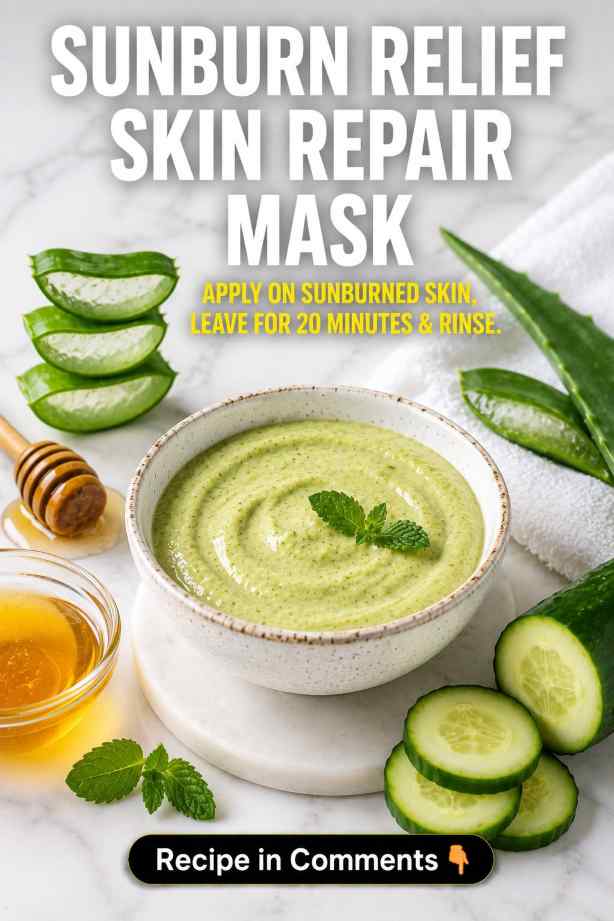
Sunburn is an inflammatory skin injury caused by excessive ultraviolet exposure. Redness, warmth, tenderness, dryness, and later peeling occur because UV radiation damages skin cells and triggers inflammation. A cooling natural treatment can reduce discomfort and support the damaged moisture barrier, but no homemade mask can instantly reverse UV-induced cellular or DNA damage. The American Academy of Dermatology recommends getting out of the sun, using cool baths or compresses, moisturizing damp skin with preparations containing aloe vera or soy, using colloidal oatmeal for soothing, and drinking extra water. (American Academy of Dermatology) For that reason, the commonly pictured combination of cucumber, mint, and honey is not the foundation of these remedies; the formulas below focus on ingredients with stronger clinical or dermatologic support.

Remedy 1: For Normal Skin
Aloe, Soy and Oat Cooling Repair Mask
Ingredients
- 1 tablespoon pure aloe vera gel — studied for reducing UV-induced redness and inflammation.
- 1 tablespoon plain unsweetened soy milk — soy-containing moisturizers are recommended by dermatologists for soothing sunburn.
- 1 teaspoon colloidal oatmeal — supports the damaged skin barrier and improves hydration.
- 1 teaspoon cool boiled water — provides immediate gentle cooling.
- 1/4 teaspoon vegetable glycerin — a humectant that helps the outer skin hold water.
Scientific Working of Each Ingredient
Aloe vera has mixed clinical evidence, so it should not be described as an instant sunburn cure. One randomized controlled UV-erythema study found that highly concentrated aloe gel significantly reduced redness after 48 hours, while another aloe-cream study found no advantage over placebo. (PubMed) This is why aloe is best considered a soothing supportive treatment rather than a guaranteed cure.
Colloidal oatmeal has demonstrated improvements in skin hydration and barrier function, while glycerin-based emollients significantly increase hydration of the outer skin. (PubMed)
Procedure: Mix all five ingredients until smooth. Refrigerate the mixture for about 10 minutes so that it feels cool, but not icy. Apply a thin layer to intact sunburned skin without rubbing. Leave for 10–15 minutes, rinse gently with cool or lukewarm water, and pat dry.
How Often to Apply: Once or twice daily for 3–5 days.
Initial Results: Cooling and hydration may reduce tightness and discomfort after the first application. Redness may start easing over the following 1–3 days, depending on the severity of the burn.
Remedy 2: For Combination Skin
Rice-Starch and Oat Barrier-Recovery Compress
Ingredients
- 1 teaspoon pure rice starch — studied for improving recovery of damaged skin-barrier function.
- 1 teaspoon colloidal oatmeal — helps soothe irritation and reduce moisture loss.
- 1 tablespoon aloe vera gel — adds cooling hydration.
- 1 tablespoon plain unsweetened soy milk — provides a lightweight soothing base.
- 2 tablespoons cool boiled water — creates a gentle cooling compress.
How This Remedy Supports Skin Repair
A human study of rice starch found that exposure to rice-starch-containing bath water twice daily improved the healing capacity of experimentally damaged skin by about 20%. Importantly, this research concerned barrier-damaged skin rather than specifically sunburn, so rice starch should be viewed as a barrier-support ingredient rather than an antidote to UV damage. (PubMed)
Oatmeal is particularly useful when burned skin begins feeling dry or itchy, and the AAD specifically includes colloidal oatmeal baths among its sunburn-relief recommendations. (American Academy of Dermatology)
Procedure: Combine rice starch and colloidal oatmeal. Slowly stir in the water and soy milk, then add aloe. Saturate a clean soft cotton cloth with the thin mixture and place it gently over the burned area for 10–15 minutes. Do not scrub.
How Often to Apply: Once daily for at least 3 days, or twice daily if the skin tolerates it comfortably.
Initial Results: The surface may feel less hot and tight after treatment. Mild dryness and roughness may improve within 2–3 days.
Remedy 3: For Oily Skin
Lightweight Aloe-Soy Cooling Gel
Ingredients
- 2 tablespoons pure aloe vera gel — provides a water-rich cooling base.
- 1 tablespoon unsweetened soy milk — recommended as a soothing component for sunburned skin.
- 1 teaspoon colloidal oatmeal — protects against excessive dryness.
- 2 teaspoons cool boiled water — thins the mixture for oily skin.
- 1/4 teaspoon vegetable glycerin — supports hydration without adding heavy oils.
Scientific Working for Oily Sunburned Skin
Even oily skin can become dehydrated after UV injury. Removing all moisture with strong cleansers or astringents can make the damaged barrier feel tighter and more uncomfortable. The AAD recommends moisturizing sunburned skin while it is still damp and specifically mentions aloe vera or soy. (American Academy of Dermatology) Glycerin provides hydration without the heaviness of an oil-rich mask, and clinical studies show that glycerol-containing emollients improve stratum-corneum hydration. (PubMed)
Procedure: Whisk the aloe, soy milk, water, oatmeal, and glycerin into a light gel. Apply a very thin coating to the burned area for 10 minutes. Rinse gently and allow the skin to air-dry briefly.
How Often to Apply: Once or twice daily for 3–5 days.
Initial Results: Skin may feel cooler and more comfortable immediately. A reduction in tightness and superficial dryness can become noticeable within 1–3 days.
Remedy 4: For Dry Skin
Aloe, Oat and Sunflower Barrier Mask
Ingredients
- 1 tablespoon pure aloe vera gel — supports soothing hydration.
- 1 teaspoon colloidal oatmeal — reduces dryness and supports barrier recovery.
- 1 teaspoon sunflower-seed oil — supplies linoleic-acid-rich lipids that support the skin barrier.
- 1/4 teaspoon vegetable glycerin — attracts water into the outer skin.
- 1 tablespoon cool boiled water — provides gentle cooling.
Why It Works for Dry, Peeling Skin
Sunflower-seed oil has been studied in humans for its effect on the skin barrier. In contrast with olive oil, sunflower oil preserved barrier integrity and improved hydration in research on adult skin. (PubMed) This does not mean oil should be applied immediately to skin that still feels intensely hot. Begin with cooling first; use the small amount of oil only after the skin has cooled and the main problem has become dryness or peeling.
Colloidal oatmeal and glycerin then provide additional hydration and barrier support. (PubMed)
Procedure: First cool the area with a damp cloth for 10 minutes. Mix aloe, oatmeal, glycerin, water, and sunflower oil. Spread a very thin layer over intact skin. Leave for 15 minutes and rinse lightly.
How Often to Apply: Once daily for 3–5 days. Continue gentle moisturization until peeling and dryness have resolved.
Initial Results: Dryness and tightness may improve after the first few applications. Peeling usually needs several days to settle naturally.
Remedy 5: For Sensitive Skin
Ultra-Gentle Colloidal Oat Cooling Treatment
Ingredients
- 1 tablespoon colloidal oatmeal — clinically supported for barrier protection and hydration.
- 3 tablespoons cool boiled water — cools without exposing skin to ice.
- 1 teaspoon pure aloe vera gel — adds soothing hydration if tolerated.
- 1 teaspoon rice starch — supports damaged barrier recovery.
- 1/4 teaspoon vegetable glycerin — helps maintain skin moisture.
Scientific Working for Sensitive Skin
Sensitive sunburned skin benefits from fewer active botanicals rather than heavily fragranced mixtures. Colloidal oatmeal significantly improved skin-barrier function and hydration in clinical research and is specifically recommended by dermatologists as a soothing sunburn option. (PubMed) Rice starch has also demonstrated barrier-recovery benefits in damaged human skin. (PubMed)
Because aloe studies have produced conflicting results, people with very reactive skin should patch-test it or simply omit it if it causes stinging. (PubMed)
Procedure: Mix the oatmeal and rice starch with cool water, then add glycerin and aloe. Apply without rubbing for 10 minutes. Rinse gently. Stop immediately if discomfort increases.
How Often to Apply: Once daily for 3–5 days.
Initial Results: Cooling may provide immediate comfort, while dryness and roughness can begin improving within 1–3 days.
Final Tips for Faster Sunburn Recovery
Get completely out of direct sunlight as soon as a burn is noticed. Take cool—not ice-cold—showers or baths and gently pat the skin rather than rubbing it. Apply moisturizer while the skin is still slightly damp, drink extra water, and keep the affected area protected from additional UV exposure. The AAD recommends broad-spectrum, water-resistant SPF 30 or higher, protective clothing, shade, and sunscreen reapplication approximately every two hours when outdoors. (American Academy of Dermatology)
Do not intentionally peel damaged skin or pop blisters. A blister indicates a second-degree sunburn, and keeping it intact reduces infection risk. (American Academy of Dermatology) Avoid harsh exfoliating acids, lemon juice, baking soda, strong essential oils, and vigorous scrubs while the skin is healing.
A mild sunburn commonly improves over several days and usually resolves within about a week. (nhs.uk) The goal of a home remedy is comfort and barrier support, not overnight reversal of UV damage.
Diet Plan During Sunburn Recovery
Food cannot cure a sunburn, but hydration and adequate nutrition support normal skin healing. The most important dietary step during an acute burn is adequate fluid intake because sunburn can contribute to dehydration; the AAD specifically advises drinking extra water. (American Academy of Dermatology)
Breakfast: Oatmeal with berries, orange, guava, or kiwi plus eggs or plain yogurt.
Mid-Morning: Water with a piece of fresh fruit such as watermelon, orange, or melon.
Lunch: Lentils, beans, chicken, fish, or eggs with green vegetables, tomatoes, peppers, and whole grains.
Snack: Unsalted nuts, seeds, fruit, or plain yogurt.
Dinner: Fish, chicken, tofu, beans, or lentils with vegetables and brown rice or whole-grain bread.
Continue normal balanced meals with sufficient protein, fruits, vegetables, and fluids rather than using restrictive “detox” diets.
How Long Should You Continue?
Use cooling and gentle moisturizing care for 3–7 days, or until pain, redness, dryness, and peeling have clearly settled. A mild sunburn usually heals without medical treatment within approximately one week. (nhs.uk)
If the burn becomes worse instead of better, covers a very large area, develops extensive blistering, or is accompanied by high fever, chills, nausea, pus, marked swelling, dehydration, dizziness, faintness, confusion, or other severe symptoms, see a doctor promptly. The AAD and Mayo Clinic identify systemic symptoms, infection, and dehydration as warning signs requiring medical attention. (American Academy of Dermatology)
References for the above remedy
- American Academy of Dermatology. How to Treat a Sunburn: Dermatologist Tips.
https://www.aad.org/news/how-to-treat-a-sunburn - Reuter J, Jocher A, Stump J, et al. Investigation of the Anti-Inflammatory Potential of Aloe Vera Gel (97.5%) in the Ultraviolet Erythema Test.
https://pubmed.ncbi.nlm.nih.gov/18253066/ - Puvabanditsin P, Vongtongsri R. Efficacy of Aloe Vera Cream in Prevention and Treatment of Sunburn and Suntan.
https://pubmed.ncbi.nlm.nih.gov/16623024/ - Capone K, et al. Effects of Colloidal Oatmeal Topical Cream on Skin Barrier Properties.
https://pubmed.ncbi.nlm.nih.gov/32484623/ - De Paepe K, et al. Effect of Rice Starch as a Bath Additive on the Barrier Function of Damaged Skin.
https://pubmed.ncbi.nlm.nih.gov/12353708/ - Danby SG, et al. Effect of Olive and Sunflower Seed Oil on the Adult Skin Barrier.
https://pubmed.ncbi.nlm.nih.gov/22995032/ - Breternitz M, et al. Placebo-Controlled, Double-Blind, Randomized Study of a Glycerol-Based Emollient on Skin Hydration.
https://pubmed.ncbi.nlm.nih.gov/18025807/ - U.S. Food and Drug Administration. Skin Protectant Drug Products for Over-the-Counter Human Use.
https://pubmed.ncbi.nlm.nih.gov/12785379/ - NHS. Sunburn.
https://www.nhs.uk/conditions/sunburn/ - Mayo Clinic. Sunburn: Symptoms and Causes.
https://www.mayoclinic.org/diseases-conditions/sunburn/symptoms-causes/syc-20355922