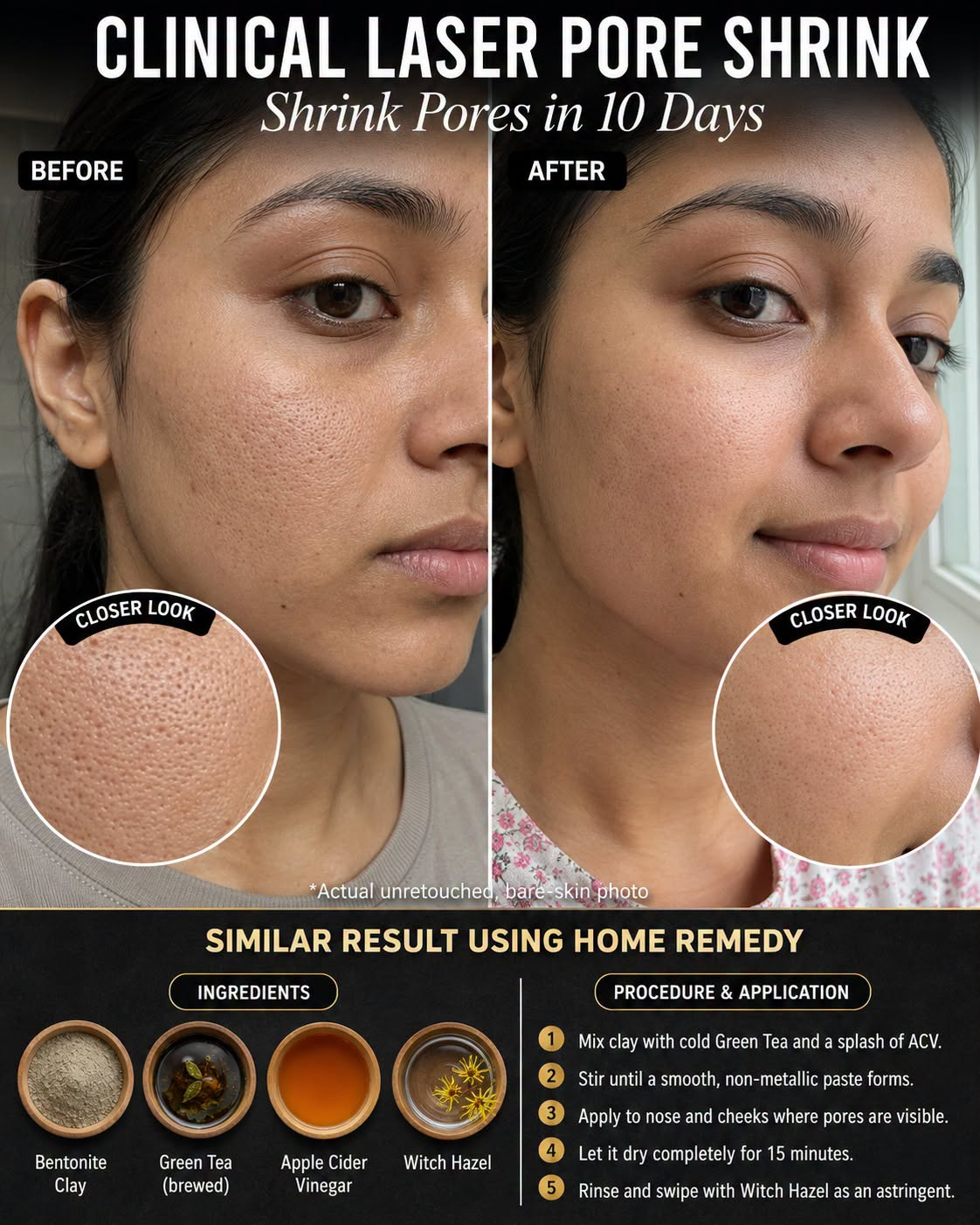
Large facial pores can make the skin look rough, oily, uneven, and less smooth under makeup or sunscreen. Pores are normal openings of oil glands, so they cannot be permanently closed or erased like a filter effect. However, clogged pores, excess oil, dead skin buildup, dehydration, and sun damage can make them look bigger. Dermatology guidance explains that cleansing, reducing oiliness, using non-comedogenic care, and protecting skin from the sun can help pores appear smaller over time. (American Academy of Dermatology) These natural remedies focus on gentle oil control, hydration, barrier repair, and mild surface smoothing. They are safer than harsh viral methods such as strong apple cider vinegar, lemon juice, baking soda, or alcohol-heavy toners, which can irritate the skin and make pores look worse.
Remedy 1: For Normal Skin
Ingredients
1 teaspoon kaolin clay: Gently absorbs extra oil and helps reduce the look of clogged pores.
1 tablespoon cooled green tea: Green tea catechins provide antioxidant support and may help reduce sebum activity.
1 teaspoon aloe vera gel: Hydrates the skin without making it greasy.
Half teaspoon raw honey: Works as a humectant and keeps the mask from over-drying.
1 teaspoon plain yogurt: Contains natural lactic acid for mild surface exfoliation.
Half teaspoon rice flour: Gives very gentle polishing and improves skin softness.
Scientific Working of Each Ingredient
Kaolin clay lifts surface oil and impurities, so pores look cleaner. Green tea contains polyphenols such as EGCG, which have been studied for reducing sebum and calming oily skin. (PMC) Aloe vera adds water-based hydration, honey holds moisture, yogurt’s lactic acid loosens dull dead cells, and rice flour gives a soft smoothing effect without aggressive scrubbing.
Procedure
Mix all ingredients into a smooth paste. Apply a thin layer on clean skin, mainly on cheeks, nose, chin, and forehead. Leave for 8–10 minutes. Do not let the mask become fully cracked. Rinse with cool water and apply a light moisturizer.
How Often to Apply
Use once daily for 3 days, then 3 times weekly for 10 days.
Initial Results
Within 1–3 days, the skin may feel cleaner, smoother, and less greasy. Pores may look slightly smaller because oil and dead buildup are reduced.
Remedy 2: For Combination Skin
Ingredients
1 teaspoon multani mitti or kaolin clay: Controls shine on the T-zone.
1 teaspoon colloidal oatmeal: Calms dry cheek areas and supports the skin barrier.
1 tablespoon cooled green tea: Refreshes oily areas and provides antioxidant support.
1 teaspoon aloe vera gel: Balances hydration without heaviness.
Half teaspoon honey: Softens dry zones and prevents tightness.
3 drops jojoba oil: Lightly moisturizes without clogging the skin.
Scientific Working of Each Ingredient
Combination skin needs two actions at once: oil control on the forehead, nose, and chin, and moisture support on cheeks. Clay absorbs shine, while oatmeal helps reduce dryness and roughness. Colloidal oatmeal has clinical support for improving dryness, scaling, roughness, and barrier comfort. (PubMed) Green tea supports oil balance, aloe hydrates, honey holds water, and jojoba oil softens dry patches.
Procedure
Mix clay, oatmeal, green tea, aloe, and honey first. Add jojoba oil last. Apply a slightly thicker layer on the T-zone and a very thin layer on cheeks. Leave for 7 minutes. Rinse gently and moisturize.
How Often to Apply
Apply on alternate days for 10 days.
Initial Results
By day 2 or 3, the T-zone may look less shiny, while cheeks should feel softer instead of tight or flaky.
Remedy 3: For Oily Skin
Ingredients
1 teaspoon bentonite clay: Stronger oil absorption for very oily skin.
1 tablespoon strong cooled green tea: Helps reduce greasy appearance and supports antioxidant defense.
1 teaspoon aloe vera gel: Hydrates without oiliness.
Half teaspoon cucumber juice: Cools and refreshes the skin.
Half teaspoon honey: Prevents harsh dryness after clay.
Half teaspoon plain yogurt: Provides gentle lactic-acid exfoliation.
Scientific Working of Each Ingredient
Oily skin often makes pores look enlarged because sebum collects around pore openings. Bentonite clay absorbs excess oil, while green tea has research support for lowering sebum in topical use. A clinical study found a 3% green tea formulation reduced skin sebum production in volunteers. (PMC) Aloe and cucumber hydrate lightly, honey protects from over-drying, and yogurt gently removes dead surface cells.
Procedure
Mix the ingredients into a thin paste. Apply only where pores are visible, especially nose, inner cheeks, chin, and forehead. Leave for 6–8 minutes. Rinse before the mask feels extremely tight. Apply a gel-based moisturizer afterward.
How Often to Apply
Use daily for the first 3 days, then every other day until day 10.
Initial Results
Oiliness may reduce within 1–2 days. By day 3, pores may look cleaner and makeup may sit more smoothly.
Remedy 4: For Dry Skin
Ingredients
1 tablespoon aloe vera gel: Adds water-based hydration.
1 teaspoon raw honey: Pulls moisture into the upper skin layer.
1 teaspoon colloidal oatmeal: Reduces roughness and barrier discomfort.
Half teaspoon plain yogurt: Gives mild lactic-acid smoothing.
3 drops sunflower seed oil: Helps seal hydration and supports barrier lipids.
Half teaspoon mashed avocado: Softens dry, dull skin.
Scientific Working of Each Ingredient
Dry skin can make pores look stretched and texture more visible. Aloe and honey hydrate, oatmeal calms dryness, yogurt mildly smooths dead cells, sunflower seed oil helps reduce water loss, and avocado provides softening fatty acids. Reviews on topical plant oils describe sunflower seed oil as useful for supporting barrier repair and reducing inflammation. (PMC)
Procedure
Mash avocado until completely smooth. Add aloe, honey, oatmeal, yogurt, and sunflower oil. Apply to clean skin for 10 minutes. Rinse gently with lukewarm water and moisturize immediately.
How Often to Apply
Apply once daily for 5 days, then 3 times weekly.
Initial Results
Within 1–3 days, dry tightness may reduce and pores may look less sharp because the skin surface becomes more hydrated.
Remedy 5: For Sensitive Skin
Ingredients
1 tablespoon colloidal oatmeal: Soothes and supports the skin barrier.
2 teaspoons aloe vera gel: Gives cooling hydration.
1 teaspoon boiled cooled water: Keeps the mask gentle and diluted.
Half teaspoon raw honey: Adds mild moisture support.
1 teaspoon rice water: Softens the skin surface.
2 drops sunflower seed oil: Helps protect against moisture loss.
Scientific Working of Each Ingredient
Sensitive skin should never be treated with strong vinegar, lemon, abrasive scrubs, or harsh astringents. Oatmeal helps calm irritation, aloe hydrates, honey reduces dryness, rice water gives gentle softness, and sunflower oil supports the barrier. Aloe vera has been reviewed in clinical trials for skin healing and soothing support, but sensitive users should still patch test. (PMC)
Procedure
Mix all ingredients into a soft liquid paste. Apply to a small patch first. If there is no burning after 10 minutes, apply to pore-prone areas for 5–7 minutes. Rinse with cool water and apply a plain moisturizer.
How Often to Apply
Use once daily for 3 days. If your skin stays calm, continue 2–3 times weekly.
Initial Results
Redness and tightness may feel calmer within 1–2 days. Pores may look softer because irritation and dryness are reduced.
Final Tips
Visible pores cannot be permanently shrunk at home, but they can look smaller when the skin is clean, hydrated, calm, and protected. Wash your face gently twice daily, avoid sleeping with makeup or sunscreen residue, clean makeup brushes, use a light moisturizer even if your skin is oily, and apply sunscreen every morning. Sun damage weakens collagen around pores, which can make pores look larger over time.
Avoid apple cider vinegar, lemon juice, baking soda, toothpaste, harsh scrubs, and strong witch hazel on the face. These may give a temporary tight feeling but can damage the skin barrier. Visible improvement usually begins within 2–3 days, while smoother texture and reduced pore appearance need 10 days to 4 weeks of consistent care. If you have painful acne, pus-filled pimples, burning, swelling, sudden severe oiliness, or no improvement after 4 weeks, see a dermatologist.
Diet Plan for Smaller-Looking Pores and Smoother Skin
Follow this diet plan for at least 3–4 weeks along with the remedy.
Morning: Drink water and eat oats, eggs, yogurt, chia seeds, or lentils. Add guava, orange, berries, or kiwi for vitamin C support.
Lunch: Eat chicken, fish, lentils, beans, tofu, or chickpeas with brown rice or whole wheat roti. Add cucumber, carrots, spinach, tomatoes, and capsicum for antioxidants.
Snack: Choose almonds, walnuts, pumpkin seeds, sunflower seeds, apple, pear, or unsweetened yogurt.
Dinner: Keep it light with vegetable soup, grilled protein, lentils, or fish with a small portion of whole grains.
Avoid frequent sugary drinks, deep-fried snacks, and high-glycemic foods because they may worsen oiliness and acne in some people. If dairy seems to trigger breakouts, reduce milk for 2–3 weeks and observe your skin, but do not remove major food groups without proper nutrition planning.
References for the above remedy
- American Academy of Dermatology Association. “What can treat large facial pores?” URL: https://www.aad.org/public/everyday-care/skin-care-secrets/face/treat-large-pores
- Mahmood, T., et al. “Outcomes of 3% Green Tea Emulsion on Skin Sebum Production in Male Volunteers.” URL: https://pmc.ncbi.nlm.nih.gov/articles/PMC5504505/
- Saric, S., et al. “Green Tea and Other Tea Polyphenols: Effects on Sebum Production and Acne Vulgaris.” URL: https://pmc.ncbi.nlm.nih.gov/articles/PMC5384166/
- Zhang, X., et al. “Comprehensive assessment of the efficacy and safety of a clay mask in acne and oily skin.” URL: https://pmc.ncbi.nlm.nih.gov/articles/PMC10626287/
- Reynertson, K. A., et al. “Anti-inflammatory activities of colloidal oatmeal.” URL: https://pubmed.ncbi.nlm.nih.gov/25607907/
- Hekmatpou, D., et al. “The Effect of Aloe Vera Clinical Trials on Prevention and Healing of Skin Wound.” URL: https://pmc.ncbi.nlm.nih.gov/articles/PMC6330525/
- McLoone, P., et al. “Honey: A Therapeutic Agent for Disorders of the Skin.” URL: https://pmc.ncbi.nlm.nih.gov/articles/PMC5661189/
- Almeman, A. A. “Evaluating the Efficacy and Safety of Alpha-Hydroxy Acids in Dermatology.” URL: https://pmc.ncbi.nlm.nih.gov/articles/PMC11268769/
- Lin, T. K., Zhong, L., & Santiago, J. L. “Anti-Inflammatory and Skin Barrier Repair Effects of Topical Application of Some Plant Oils.” URL: https://pmc.ncbi.nlm.nih.gov/articles/PMC5796020/