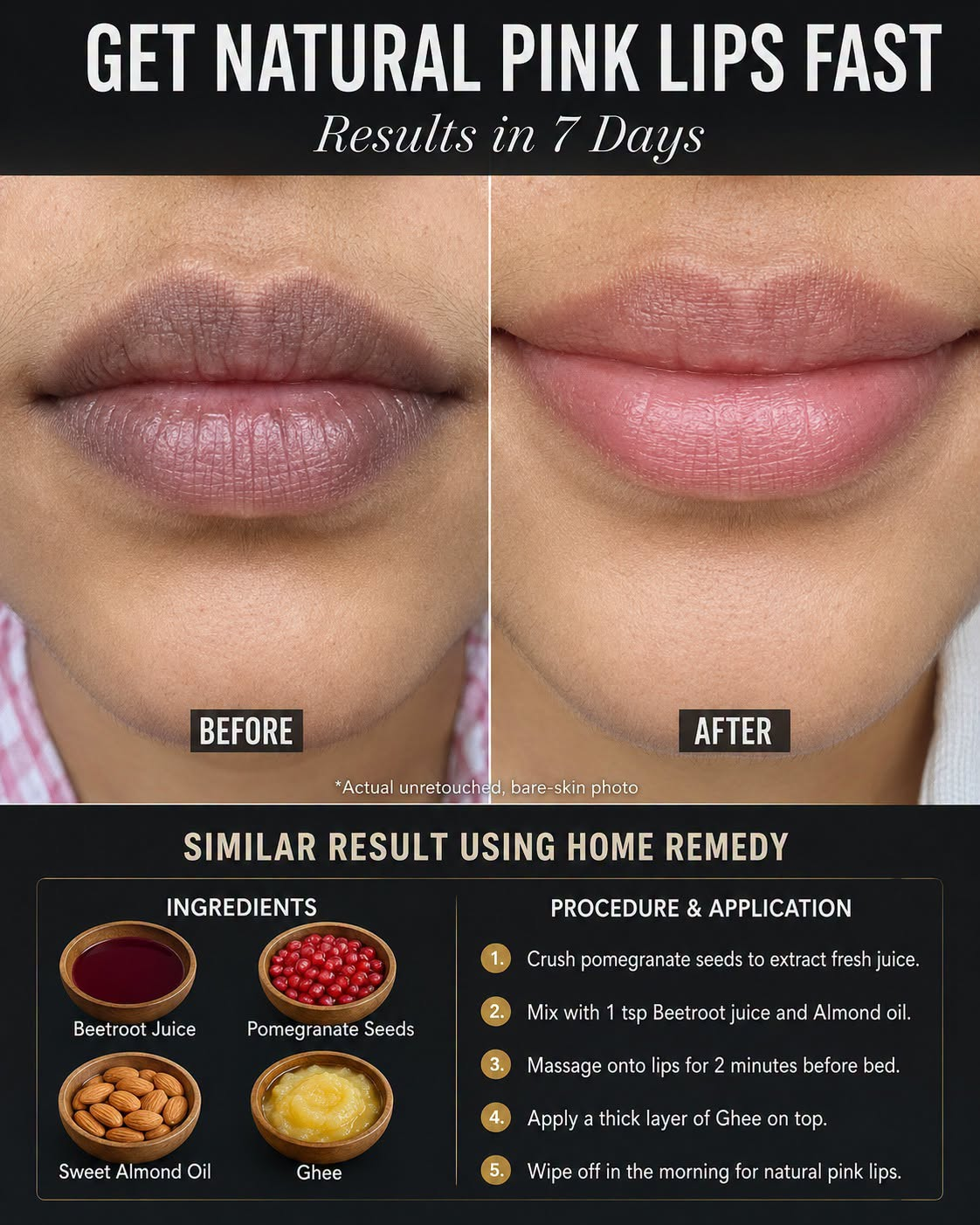
Dark, dull, or uneven lips can happen because of dryness, sun exposure, lip licking, smoking, dehydration, irritation from toothpaste or lip products, hormonal pigmentation, or natural genetics. Truly “pink” lips depend on your natural skin tone, blood circulation, and melanin level, so no home remedy can permanently change lip color in 7 days. However, lips can look fresher, smoother, and naturally rosy when dead skin, dryness, irritation, and sun damage are controlled. Dermatology guidance recommends protecting lips with SPF, staying hydrated, and avoiding irritating ingredients such as menthol, camphor, fragrance, and harsh exfoliants because irritation can worsen chapping and darkness. (American Academy of Dermatology)
Remedy 1: For Normal Skin
Ingredients
1 teaspoon fresh beetroot juice: Gives a temporary natural tint and contains betalain antioxidants.
1 teaspoon pomegranate juice: Rich in polyphenols and ellagic acid, which may support brighter-looking skin.
Half teaspoon licorice tea concentrate: Licorice compounds are studied for melanin-regulating effects.
Half teaspoon raw honey: Works as a humectant to keep lips soft and hydrated.
3 drops sweet almond oil: Adds emollient softness and reduces dryness lines.
2 drops aloe vera gel: Soothes the delicate lip surface.
Scientific Working of This Remedy
Beetroot gives a light natural stain, so lips look rosy immediately. Pomegranate contains ellagic acid, which has shown tyrosinase-inhibiting and pigmentation-reducing activity in research. (PubMed) Licorice supports uneven pigmentation control, honey and aloe improve hydration, and almond oil seals softness so the lips look smoother instead of cracked.
Procedure
Mix all ingredients in a small clean bowl. Apply a thin layer on clean lips before bedtime. Massage gently for 1 minute with your fingertip. Leave it on for 15 minutes, then dab off extra liquid. Apply a plain lip balm or a tiny layer of ghee on top.
How Often to Apply
Use once daily at night for 5–7 days.
Initial Results
Within 1–3 days, lips may feel softer and look less dull. The beetroot tint can give a temporary pink effect from the first use.
Remedy 2: For Combination Skin
Ingredients
1 teaspoon aloe vera gel: Hydrates without heaviness.
Half teaspoon pomegranate juice: Adds antioxidant support.
Half teaspoon cooled green tea: Helps calm irritation caused by heat, sun, or licking.
Half teaspoon honey: Holds moisture in the upper lip layer.
2 drops jojoba oil: Light oil that softens without feeling greasy.
A tiny pinch of licorice powder: Supports gentle brightening.
Scientific Working of This Remedy
Combination skin around the mouth may have dry lips but slightly oily or breakout-prone skin nearby. Aloe, green tea, and honey hydrate without clogging. Jojoba adds a lightweight protective layer. Licorice and pomegranate support pigment balance through antioxidant and tyrosinase-related pathways. Reviews of natural hyperpigmentation ingredients describe botanicals such as licorice, aloe, and green tea as promising supportive options, though not instant cures. (PMC)
Procedure
Mix the ingredients into a light gel. Apply only on the lips, not around the mouth. Leave for 10–12 minutes. Rinse gently with cool water and apply a plain lip balm.
How Often to Apply
Use on alternate nights for 7 days.
Initial Results
By day 2 or 3, lips may feel smoother, while the area around the mouth should not feel oily or heavy.
Remedy 3: For Oily or Acne-Prone Surrounding Skin
Ingredients
1 teaspoon cooled green tea: Provides antioxidant support and a fresh feel.
Half teaspoon aloe vera gel: Gives non-greasy hydration.
Half teaspoon honey: Prevents dryness and tightness.
Half teaspoon licorice tea: Helps soften the look of uneven lip tone.
2 drops sunflower seed oil: Supports the skin barrier without a heavy feel.
2 drops beetroot juice: Adds a mild temporary rosy tint.
Scientific Working of This Remedy
Oily skin around the lips can react badly to heavy butters and thick oils. Green tea and aloe keep the mixture light. Honey hydrates, sunflower oil supports barrier repair, licorice helps with uneven tone, and beetroot gives instant color. Topical plant oils such as sunflower oil are discussed in research for barrier-supporting effects. (PMC)
Procedure
Mix the ingredients well. Apply with a clean cotton bud only on the lip surface. Leave for 8–10 minutes. Rinse, then apply a very thin layer of plain balm.
How Often to Apply
Use once daily for 3 days, then every other day for the rest of the week.
Initial Results
Lips may look fresher within 1–2 days without making the surrounding skin greasy.
Remedy 4: For Dry Skin
Ingredients
Half teaspoon ghee: Creates an occlusive layer that reduces moisture loss.
3 drops sweet almond oil: Softens rough, dry lips.
Half teaspoon honey: Pulls water into the surface layer.
Half teaspoon aloe vera gel: Adds soothing hydration.
Half teaspoon pomegranate juice: Provides antioxidant support.
A tiny pinch of finely ground oat powder: Gently comforts dryness without harsh scrubbing.
Scientific Working of This Remedy
Dry lips often appear darker because cracks and flakes cast shadows. Honey and aloe hydrate first, while ghee and almond oil seal moisture. Oat powder calms roughness, and pomegranate adds antioxidant support. Honey has published evidence for skin-healing and anti-inflammatory effects, although lip pigmentation results still depend on the cause of darkness. (PMC)
Procedure
Mix honey, aloe, pomegranate juice, and oat powder first. Add almond oil and ghee. Apply a thick layer before sleeping. Leave overnight if comfortable. In the morning, wipe gently with a damp cloth.
How Often to Apply
Use nightly for 5–7 days.
Initial Results
Dryness may improve within 1 day. By day 3, lips may look smoother, fuller, and naturally brighter.
Remedy 5: For Sensitive Skin
Ingredients
1 teaspoon aloe vera gel: Soothes and hydrates.
Half teaspoon honey: Adds gentle moisture.
1 teaspoon boiled cooled water: Dilutes the mixture.
Half teaspoon rice water: Softens the surface gently.
1 drop sunflower seed oil: Protects against moisture loss.
1 drop pomegranate juice: Adds very mild antioxidant support.
Scientific Working of This Remedy
Sensitive lips need barrier repair, not strong exfoliation. Aloe and honey calm dryness, rice water softens, sunflower oil seals moisture, and diluted pomegranate gives gentle antioxidant support. Avoid lemon, baking soda, toothpaste hacks, cinnamon, peppermint oil, and strong scrubs because lip skin is thin and easily irritated. Aloe vera has clinical research support for soothing and skin-healing activity, but sensitive users should still patch test. (PubMed)
Procedure
Mix everything into a watery gel. Apply a small amount on one corner of the lip first. If there is no burning after 10 minutes, apply to all lips for 5 minutes. Rinse gently and apply a plain fragrance-free balm.
How Often to Apply
Use once daily for 3 days. If tolerated, continue 2–3 times weekly.
Initial Results
Sensitive lips may feel calmer within 1–2 days. Stop immediately if burning, swelling, itching, or rash appears.
Final Tips
Use only one remedy according to your lip and surrounding skin type. Do not scrub lips daily. Do not lick or bite lips because saliva dries them further. Apply SPF 30 or higher lip protection in the daytime, especially if lips darken after sun exposure. The American Academy of Dermatology recommends SPF lip care outdoors and drinking enough water for dry lips. (American Academy of Dermatology)
Visible softness can begin within 2–3 days, and a temporary pink tint may appear immediately with beetroot. Natural brightness usually needs 7–21 days of gentle care. If lips stay dark despite care, or if there is cracking, bleeding, burning, swelling, white patches, sudden color change, or sores that do not heal, see a doctor or dermatologist.
Diet Plan for Naturally Healthy Lips
Follow this diet plan for at least 3–4 weeks.
Morning: Drink water and eat eggs, oats, yogurt, chia seeds, lentils, or whole-grain toast. Add vitamin C fruit such as guava, orange, kiwi, strawberries, or amla.
Lunch: Eat lentils, chicken, fish, tofu, beans, or chickpeas with whole wheat roti or brown rice. Add cucumber, carrots, spinach, tomatoes, and capsicum.
Snack: Choose pomegranate, apple, almonds, walnuts, pumpkin seeds, sunflower seeds, or unsweetened yogurt.
Dinner: Keep it light with vegetable soup, fish, lentils, eggs, tofu, or beans with a small portion of whole grains.
Avoid dehydration, smoking, frequent sugary drinks, very spicy foods if they irritate your lips, and constant licking. Continue the remedy for 7 days, then maintain 2–3 times weekly. If the problem persists, see a doctor to rule out allergy, vitamin deficiency, fungal infection, medication-related pigmentation, or another medical cause.
References for the above remedy
- American Academy of Dermatology Association. “7 dermatologists’ tips for healing dry, chapped lips.” URL: https://www.aad.org/public/everyday-care/skin-care-basics/dry/heal-dry-chapped-lips
- American Academy of Dermatology Association. “Dermatologists’ top tips for relieving dry skin.” URL: https://www.aad.org/public/everyday-care/skin-care-basics/dry/dermatologists-tips-relieve-dry-skin
- Yoshimura, M., et al. “Inhibitory effect of an ellagic acid-rich pomegranate extract on tyrosinase activity and ultraviolet-induced pigmentation.” URL: https://pubmed.ncbi.nlm.nih.gov/16377895/
- Hollinger, J. C., et al. “Are Natural Ingredients Effective in the Management of Hyperpigmentation? A Systematic Review.” URL: https://pmc.ncbi.nlm.nih.gov/articles/PMC5843359/
- Kang, M. H., et al. “Antioxidant and Anti-Melanogenic Activities of Heat-Treated Licorice Extract.” URL: https://pmc.ncbi.nlm.nih.gov/articles/PMC8928971/
- Ghafarzadeh, M., & Eatemadi, A. “Clinical efficacy of liposome-encapsulated Aloe vera on melasma treatment during pregnancy.” URL: https://pubmed.ncbi.nlm.nih.gov/28139161/
- McLoone, P., et al. “Honey: A Therapeutic Agent for Disorders of the Skin.” URL: https://pmc.ncbi.nlm.nih.gov/articles/PMC5661189/
- Lin, T. K., Zhong, L., & Santiago, J. L. “Anti-Inflammatory and Skin Barrier Repair Effects of Topical Application of Some Plant Oils.” URL: https://pmc.ncbi.nlm.nih.gov/articles/PMC5796020/
- Sadowska-Bartosz, I., & Bartosz, G. “Biological Properties and Applications of Betalains.” URL: https://pmc.ncbi.nlm.nih.gov/articles/PMC8123435/