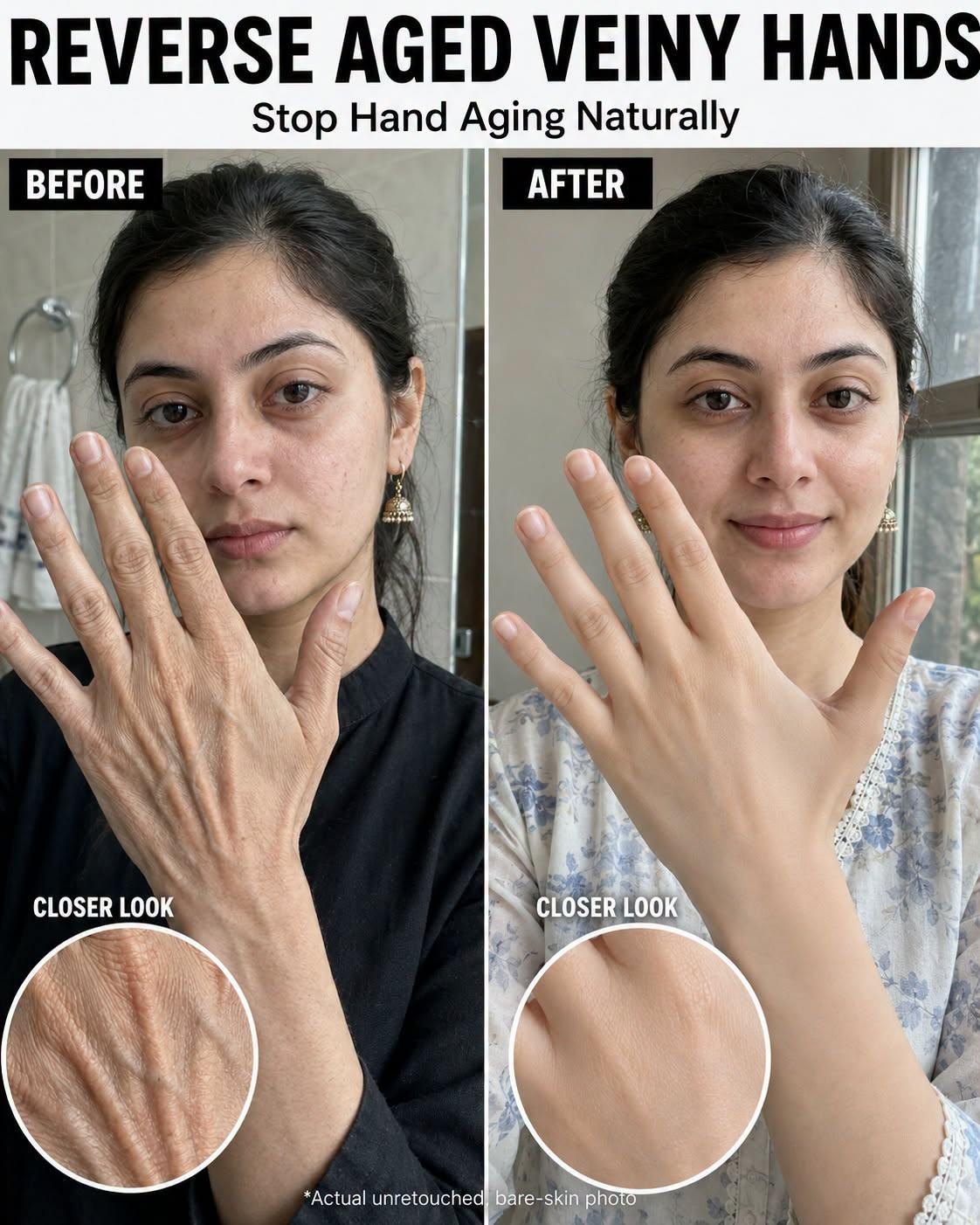
Aged, veiny hands usually appear when the skin on the back of the hands becomes thin, dry, sun-damaged, and lower in natural fat padding. As collagen, elastin, hydration, and soft tissue volume decrease, veins and tendons look more raised. Home remedies cannot remove true veins or replace lost volume like medical fillers, but they can make hands look smoother, softer, brighter, and temporarily plumper by improving hydration and the skin barrier. Dermatology guidance strongly supports moisturizing, sun protection, and protecting hands from drying triggers as key steps for younger-looking hands. (American Academy of Dermatology)

Remedy 1: For Normal Skin
Ingredients
1 tablespoon fresh aloe vera gel: Hydrates the upper skin layer and supports skin comfort.
Half teaspoon vegetable glycerin: A humectant that attracts water and makes fine lines look softer.
1 teaspoon colloidal oatmeal powder: Helps reduce dryness, roughness, and barrier stress.
Half teaspoon raw honey: Adds moisture and keeps the mask gentle.
1 tablespoon cooled green tea: Provides antioxidant support against environmental aging.
4 drops rosehip seed oil: Softens the skin and improves the look of dry texture.
Scientific Working of Each Ingredient
Aloe vera provides water-based hydration and has been studied for skin repair support. Glycerin pulls moisture into the outer skin, giving a temporary plumping effect. Colloidal oatmeal supports barrier recovery and improves dryness. Honey adds humectant softness, green tea helps reduce oxidative stress, and rosehip oil supplies fatty acids that make the hand surface look smoother.
Procedure
Mix aloe vera, glycerin, oatmeal, honey, and green tea into a smooth paste. Add rosehip oil last. Apply on the back of clean hands and massage gently for 3 minutes. Leave for 15 minutes, then rinse with lukewarm water. Apply a light moisturizer afterward.
How Often to Apply
Use once daily for 5 days, then 3 times weekly.
Initial Results
Within 1–3 days, hands may feel softer and less tight. Veins may look slightly less harsh because the skin surface is better hydrated.
Remedy 2: For Combination Skin
Ingredients
1 tablespoon rice water: Softens the skin and gives a smooth surface feel.
2 teaspoons aloe vera gel: Hydrates without heaviness.
1 teaspoon cucumber juice: Cools and refreshes dry or warm-looking hands.
Quarter teaspoon vegetable glycerin: Adds light plumping hydration.
3 drops jojoba oil: Balances dry patches without a greasy feel.
Half teaspoon finely ground oatmeal: Comforts rough knuckles and dry areas.
Scientific Working of Each Ingredient
Combination hand skin may feel dry on the back of the hands but slightly sweaty on the palms. Rice water and cucumber juice keep the remedy light. Aloe and glycerin hydrate, oatmeal calms roughness, and jojoba oil creates a thin softening layer without making the hands oily.
Procedure
Mix all ingredients well. Apply mainly to the back of the hands, fingers, and knuckles. Avoid applying too much on the palms if they become sweaty. Massage for 2 minutes and leave for 12 minutes. Rinse gently and moisturize.
How Often to Apply
Apply on alternate days for 5 days, then continue 3 times weekly.
Initial Results
By day 2 or 3, the back of the hands may look smoother while the palms remain comfortable and non-greasy.
Remedy 3: For Oily or Sweaty Hands
Ingredients
1 tablespoon cooled green tea: Refreshes the skin and adds antioxidant support.
2 teaspoons aloe vera gel: Hydrates without oiliness.
Half teaspoon kaolin clay: Absorbs excess sweat and surface oil.
Half teaspoon raw honey: Prevents the mask from over-drying.
2 drops sunflower seed oil: Supports the skin barrier with a light feel.
1 teaspoon cucumber juice: Adds cooling hydration.
Scientific Working of Each Ingredient
Oily or sweaty hands still need moisture, but heavy oils can feel uncomfortable. Kaolin clay reduces surface greasiness, green tea and cucumber refresh the skin, aloe hydrates, honey prevents tightness, and sunflower seed oil supports barrier lipids. Reviews on topical plant oils describe sunflower oil as useful for barrier support. (PMC)
Procedure
Mix the ingredients into a thin paste. Apply only on the back of the hands and around visible veins. Leave for 7–8 minutes. Rinse before the clay becomes fully dry. Apply a small amount of light moisturizer.
How Often to Apply
Use once daily for 3 days, then every other day for 2 weeks.
Initial Results
Hands may feel cleaner and less sticky within 1–2 days. Dryness lines may look softer without a greasy finish.
Remedy 4: For Dry Skin
Ingredients
1 teaspoon shea butter: Seals moisture and softens rough skin.
1 tablespoon fresh flaxseed gel: Gives a slippery, water-binding coating effect.
1 teaspoon aloe vera gel: Adds hydration before sealing.
Half teaspoon vegetable glycerin: Helps plump dehydration lines.
1 teaspoon raw honey: Holds moisture in the outer skin.
4 drops sweet almond oil: Softens dry, thin-looking hand skin.
Scientific Working of Each Ingredient
Dry skin makes veins look more raised because the skin surface becomes tight and flat. Aloe, glycerin, honey, and flaxseed gel hydrate first. Shea butter and almond oil then seal moisture and reduce water loss. This makes the skin look more cushioned and less crepey.
Procedure
Mix aloe, glycerin, honey, and flaxseed gel first. Add softened shea butter and almond oil. Massage over the back of the hands for 5 minutes. Wear loose cotton gloves for 30–60 minutes or overnight.
How Often to Apply
Use daily for 5 days, then nightly 4 times weekly for 6–8 weeks.
Initial Results
Dryness may improve after the first use. By day 3, hands may look smoother, glossier, and temporarily fuller.
Remedy 5: For Sensitive Skin
Ingredients
1 tablespoon colloidal oatmeal powder: Soothes and protects sensitive skin.
2 teaspoons aloe vera gel: Gives gentle cooling hydration.
1 tablespoon boiled cooled water: Dilutes the remedy to reduce irritation risk.
2 drops vegetable glycerin: Adds mild hydration.
2 drops sunflower seed oil: Helps reduce moisture loss.
Quarter teaspoon raw honey: Adds softening moisture.
Scientific Working of Each Ingredient
Sensitive hands need barrier repair, not harsh stimulation. Oatmeal supports irritated, dry skin and has clinical evidence for improving hydration and barrier comfort. Aloe and honey hydrate gently, glycerin plumps dryness lines, sunflower oil supports the barrier, and water keeps the mask mild. (PubMed)
Procedure
Mix everything into a thin paste. Patch test on a small area for 24 hours. If safe, apply to the back of the hands for 7–10 minutes. Rinse gently and apply a fragrance-free moisturizer.
How Often to Apply
Use once daily for 3 days. If there is no burning or redness, continue 2–3 times weekly.
Initial Results
Sensitive hands may feel calmer within 1–2 days. Stop immediately if itching, swelling, rash, or burning appears.
Final Tips
Visible hand veins cannot be permanently erased with home remedies. They often become more noticeable because of natural aging, sun damage, dehydration, low body fat, genetics, or loss of hand volume. Medical options such as hyaluronic acid or calcium hydroxylapatite fillers are used professionally to restore hand volume, but home care mainly improves hydration, texture, and temporary plumpness. (PMC)
For best results, moisturize after every hand wash, use lukewarm water instead of hot water, wear gloves while washing dishes or cleaning, and apply broad-spectrum SPF 30 or higher to the back of the hands every morning. Visible softness usually begins within 2–3 days, while smoother texture needs 4–8 weeks. If veins become painful, swollen, hard, red, suddenly more visible, or if one hand changes more than the other, see a doctor. If the problem persists or affects your confidence, consult a dermatologist for proper treatment options.
Diet Plan for Younger-Looking Hands
Follow this diet plan for at least 6–8 weeks along with the suitable hand remedy.
Morning: Drink water and eat eggs, oats, yogurt, lentils, or chia pudding. Add guava, orange, kiwi, berries, or amla for vitamin C, which supports collagen formation.
Lunch: Choose fish, chicken, lentils, beans, chickpeas, tofu, or paneer with whole wheat roti, brown rice, or quinoa. Add spinach, cucumber, carrots, tomatoes, and capsicum for antioxidants.
Snack: Eat almonds, walnuts, pumpkin seeds, sunflower seeds, dates, apple, or pomegranate. These provide healthy fats, zinc, vitamin E, and minerals that support skin barrier health.
Dinner: Keep it balanced with vegetable soup, grilled protein, lentils, eggs, fish, or tofu with a small portion of whole grains.
Avoid smoking, crash dieting, frequent sugary drinks, excess salty snacks, and dehydration because they can make hands look thinner and duller. Continue the remedy for 5–7 days for softness, then maintain 3–4 times weekly. If the problem persists, see a doctor.
References for the above remedy
- American Academy of Dermatology Association. “What can make my hands look younger?” URL: https://www.aad.org/public/cosmetic/younger-looking/what-makes-hands-look-younger
- Mayo Clinic. “Dry skin: Diagnosis and treatment.” URL: https://www.mayoclinic.org/diseases-conditions/dry-skin/diagnosis-treatment/drc-20353891
- Mayo Clinic. “Dry skin: Symptoms and causes.” URL: https://www.mayoclinic.org/diseases-conditions/dry-skin/symptoms-causes/syc-20353885
- Roberts, W. E. “Topical Treatment of Aging Hands: Brief Report.” URL: https://pmc.ncbi.nlm.nih.gov/articles/PMC5605213/
- Rivkin, A. Z. “Volume correction in the aging hand: role of dermal fillers.” URL: https://pmc.ncbi.nlm.nih.gov/articles/PMC5012627/
- Milani, M., et al. “The 24-hour skin hydration and barrier function effects of a hyaluronic acid and glycerin formulation.” URL: https://pmc.ncbi.nlm.nih.gov/articles/PMC5560567/
- Ilnytska, O., et al. “Colloidal Oatmeal Improves Skin Barrier Through Multi-Therapy Activity.” URL: https://pubmed.ncbi.nlm.nih.gov/27272074/
- Capone, K., et al. “Effects of Colloidal Oatmeal Topical Atopic Dermatitis Cream on Skin Microbiome and Skin Barrier Properties.” URL: https://pubmed.ncbi.nlm.nih.gov/32484623/
- Hekmatpou, D., et al. “The Effect of Aloe Vera Clinical Trials on Prevention and Healing of Skin Wound.” URL: https://pmc.ncbi.nlm.nih.gov/articles/PMC6330525/
- Lin, T. K., Zhong, L., & Santiago, J. L. “Anti-Inflammatory and Skin Barrier Repair Effects of Topical Application of Some Plant Oils.” URL: https://pmc.ncbi.nlm.nih.gov/articles/PMC5796020/