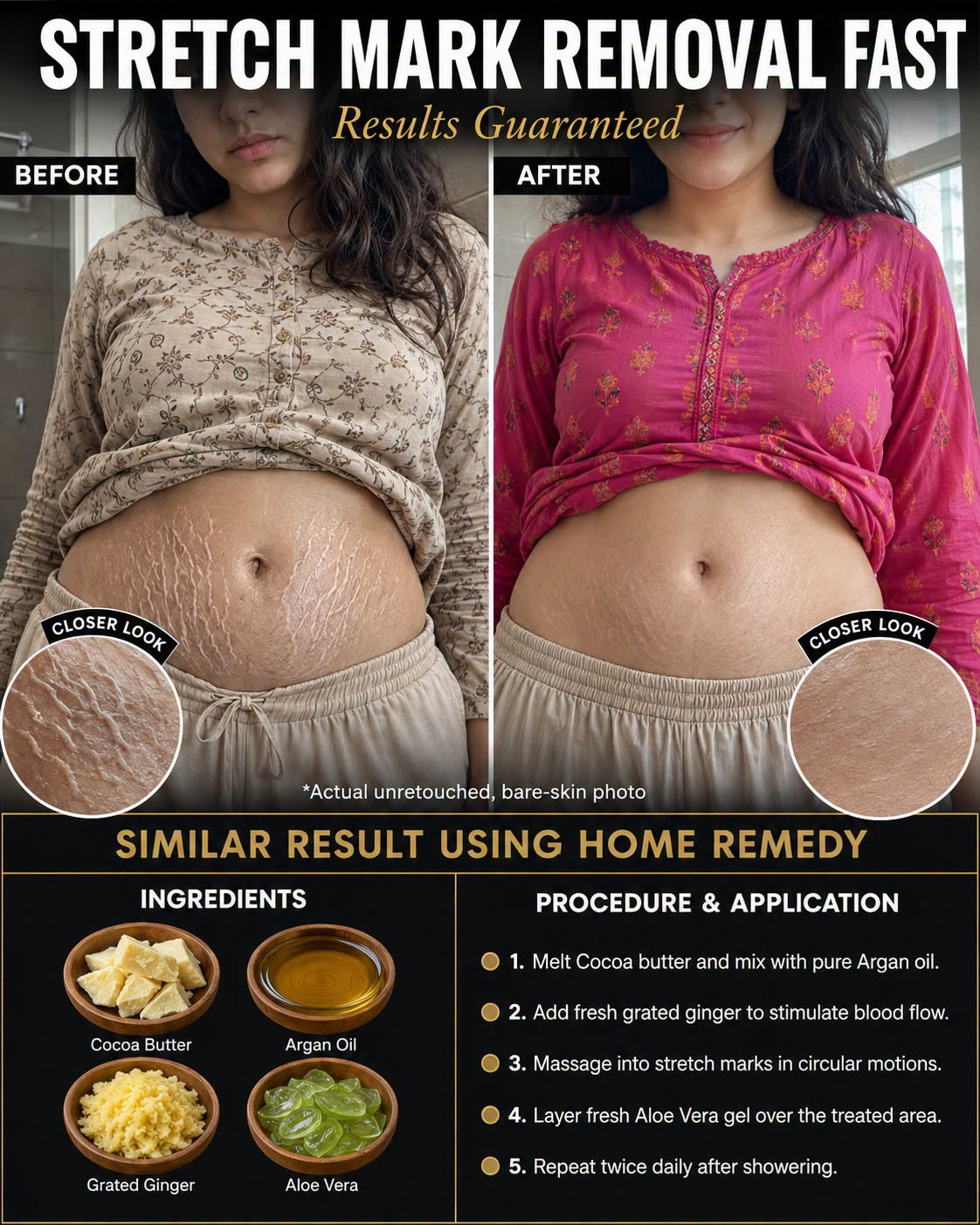
Stretch marks, also called striae, appear when the deeper layer of skin stretches faster than it can rebuild collagen and elastin. They are common on the abdomen, thighs, hips, breasts, arms, and lower back after pregnancy, puberty, weight changes, bodybuilding, or hormonal changes. The image topic promises “stretch mark removal fast,” but the honest truth is that stretch marks usually fade gradually and may not disappear completely. Mayo Clinic notes that stretch marks often fade with time, with or without treatment, but may never fully vanish. The safest home approach is to improve hydration, elasticity, texture, and skin comfort while supporting collagen repair over several weeks. Dermatology sources also show that ingredients such as Centella asiatica and hyaluronic acid have better evidence than popular but poorly proven remedies like cocoa butter alone. (Mayo Clinic)

Remedy 1: For Normal Skin
Ingredients
2 teaspoons fresh aloe vera gel: Helps hydrate skin and supports collagen-related repair.
1 teaspoon Centella asiatica powder or gotu kola paste: Centella contains asiaticoside and madecassoside, compounds linked with collagen support and wound-healing activity.
1 teaspoon rosehip seed oil: Rich in essential fatty acids that soften rough-looking marks and support skin barrier comfort.
1 teaspoon raw honey: Works as a humectant, helping the upper skin layer hold water.
Half teaspoon rice flour: Gives very mild polishing without harsh scrubbing.
1 teaspoon plain yogurt: Contains lactic acid for gentle surface smoothing.
Scientific Working of This Remedy
Aloe and honey increase moisture, which makes stretch marks look less sharp. Centella supports fibroblast activity and collagen organization, which is important because stretch marks involve collagen and elastin disruption. Rosehip oil improves softness, while yogurt and rice flour help smooth dry surface buildup. Centella is one of the few botanical ingredients with limited clinical evidence for stretch-mark prevention and improvement. (PubMed)
Procedure
Mix aloe, Centella, honey, yogurt, and rice flour into a thin paste. Add rosehip oil last. Massage gently over stretch marks for 2 minutes, then leave for 15 minutes. Rinse with lukewarm water and moisturize.
How Often to Apply
Apply once daily for 5 days, then continue 4 times weekly for 8–12 weeks.
Initial Results
Within 1–3 days, the area may feel softer and less tight. True fading usually needs consistent use for several weeks.
Remedy 2: For Combination Skin
Ingredients
1 tablespoon aloe vera gel: Lightweight hydration for both dry and oily body areas.
1 teaspoon cooled green tea: Provides antioxidant support and reduces the look of irritation.
Half teaspoon Centella asiatica powder: Supports elasticity and collagen repair pathways.
1 teaspoon jojoba oil: Balances dry patches without feeling too heavy.
Half teaspoon oat powder: Calms roughness and supports the skin barrier.
Half teaspoon cucumber juice: Adds cooling hydration.
Scientific Working of This Remedy
Combination skin needs moisture without heaviness. Aloe and cucumber hydrate, green tea reduces oxidative stress, oat powder calms the barrier, jojoba softens uneven texture, and Centella supports dermal repair. This blend is suitable for areas where stretch marks feel dry but the surrounding skin becomes sweaty or congested.
Procedure
Mix all ingredients into a smooth gel-like paste. Apply a thin layer to stretch marks after bathing. Massage gently in circular motions for 3 minutes. Leave for 20 minutes, then wipe off with a damp cloth or rinse lightly.
How Often to Apply
Use daily for 5 days, then every other day for 2–3 months.
Initial Results
The skin may feel smoother and less rough within 2–3 days. Color changes need more time.
Remedy 3: For Oily Skin
Ingredients
2 teaspoons aloe vera gel: Hydrates without a greasy finish.
1 teaspoon green tea: Helps calm oiliness and irritation.
Half teaspoon kaolin clay: Absorbs excess sweat and oil from the surface.
Half teaspoon Centella asiatica powder: Supports collagen and elasticity.
Half teaspoon honey: Prevents the clay from over-drying the skin.
3 drops sunflower seed oil: Adds linoleic acid for barrier support without heavy greasiness.
Scientific Working of This Remedy
Oily skin can still be dehydrated. Kaolin reduces surface oil, while honey and aloe prevent tightness. Sunflower seed oil is rich in linoleic acid and is widely discussed for skin barrier support in reviews of topical plant oils. Centella adds repair-focused support, which is more relevant to stretch marks than simple oiling alone. (PMC)
Procedure
Mix aloe, green tea, kaolin, Centella, and honey. Add sunflower oil at the end. Apply only to stretch-mark areas, not the entire oily region. Leave for 10 minutes. Rinse before the clay becomes fully dry.
How Often to Apply
Apply once daily for 3–5 days, then 3 times weekly.
Initial Results
The skin may look less shiny and feel cleaner in 1–2 days. Stretch marks may appear slightly softer because the surface is less dry and less inflamed.
Remedy 4: For Dry Skin
Ingredients
1 teaspoon shea butter: Rich emollient that seals moisture and reduces dryness.
1 teaspoon rosehip seed oil: Supports softness and improves the look of uneven tone.
1 teaspoon aloe vera gel: Adds water-based hydration before sealing.
Half teaspoon Centella asiatica powder: Supports collagen-related repair.
Half teaspoon raw honey: Draws moisture into the surface layer.
2 drops vitamin E oil from a capsule: Adds antioxidant support, but use only if your skin tolerates it.
Scientific Working of This Remedy
Dry skin makes stretch marks look deeper because the skin surface becomes tight and dull. Aloe and honey hydrate first, while shea butter and rosehip oil seal softness into the skin. Centella supports dermal repair activity, while vitamin E adds antioxidant support. However, vitamin E and heavy butters alone are not proven to remove stretch marks, so they work best as support ingredients, not miracle cures. (American Academy of Dermatology)
Procedure
Warm shea butter between your palms until soft. Mix with aloe, honey, Centella, rosehip oil, and vitamin E. Massage over stretch marks for 5 minutes after showering. Leave on overnight if comfortable.
How Often to Apply
Use daily for 5 days, then continue once daily for 8–12 weeks.
Initial Results
Dryness, itchiness, and tightness may improve within 1–3 days. Old white stretch marks may soften slowly but will not disappear overnight.
Remedy 5: For Sensitive Skin
Ingredients
1 tablespoon aloe vera gel: Cooling and hydrating when tolerated.
1 teaspoon colloidal oatmeal or finely ground oat powder: Helps calm sensitive, itchy skin.
Half teaspoon Centella asiatica tea or very diluted paste: Supports repair but should be used gently.
Half teaspoon honey: Adds moisture and reduces dryness.
3 drops sunflower seed oil: Helps protect the skin barrier.
1 teaspoon plain boiled cooled water: Keeps the remedy mild and less concentrated.
Scientific Working of This Remedy
Sensitive skin should not be treated with ginger, lemon, strong scrubs, baking soda, or aggressive exfoliation. Oatmeal calms the barrier, aloe and honey hydrate, sunflower oil reduces moisture loss, and diluted Centella gives repair support without making the mixture too strong. Reviews of aloe vera describe hydration, collagen-related effects, and wound-healing support, but sensitive users should patch test carefully. (PMC)
Procedure
Mix the ingredients into a thin soothing paste. Apply to a small area first. If there is no burning after 10 minutes, apply to stretch marks for 8–10 minutes. Rinse gently and apply a plain moisturizer.
How Often to Apply
Use once daily for 3 days. If the skin stays calm, continue 2–3 times weekly.
Initial Results
The area may feel calmer and less itchy within 1–2 days. Stop immediately if redness, burning, swelling, or rash appears.
Final Tips
Do not expect guaranteed stretch mark removal in a few days. Fresh red or purple stretch marks usually respond better than older white stretch marks. Massage can improve the look of skin by increasing local circulation and helping moisturizers spread evenly, but deep stretch marks often need professional options such as prescription retinoids, microneedling, radiofrequency, or laser therapy. Do not use prescription retinoids during pregnancy or breastfeeding unless a doctor approves.
Stay hydrated, sleep 7–8 hours, avoid sudden weight changes when possible, keep the skin moisturized after every shower, and do a patch test before using any herbal ingredient. Visible comfort and softness may begin within 2–3 days, but fading usually requires 8–12 weeks. If stretch marks appear suddenly, spread quickly, become painful, or come with unexplained weight gain, bruising, irregular periods, or steroid medicine use, see a doctor.
Diet Plan for Stretch Mark Repair Support
Continue this diet plan for at least 8–12 weeks because collagen support takes time.
Morning: Drink water and eat eggs, oats, yogurt, chia seeds, or lentils for protein. Add guava, orange, strawberries, or lemon water for vitamin C, which supports collagen formation.
Lunch: Eat chicken, fish, beans, chickpeas, tofu, or lentils with whole wheat roti or brown rice. Add spinach, carrots, tomatoes, cucumber, and capsicum for antioxidants.
Snack: Take almonds, walnuts, pumpkin seeds, sunflower seeds, or fruit. These provide zinc, vitamin E, and healthy fats.
Dinner: Choose vegetable soup, grilled protein, beans, or fish with a small serving of whole grains. Avoid frequent sugary drinks, deep-fried snacks, and crash dieting because unstable weight changes can make stretch marks more noticeable.
If the problem persists, worsens, or affects your confidence strongly, consult a dermatologist for evidence-based treatment options.
References for the above remedy
- American Academy of Dermatology Association. “Stretch marks: Why they appear and how to get rid of them.” URL: https://www.aad.org/public/cosmetic/scars-stretch-marks/stretch-marks-why-appear
- Mayo Clinic. “Stretch marks: Symptoms and causes.” URL: https://www.mayoclinic.org/diseases-conditions/stretch-marks/symptoms-causes/syc-20351139
- Korgavkar, K., & Wang, F. “Stretch marks during pregnancy: A review of topical prevention.” PubMed. URL: https://pubmed.ncbi.nlm.nih.gov/25255817/
- Ud-Din, S., McGeorge, D., & Bayat, A. “Topical management of striae distensae.” URL: https://pmc.ncbi.nlm.nih.gov/articles/PMC5057295/
- Mendes, N., et al. “A Narrative Review of Current Striae Treatments.” URL: https://pmc.ncbi.nlm.nih.gov/articles/PMC9777947/
- Bylka, W., et al. “Centella asiatica in cosmetology.” URL: https://pmc.ncbi.nlm.nih.gov/articles/PMC3834700/
- Hekmatpou, D., et al. “The Effect of Aloe Vera Clinical Trials on Prevention and Healing of Skin Wound.” URL: https://pmc.ncbi.nlm.nih.gov/articles/PMC6330525/
- Lin, T. K., Zhong, L., & Santiago, J. L. “Anti-Inflammatory and Skin Barrier Repair Effects of Topical Application of Some Plant Oils.” URL: https://pmc.ncbi.nlm.nih.gov/articles/PMC5796020/
- Arribas-López, E., et al. “A Systematic Review of the Effect of Centella asiatica on Wound Healing.” URL: https://pmc.ncbi.nlm.nih.gov/articles/PMC8956065/